
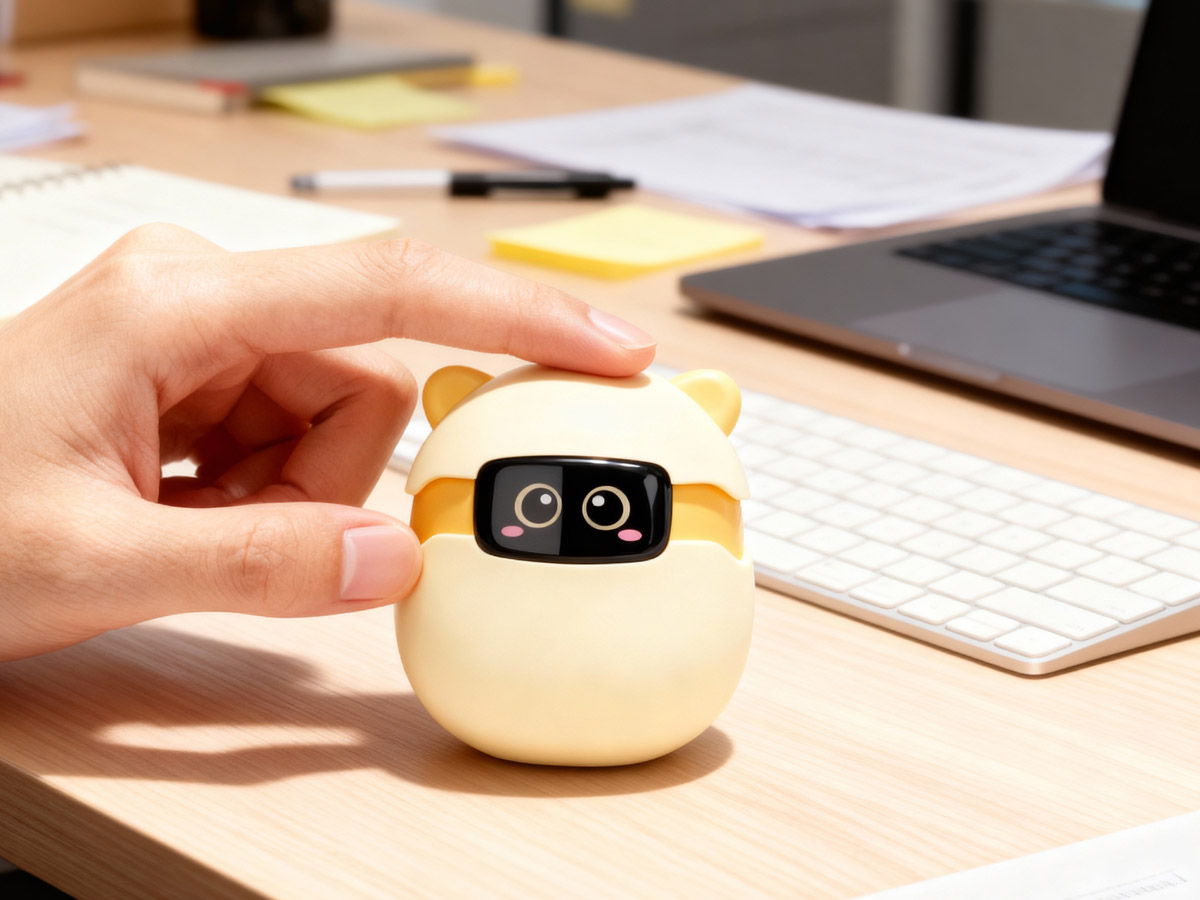
Sweekar, the AI Pocket Pet “that grows up with you,” is now being promoted on Kickstarter. The pocket-sized companion is designed to grow through life stages, remember interactions, and develop language over time. The concept is an interesting example of physical AI, requiring an effective voice and communication interface. Sweekar begins with pre-verbal sounds and gradually progresses toward fluent conversation as the relationship with its owner develops.
Sweekar, the AI Pocket Pet “that grows up with you,” is now being promoted on Kickstarter. The pocket-sized companion is designed to grow through life stages, remember interactions, and develop language over time. The concept is an interesting example of physical AI, requiring an effective voice and communication interface. Sweekar begins with pre-verbal sounds and gradually progresses toward fluent conversation as the relationship with its owner develops.

Introduced at CES 2026 by Takway AI, a robotics/AI company working on gamified AI-powered robots meant to provide emotionally interactive companionship, Sweekar is an AI-based pet inspired by the global phenomenon of the Tamagotchi. The concept is said to be emotionally intelligent, physically growing (it uses a step motor to expand to four stages in size), connected simply via 2.4GHz Wi-Fi or a phone hotspot, but able to work offline, and responsive to touch and voice interactions. The battery will ensure two hours of interactions before needing a recharge (USB-C), but a charging base is provided and allows interactions while charging.
This is an ambitious development for Takway AI, a company founded in April 2024 in Shenzhen, China. But Takway AI is not positioning Sweekar simply as another AI toy. The AI pocket pet weighs 89 grams and uses staged vocal development — from pre-verbal sounds to fluent dialogue — to make speech part of the emotional relationship rather than simply a command interface. From egg to adulthood, it listens, remembers, and transforms based on how the user nurtures it, becoming an evolving reflection of the owner in the palm of your hand.
Takway AI describes Sweekar as an emotionally intelligent AI pet that combines tangible robotic hardware with an AI-driven emotional nurturing system. Unlike a conventional voice assistant, Sweekar is not presented as fully conversational from the first interaction. Instead, speech itself becomes part of the raising experience. The company says Sweekar evolves through Egg, Baby, Teen, and Adult stages, with growth driven by an XP-based system earned through everyday actions such as feeding, cleaning, and talking.

That makes voice interaction central to the product concept. On the Sweekar prelaunch page, the Baby stage is described as unable to speak clearly, using sounds such as “mmm,” “ooh,” and “wah.” As more time is spent with the device, it is described as learning more words, speaking more clearly, and eventually holding complete conversations. The product claim is not just that an AI companion can talk. It is that the ability to talk appears gradually, as a reward for repeated interaction.
This is a different design pattern from the smart speaker, the chatbot, or the familiar voice-controlled toy. Most voice interfaces are judged by how quickly they understand the user and complete a task. Sweekar reframes speech as a developmental signal. The early vocal output is intentionally limited. The user is asked to tolerate ambiguity, respond to small sounds, and build the relationship before full dialogue emerges. From an audio-design perspective, that places vocalization, prosody, timing, and memory inside the emotional architecture of the product.
Takway says Sweekar includes long-term emotional memory capable of retaining user preferences, moods, and past conversations. The prelaunch page gives examples such as remembering a nickname, a favorite drink, what cheers the user up, and what causes stress. These remain company claims, not independent test results, but they show the intended interaction model: voice is not only real-time input. It becomes material for future responses, personality development, and continuity.

The company also says Sweekar’s AI personality system is influenced by a MBTI-based behavioral modeling (the Myers–Briggs Type Indicator (MBTI) is a popular personality assessment tool), allowing traits to evolve dynamically through interaction. In practice, this means Takway is describing Sweekar as a companion whose behavior is shaped by how it is spoken to, cared for, and engaged with over time. Again, the technical implementation is ambitious and effective performance will be proven in practice. But the design intent is clear: conversation is being used as a long-term behavioral input, not simply as a query-response channel.
The Technical Challenge
Whether a product concept like Sweekar delivers convincingly will depend not only on the AI model, but on acoustic design, speech synthesis, microphone performance, memory handling, and the pacing of interaction.
Takway details that the underlying software uses an AI-driven companion-game architecture built on a hybrid stack leveraging Gemini Flash and ChatGPT-class models. According to the company, this enables multimodal interaction, context-aware responses, and continuous learning over time. audioXpress reached out to the company to clarify how voice is captured, how speaker recognition is handled, and how much processing happens locally.
The response confirms that the Sweekar design includes a built-in speaker and its own dedicated AI-generated voice. The user’s voice is captured and processed locally through a built-in microphone array and audio front-end. Real-time speech recognition converts the user’s voice into text, which is then sent to the large language model. The model analyzes the text input and generates a response in text, which is converted back to audio and streamed through the speaker on the device. This means that voice interactions will have a latency that depends mostly on the query and connection speed to the cloud when required. Takway says that most AI-related processing happens in the cloud, but sensor data that requires a real-time response is processed locally.

One of the interesting features is that when Sweekar is placed on the base, users can still wake it up by voice to start a conversation. When Sweekar is not on the base, picking it up can activate the screen. Once the screen is active, users can also use voice wake-up to enter conversation mode. The physical product is part of that interaction model.
Takway says Sweekar supports offline functionality for basic care. The prelaunch page adds that periodic connectivity may be required for software updates and advanced AI features. That distinction matters. A portable AI companion depends on voice interaction that can work across changing acoustic conditions: at home, in a bag, in a car, in a public space, or in a noisy room. If the product is intended to travel with the user rather than sit on a desk, microphone placement, noise handling, wake behavior, speech intelligibility, battery life, and privacy controls become central engineering concerns.
The company confirms that Sweekar was designed to be taken anywhere the user goes. The company even says that the built-in microphone array will be able to withstand wind noise, although in outdoor environments with a lot of human voices or background speech, the conversation may potentially be interrupted.

A New Concept
Sweekar belongs to a broader consumer technology shift. The difference from earlier digital pets is not simply that the character is more expressive. It is that generative AI allows the companion to remember, respond, and speak in ways that appear to evolve from previous interaction.
That shift makes voice one of the product’s most important interfaces. In a Tamagotchi-like screen-based virtual pet, the relationship is often managed through buttons, icons, meters, and scheduled care loops. In Sweekar, the company is moving much of that emotional feedback into sound: baby-like vocalizations, clearer speech, remembered conversations, and stories brought back from autonomous activities.
The audio challenge is not subtle. A companion voice cannot behave like a generic assistant if the product’s promise is growth and attachment. Early sounds must feel limited without becoming irritating. Later speech must feel more capable without becoming uncanny or overly adult. The device has to recognize and respond to the user while avoiding the impression that every private moment is being captured without control. For a category aimed at emotional companionship, privacy and trust are not secondary software-policy details. They are part of the listening experience.
Sweekar points to an emerging class of products where voice interaction becomes a developmental mechanism, a memory trigger, and a marker of relationship depth. This makes this project extremely interesting to follow, and audioXpress intends to review the product when possible.

Sweekar is promoted for adults “who remember the Tamagotchi feeling and always wanted it to go further.” It is also designed to feel safe. No camera. No personal data stored beyond what is needed for interaction. EN 18031 privacy standards throughout. And unlike the Tamagotchi it takes inspiration from, it does not end. From Level 30 onward, Sweekar cannot die. The emotional investment compounds for years if you keep the battery charged.
For now, visit the Kickstarter page to follow the campaign and back this project.
www.takway.ai