
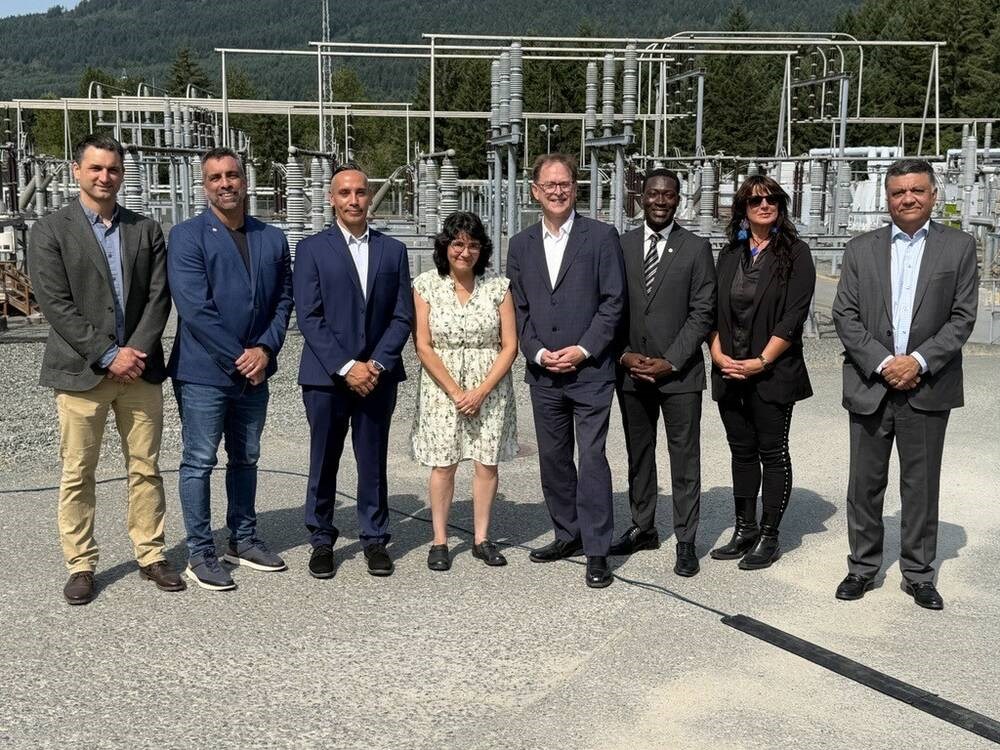
The 100-megawatt battery storage project is part of a province-wide effort to add 500 megawatts of battery power to the grid.
North Cowichan has been announced as the location of the first grid-scale battery-storage facility in British Columbia, as the province seeks to increase peak capacity and reliability of Vancouver Island’s electrical grid.
Nanaimo-Lantzville MLA George Anderson, parliamentary secretary for Energy and Climate Solutions, announced Monday that B.C. Hydro will start the procurement process for a 100-megawatt battery storage project, as part of a province-wide effort to add 500 megawatts worth of battery power to the grid.
The facility will be used to help manage peak demands and avoid blackouts, and will be built next to the Vancouver Island Terminal substation on Bell McKinnon Road just north of Duncan. The substation is a major power hub that helps send electricity from mainland B.C. to the Island.
“Demand is rising, and it is rising quickly,” said Anderson. “We cannot wait for that pressure to arrive before we act.”
The 100-megawatt facility, which is expected to enter service by 2030, will be the province’s first major grid-scale battery facility.
“This is going to be a big part of our system from now on,” said Energy Minister Adrian Dix.
Alberta, Ontario and Nova Scotia have also announced major expansions to energy-storage capacity in recent years.
Active projects across the country are poised to more than double Canada’s power from stored energy to 1,149 megawatts by 2030, according to the Canada Energy Regulator.
Ontario is building or has plans for up to 2,800 megawatts of power through energy storage, while Alberta has identified 600 megawatts in its plans, Anderson said.
B.C. Hydro has dipped its toes in battery storage facilities before — a one-megawatt battery bank was built in Yoho National Park in 2013 for $13 million to serve the unincorporated community of Field — but the North Cowichan facility will be on a different scale.
Ajay Kumar, B.C. Hydro’s senior vice-president of integrated planning, said B.C. Hydro has been built on hydroelectric power for decades, but the power grid needs to diversify to support the province’s growth.
Kumar said the procurement process will explore the exact battery design and technology that will be used, but the plan is to find a safe, modular approach that can be easily scaled up if needed.
B.C. Hydro is looking for a design that has a four-hour charge and discharge rate, he said — the length of time it takes for the battery to charge and discharge.
Battery energy-storage systems suck up cheap power during periods of low demand and discharge during periods of high demand.
They’re considered critical infrastructure when the grid is powered by intermittent energy sources such as wind power, such as the 197.2-megawatt Yəyus Energy project northwest of Campbell River.
Stephen Rayner, executive director of Clean Energy BC, said battery storage is a cost-effective, rapidly deployable and clean technology that can help a power grid make better use of the electricity produced within it.
Justin Rangooni, president and CEO of Energy Storage Canada, said members of his organization were excited when B.C. Hydro first began shopping the idea around last year.
“Energy storage is moving from planning into development and becoming a central part of how we build a more reliable and flexible electricity system,” he said.
As battery costs have fallen, countries across the world have been rapidly adopting the technology for energy-storage needs.
Global spending on grid-scale batteries was estimated at US$66 billion last year, according to the International Energy Agency.
Canada lags behind other comparable economies in adding battery storage to its power grids, while globally, China is the market leader, with the U.S. a distant second.