

Listen to this article
Estimated 4 minutes
The audio version of this article is generated by AI-based technology. Mispronunciations can occur. We are working with our partners to continually review and improve the results.
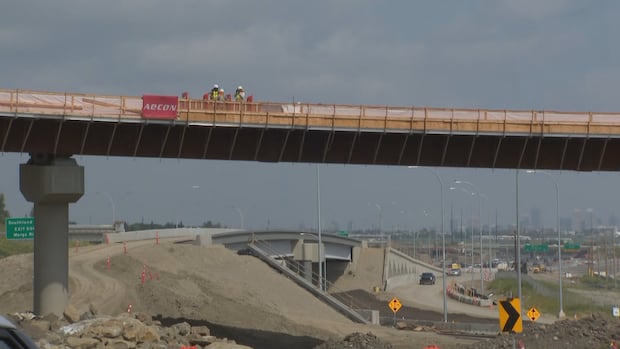
A major milestone has been reached in Alberta’s $700-million Deerfoot Trail improvements project, with the new Ivor Strong Bridge scheduled to open to traffic on July 27.
In an announcement on Tuesday, Minister of Transportation and Economic Corridors Devin Dreeshen said the new Ivor Strong Bridge is expected to open “on time and on budget.”
Once traffic is shifted onto the new bridge, rehabilitation will begin on the existing Ivor Strong Bridge. When both structures are complete, the new bridge will carry all southbound traffic while the rehabilitated bridge will carry northbound traffic, providing four lanes in each direction.
This opening marks the latest phase in a multi-year project, which is designed to reduce congestion, improve safety and increase capacity along Deerfoot Trail, the province’s busiest highway. Dreeshen said commuters can expect to save about 20 per cent on daily travel times once the entire project is complete.
“This means less time stuck in traffic, and more time spent doing the things you like,” said Dreeshen at the news conference.
Upgrades ongoing
The overall project includes 70 kilometres of resurfacing, 40 kilometres of lane widening, 20 kilometres of new concrete barriers, construction of seven new bridges and rehabilitation of two existing bridges.
Construction remains active across several sections of Deerfoot Trail.
At the Anderson Road and Bow Bottom Trail interchange, crews are continuing to work on bridge structures, with the Anderson intersection expected to be completed this fall.
At Southland Drive, girder installation for the new bridges has been completed and crews are preparing for the widening of Deerfoot Trail. The Southland interchange is also expected to open later this fall.
Rehabilitation continues on the existing southbound Glenmore Trail bridge. Crews are removing deteriorated concrete, installing temporary supports and preparing new barrier walls. The Glenmore interchange is expected to be complete in early spring 2027.
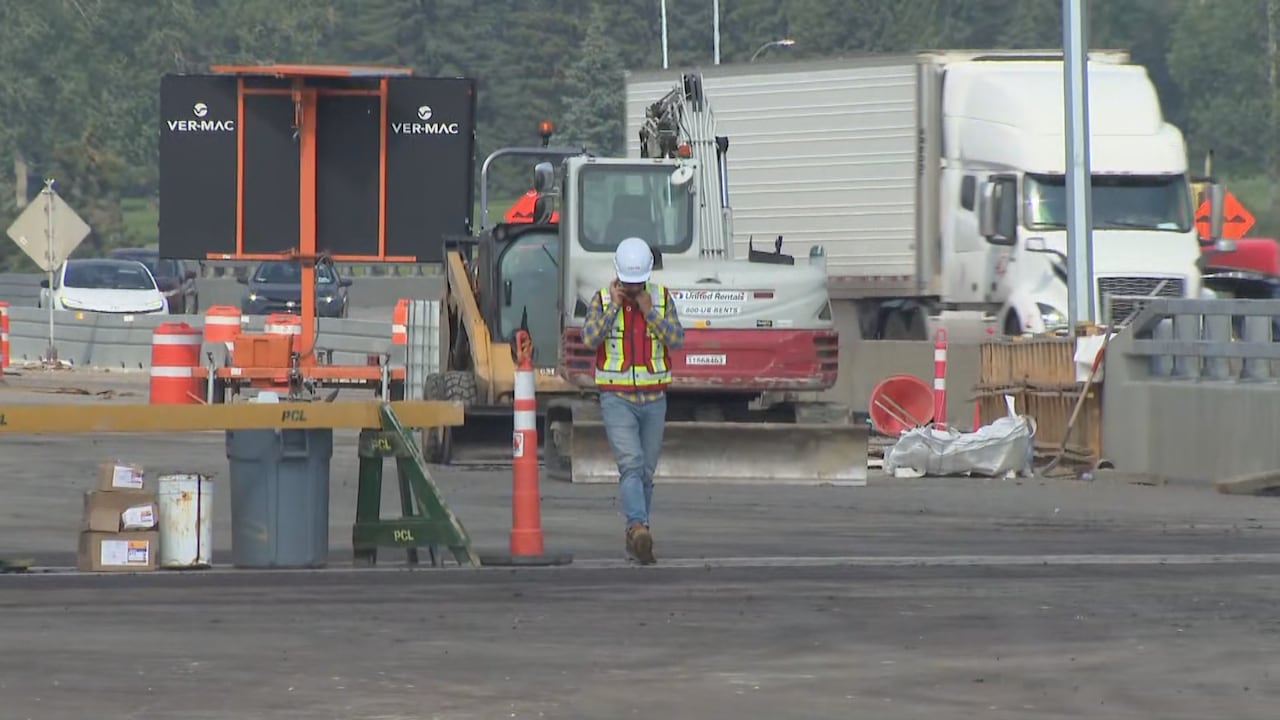 Deerfoot Trail is Alberta’s busiest highway, seeing up to 180,000 vehicles per day. (Mike Symington/CBC)
Four northern improvement projects have already been completed, including upgrades at 64th Avenue N.E., Beddington Trail N.W. and 11th Street N.E., McKnight Boulevard N.E., and 16th Avenue N.E.
Drivers should expect changing traffic patterns throughout 2026 and 2027 as construction progresses. The province says night work is being used wherever possible to minimize disruptions.
Tense priorities, safety first
The Deerfoot Trail improvements project started construction in 2023 following a long-term planning study completed jointly by the province and the City of Calgary.
This study concluded that Deerfoot Trail, which was originally built in the 1970s, was designed for a much smaller city. Since then, Calgary’s population has more than doubled and traffic volumes have steadily increased, prompting the need for upgrades.
According to Jason Hawkins, an assistant professor of civil engineering at the University of Calgary, there is sometimes tension between local and provincial goals.
He said the province is likely focused on freight movement and intercity travel, whereas the city is most interested in improving access to people within the city, and these priorities “don’t always align. ”
Because Deerfoot Trail is a provincially-owned highway, Hawkins feels this project is focused on the speed of movement versus the ease of access.
“It doesn’t really solve the problem; it gives more capacity for people to move at high speeds,” said Hawkins. “Is that really the purpose of our road?”
Even so, Hawkins agrees that adding lanes can benefit road safety because it reduces the amount of weaving traffic.
“I think those are good improvements to make,” he said.
WATCH | Calgary police commission wants to see harsher penalties for excessive speeders: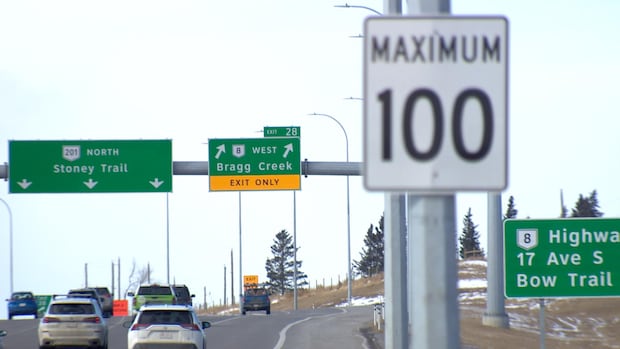
Calgary police commission wants to see harsher penalties for excessive speeders
Calgary police reported issuing 677 speeding tickets on Stoney Trail in January, and 149 along Deerfoot Trail. Alberta legislation doesn’t allow officers to impound vehicles for speeding infractions. But the province says fines for excessive speeding and racing will increase by 50 per cent next month.
Project officials say road safety is top of mind.
The province said the Deerfoot Trail improvements project is scheduled for full completion by fall 2027, with all phases expected to be open to traffic by October next year.