
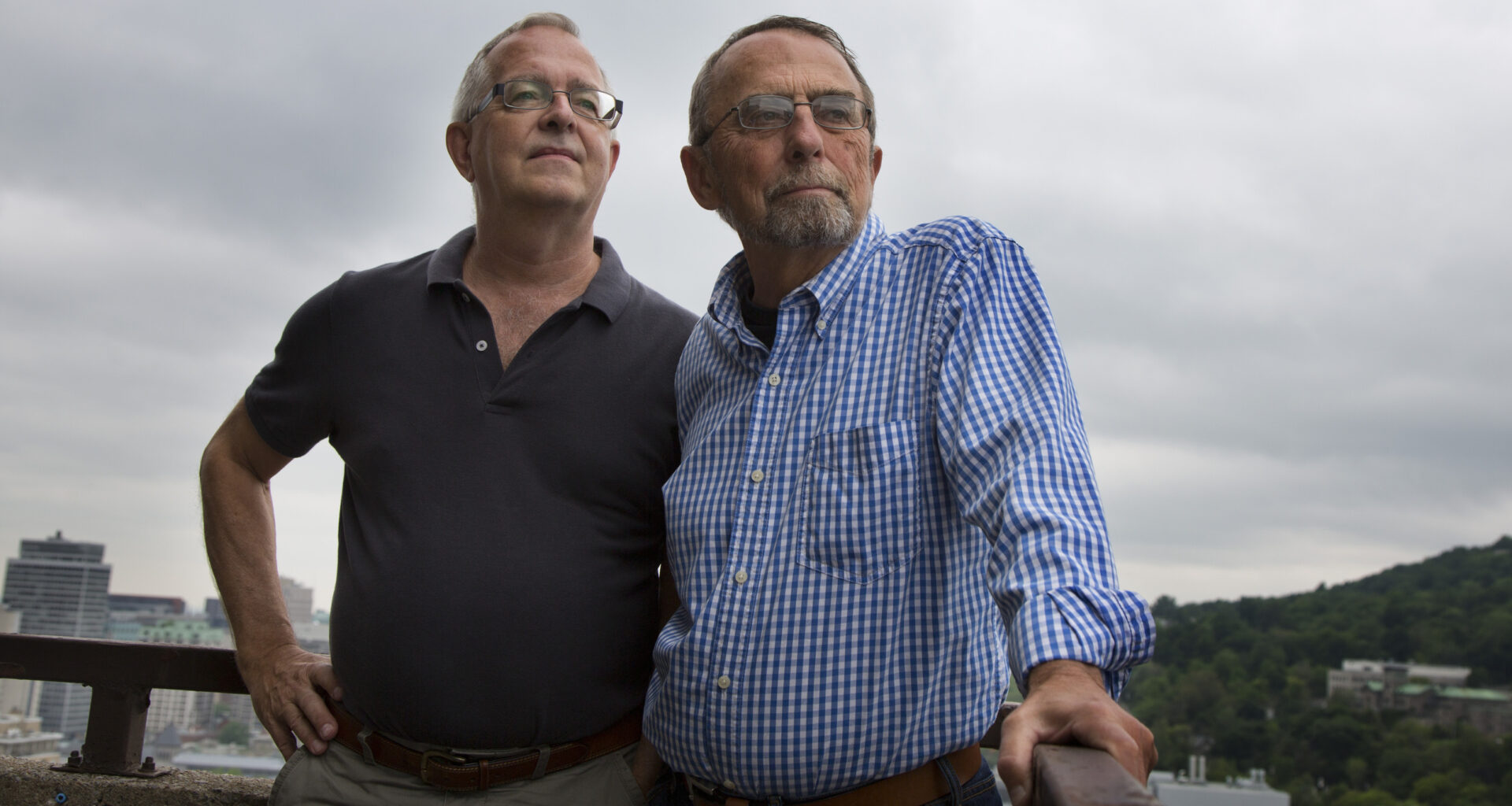
Michael Hendricks (1941-2026), a foundational figure in Montreal HIV/AIDS activism, a prominent LGBTQ+ rights advocate and one-half of the first same-sex couple to legally marry in Quebec, has died at 85.
In declining health with a progressive lung disease, he had requested medical assistance in dying. He died on Saturday.
Known for his decades of advocacy in Montreal, Hendricks leaves a rich legacy of achievement and commitment to human rights.
The Vietnam War was raging as the New Jersey native visited Montreal in 1968 — and his mother let him know that his draft notice had arrived, he told the LGBTQ+ publication Fugues.
He moved to Montreal, learned French — which he spoke with “an accent, which was charming,” said fellow queer activist Claudine Metcalfe — and went on to devote his energies to a range of causes, including efforts to combat the HIV/AIDS epidemic and to help those affected. Until antiretroviral therapy, introduced in 1996, made HIV a chronic and treatable condition, to be HIV-positive was a death sentence.
“People with HIV were banned from their homes, their family, their jobs,” recalled fellow queer activist Roger Le Clerc, who goes back 40 years with Hendricks. “They were on welfare and alone at the holidays because their friends had disappeared.”
Every year for several years, Hendricks would organize a supper with the Comité des personnes atteintes du VIH du Québec and bring all the food.
“No questions asked: He was beyond generous. For those who could dance, there was dancing. It was a moment to be together,” Le Clerc said.
Most of the people were extremely ill or would soon become ill, and yet “the supper was joyful. We celebrated being alive.”
The early 1990s were turbulent years for Montreal’s LGBTQ+ community: Along with the AIDS crisis, it was also grappling with violent police raids on gay establishments including Sex Garage in 1990 and Katacombes in 1994. A string of unsolved murders of gay men included a young man named Joe Rose on a city bus in 1989, said Montreal arts and culture journalist Richard Burnett, a longtime AIDS activist and friend of Hendricks.
“People were worried there was a gay serial killer in town,” he said. “We were a community under siege.”
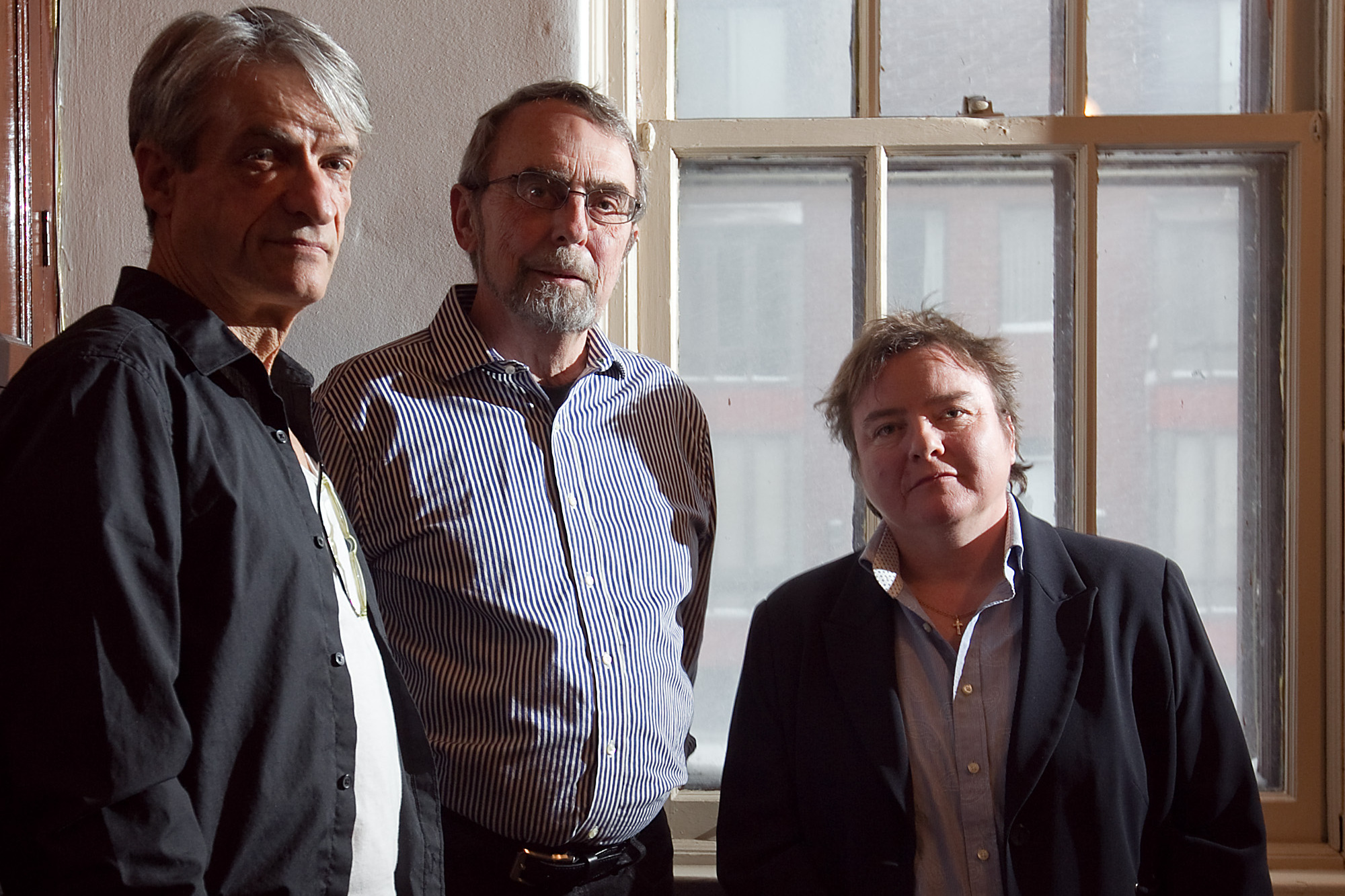 Michael Hendricks’s “most important struggle was the struggle for gay marriage,” says Roger Le Clerc, left, seen with Michael Hendricks and Claudine Metcalfe in Montreal on March 12, 2014. Pierre Obendrauf / Montreal Gazette
Hendricks co-founded the Montreal chapter of the activist group ACT UP (AIDS Coalition to Unleash Power), Lesbians and Gays Against Violence, and Dire enfin la violence (“speaking out about violence at last”), a pioneering community organization created with fellow queer activists Le Clerc and Metcalfe. He was also co-ordinator of a gay and lesbian roundtable that became the Conseil québécois LGBT.
But his “most important struggle was the struggle for gay marriage, which did not exist,” Le Clerc said. “There was civil union, but he wanted more than that. He believed that his rights as a gay man should be recognized as those of a full citizen and not a second-class citizen. And, with others, he led a struggle to have that.”
Hendricks and René LeBoeuf met at a New Year’s party in Montreal in the mid-1970s. They had been together 30 years when they sued the provincial government for the right to marry, asserting that its refusal to permit same-sex marriages violated the Canadian Charter of Rights and Freedoms. Quebec’s Superior Court ruled in their favour in 2002, but delayed implementing its decision to give the federal government time to adjust its own law. (Same-sex marriage would be legalized nationwide only in 2005.) Hendricks and LeBoeuf appealed and, in 2004, a Quebec Court of Appeal ruling allowed same-sex marriages to proceed immediately. They married on April 1, 2004.
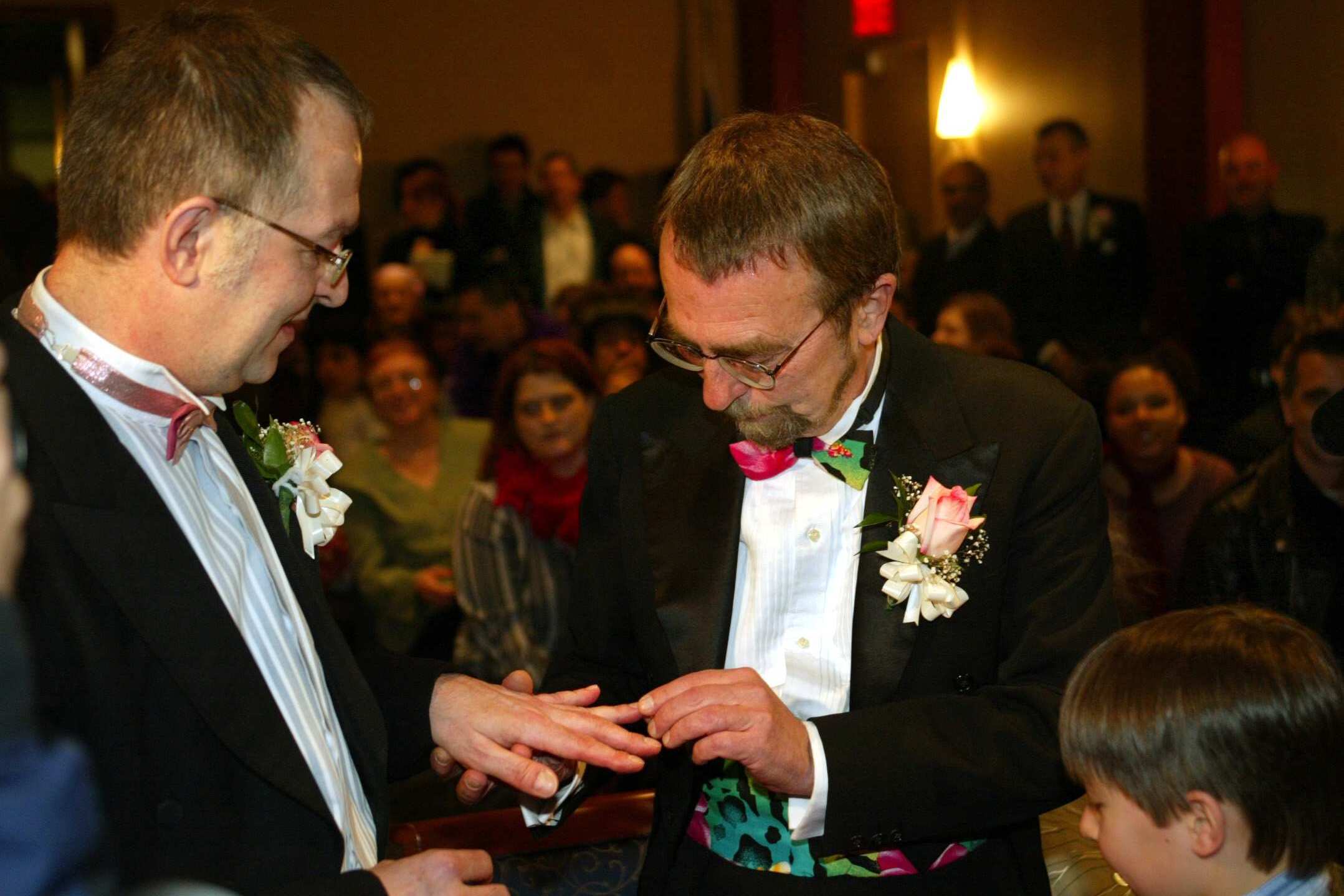 René LeBoeuf, left, and Michael Hendricks at the Montreal courthouse on April 1, 2004, as they became the first same-sex couple in Quebec to get married. MARIE FRANCE COALLIER / GAZETTE
As a couple, “they were very affectionate and absolutely adored each other and relied on each other,” Burnett said. “Particularly in his later years, René was a pillar of strength for Michael.”
The fight for same-sex marriage started out as their fight. “But it turned into doing the right thing for the wider community,” Burnett said. “They fought for all of us. Montrealers — queer and straight — all owe Michael a lot. He helped change our city for the better.”
Burnett and Hendricks met “in the LGBT trenches after the Sex Garage raid in July of 1990. That’s when there were a lot of community actions, demonstrations against police violence,” Burnett said.
They became friends after Burnett became the LGBTQ+ columnist in 1996 at the alternative weekly Hour, which embraced advocacy journalism.
He dubbed activists Hendricks, Le Clerc, Metcalfe and Douglas Buckley-Couvrette, who died of AIDS in 2001, “the queer brain trust.” As they planned and organized demonstrations and other events, “they were absolutely fearless. They worked like a hockey team. Michael was the deep-thinking strategist.”
Said Metcalfe: “What counted for Michael was to be serious, solid. He was the one who wrote everything — the letters to newspapers, all of it. It’s because of him that items remain from this period.”
The so-called queer brain trust successfully pressured the government to hold public hearings on violence against members of the gay and lesbian community. In late 1993, hearings by Quebec’s human rights commission led to 21 recommendations, including that the Montreal police department “establish liaisons with the gay community to improve relations — and that happened,” Burnett said.
Recalled Le Clerc: “We worked hard with police and did training with young officers to make them more aware of the importance of their presence and their reality when they confronted us.”
Said Burnett: “That came directly out of those hearings, which came out of the queer brain trust.
“I think we need to salute our heroes — and Michael was a hero.”
Hendricks was also a driving force behind Parc de l’Espoir, a Montreal space dedicated to victims of HIV/AIDS established in 1991 by ACT UP as a memorial site. The space was officially inaugurated in 1994 by then-mayor Jean Doré, redesigned in 1997 and renovated in 2021 into a larger and more accessible public space.
A not-for-profit organization to protect the park, Mémoire vivante du parc de l’Espoir, was established and Burnett has been volunteer administrator since 2020. Hendricks was another of the administrators and their final meeting was Feb. 13; he had announced in January that he had registered for MAID.
“I knew it would be our last time seeing each other,” Burnett recalled, and it was a difficult goodbye. “I told Michael: ‘It has been my great honour to serve alongside you, and my great fortune to become your friend.’”
Said Metcalfe: “Michael believed in freedom and justice — and that when there is injustice, you have to act.”
As a volunteer at Stella, a Montreal sex workers’ rights group, “you saw his feminism and his sense of justice. He took his experience and used it in helping them to be recognized. Few gay men would be involved in helping sex workers.
“When we saw all the injustices and that we were treated as second-class citizens, Michael demanded public hearings so people could tell their stories,” she said. “And it is a huge injustice to spend 50 years with someone and end up with no pension or recognition of your union.
“He was a courageous man — someone with a strong sense of right and wrong, someone with integrity.”
Editor’s Picks