
Published July 23, 2026 07:06AM
Watching the Tour de France as a triathlete is a complicated experience. On one hand, you are watching the best cyclists in the world push the limits of human performance. But on the other hand, much of what they’re doing is completely irrelevant in triathlon. If you try to copy a Tour de France rider’s routine, half of it will make you faster, while the other half will make you burnt out and sick. The trick is knowing which half is which.
Here are five things Tour de France riders do that can make triathletes faster, and five things that look fast at the Tour, but belong nowhere near your next triathlon.
5 things triathletes can learn from Tour de France cyclists
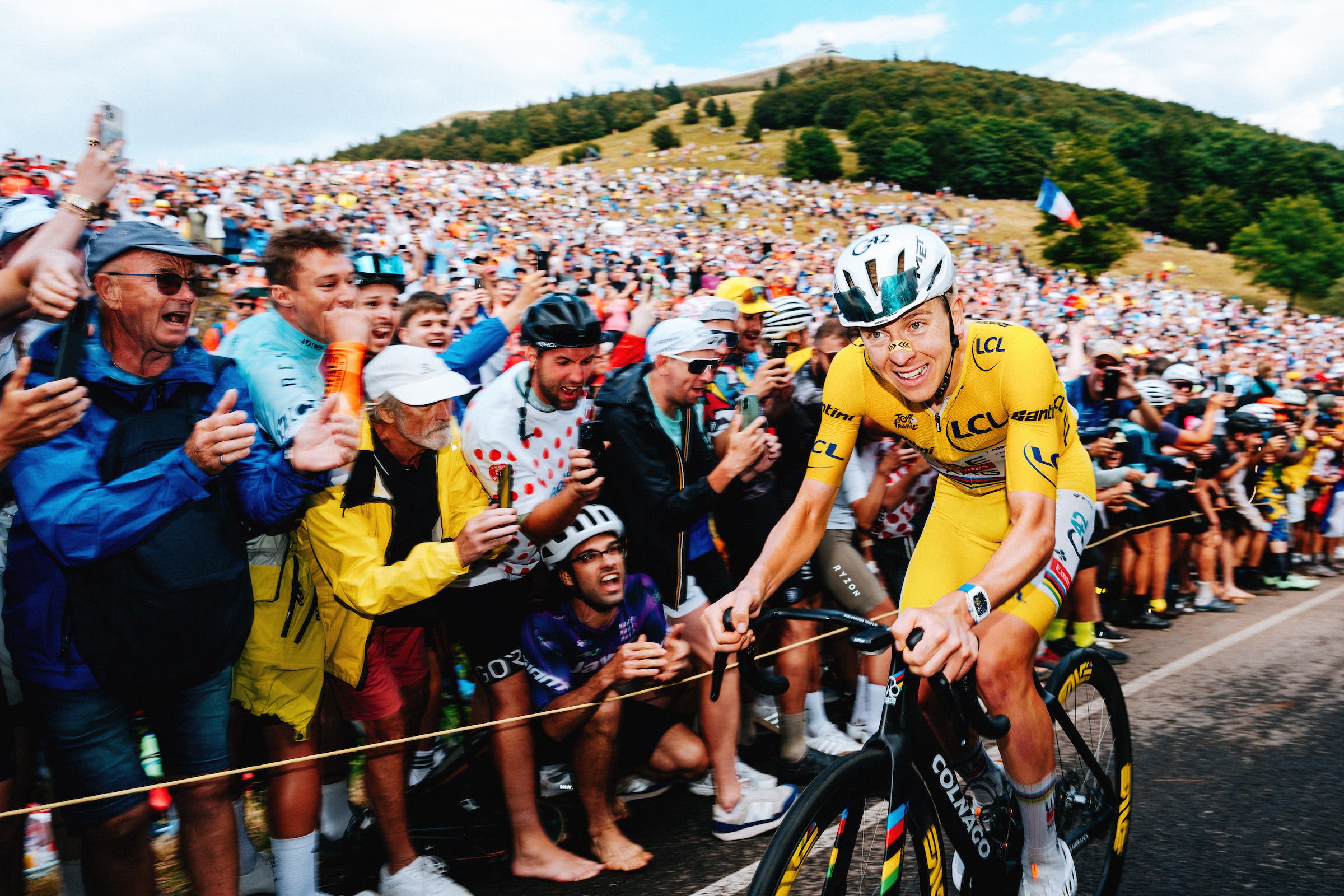 Triathlon training can benefit from the lessons of cycling’s Tour de France. (Photo: Gruber Images)
1. High-carb fueling is key
Tour de France riders consume at least 90 grams of carbohydrates per hour every single stage for three consecutive weeks. On some stages, they might consume 100-150 grams of carbs per hour, such as a hilly breakaway stage or high-mountain GC stage. With most stages lasting 4-5 hours, that means each rider is consuming a ridiculous amount of carbs day after day.
Carbs fuel performance, and the same can be seen in triathlon. It doesn’t matter that one race is three weeks long and the other is a single day. Triathletes consume at least 90 grams of carbohydrates per hour during their race, and some have reportedly consumed much more. We’ve heard of numbers in excess of 200 grams of carbs per hour, and while the exact amount varies between athletes, the same principle shines through: high-carb fueling is key to achieving peak performance in cycling and triathlon.
2. Training in the aero position pays off
In the age of power meters, lactate monitors, and an endless amount of high-tech wearables, it’s easy to forget that at the end of the day, the only thing that matters is speed. The fastest way to get from Point A to Point B (whether it’s in the Tour de France or Ironman World Championship) is to go as fast as possible. Power, heart rate, blood glucose, and lactate are certainly a part of that equation, but perhaps the biggest factor is aerodynamic drag.
Adjusting your cycling position to be 20 watts faster is often easier to do aerodynamically than it is to gain 20 watts of pure time training power. The pros engage in wind tunnel testing, but you can improve your aero position at home for free. Focus on narrowing your shoulders, lowering your head, and closing the gap between your face, hands, and arms. While everyone’s aero position will look slightly different, these are the tweaks that you can make to improve your aerodynamics. The Tour de France is faster than ever thanks in large part to improved aero positions. Some positions, such as the puppy paws and forearms resting on the hoods, have actually been banned by the UCI. At the end of the day, being as fast as possible is about much more than pushing harder on the pedals. Improve your aerodynamics, and you could improve your bike speed by 0.5-1kph at the same power output.
3. Don’t skip the warm-up
Before key stages of the Tour de France such as a time trial or uphill start, you will see riders warming up on turbo trainers next to their team buses. They’ll spend 20-40 minutes spinning their legs, doing a few efforts, and preparing their bodies for the upcoming effort. While some stages start with an easy neutral zone, others begin with a full gas effort from the gun.
A triathlon starts with a bang, each athlete sprinting towards the water, diving in, and fighting to move into a good position. The pace settles at some point, but the start is highly intense. If you’re not prepared for that kind of effort, you could lose a ton of time or start suffering from cramps. Starting cold is one of the worst approaches to the beginning of a triathlon, and like Tour de France riders on a mountain stage, you don’t want to be left behind because you neglected to warm up. (Here’s a warm-up routine for every race distance, in case you need it.)
4. Use heat training intentionally and effectively
Heat training is one of those trending topics that has stuck around much longer than many of us expected. We’ve heard plenty of training fads over the years. Heat training is still being used by hundreds of professional cyclists and triathletes to prepare for the biggest races in the world. Tour de France riders use heat training to prepare for French heat in July, while triathletes have plenty of hot-weather races where heat acclimation is critical for performance.
Not only does heat training improve performance in hot and humid conditions, but it also causes several other physiological changes that can improve performance. Changes in plasma volume, VO2 max, and sweat response are notable adaptations from heat training, both passive and active. Passive heat training such as sauna use has been shown to improve performance, but many experts suggest that active heat training (i.e., cycling or running indoors in a sauna suit) is even more effective. Either way, the performance gains are significant for both cyclists and triathletes, especially for hot-weather races.
5. Have a race-day routine (and stick to it)
Tour riders follow the same pre-race routine every day for three weeks. They focus on high-quality sleep, a well-timed and nutritious breakfast, and a pre-race equipment check before every stage. The protocol might have to be adjusted for slightly different start times, location, and weather, but that makes the routine even more valuable because there is always a plan to fall back on.
At the Tour de France, a rider’s pre-race routine is crucial for maximizing performance and recovery day after day. But in triathlon, there is only one day to focus on. That means the pre-race routine must be practiced well before the event and put to the test in training or race simulation workouts. The routine reduces the chances of things going wrong, a piece of equipment being forgotten, or last-minute stress right before the race. When your energy needs to go into your race day performance, don’t waste it on creating a packing list the night before because you’ve never practiced any of this in training.
5 Tour de France lessons triathletes can ignore
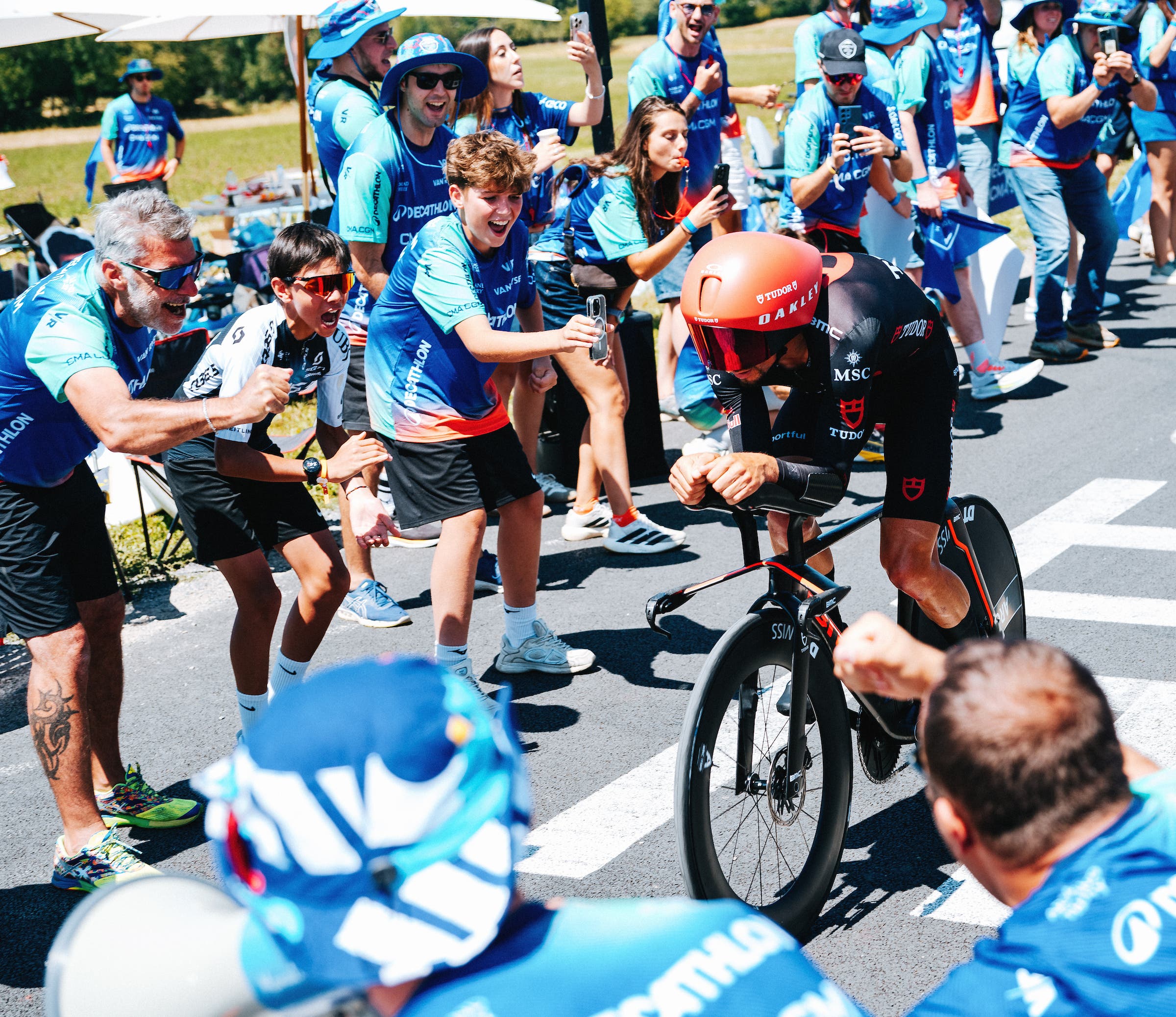 Not all lessons from the Tour de France apply to triathlon. (Photo: Gruber Images)
1. Achieve your best performance means being as lean as possible
It’s no secret that power-to-weight ratio dominates at the Tour de France, especially among the GC contenders fighting for the yellow jersey. Some of the riders have even said that they will intentionally lose 3-5kg between the winter and summer to lean out for the Tour de France. The long and steep climbs reward watts per kilogram (w/kg) over raw power output, but the same cannot be said in triathlon.
Most triathlons are flat or hilly. Very few are mountainous, which means that raw output leads to higher speed and better performance. You’ll rarely see a professional triathlete as lean as a Tour de France climber. They are simply different body types in different sports with different goals. One is meant to ride up a 30-minute climb as quickly as possible. The other is meant to power through the swim, bike, and run as quickly as possible. You need pure strength and durability to handle the demands of triathlon, and that’s something that Tour de France riders sacrifice in order to be lean.
2. Aggression is the best tactic
Every stage of the Tour de France is aggressive. Whether it’s the sprint for the win, the fight for position, or the bike throw at the KOM/QOM banner, aggression leads to success more often than not at the Tour. Especially in the modern era of professional cycling, riders are racing aggressively from Kilometer Zero. They are sprinting out of corners, sprinting for green jersey points, and sprinting into position with 5km to go. That kind of aggression burns many matches, but it’s often worth it at the Tour de France.
Burning matches is not the best way to race triathlon. Some aggression can help with positioning, but it’s a completely different level to the ‘elbows-out’ style at the Tour. You can also blow up your pacing strategy by racing aggressively. While leading into a key climb is important at the Tour, you may not want to fight your way to the front of a triathlon when there are two hours of racing to go. Pacing typically outperforms aggression in triathlon, and that’s why you don’t often see triathletes dive bombing a corner on the bike leg.
3. Work on your ability to produce a race-winning sprint
Whether you’re a sprinter, climber, puncheur, or GC contender, improving your sprint directly improves your chances of winning at the Tour de France. Some stages come down to a massive field sprint where riders are pushing 1,900 watts and going 70 kph. Other stages are decided by a two-up sprint in the breakaway, with each rider getting a chance at Tour de France glory.
But in the sport of triathlon, improving your sprint probably won’t improve your overall performance. Most triathlons come down to pacing, speed, and overall fitness. There might be the occasional sprint to the finish line, but even that is more about your ability to sprint on tired legs than your ability to produce peak power. Some sprint work might be useful in training, especially if it’s a weakness of yours. But if you can only produce 1,100w on the bike instead of 1,200w, it won’t make a difference in triathlon. If you were sprinting to win a stage of the Tour de France, that could mean the difference between winning and losing.
4. Peak for a three-week race instead of a single day
Tour de France riders don’t peak on Stage 1. In fact, they don’t peak for a single stage. Instead, they time their peak so that they hit top form during the stages that suit them. For sprinters, this might mean peaking in Week 1 of the Tour de France. For climbers and GC contenders, that might mean peaking in Weeks 2 and 3.
Triathletes aim to peak on a single day: race day. There isn’t a wide range to aim for, so it takes some practice to nail down your taper and peaking protocol. The last thing you want is to feel amazing five days after your goal race. That might work out nicely at the Tour, but you only get one day to shoot for in triathlon.
5. Copy the bike setups
At one point, you may have seen a professional cyclist running a dual-disc wheel setup in a time trial. Don’t do that in triathlon. The double disc setup is meant for short and flat time trials with minimal crosswind. Even in the shortest triathlons, a double disc wheel is impractical and dangerous. That’s not the only piece of gear that’s best kept in road cycling.
Some professional cyclists wear skinsuits without pockets, especially in time trials. That’s because cycling TTs are quite short compared to triathlon (most TTs last less than 40 minutes), but what about the road stages? Both road cycling and triathlon have feed zones or aid stations, but in professional cycling, your very own team staff will have someone standing there waiting to hand you a bottle and gels. If you have to miss the hand-up, you can drop back to the team car, which carries hundreds of bottles along with any fuel that you would need during the race. This level of support doesn’t exist in triathlon, so you’ll have to rely on carrying more fuel in your tri suit and on your bike.