
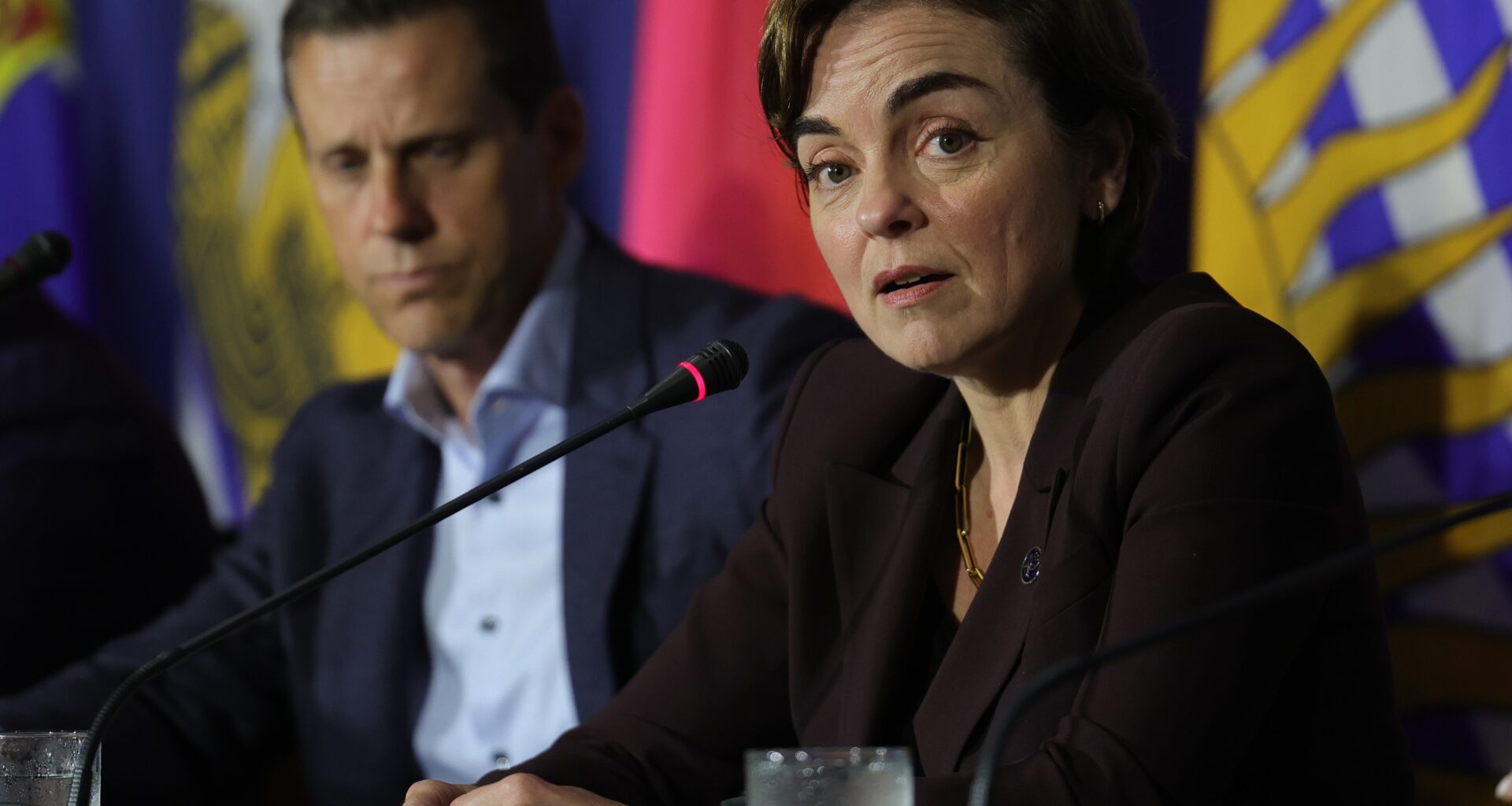
Amid renewed tariff threats from U.S. President Donald Trump, Premier Christine Fréchette is urging Ottawa to give Quebec a larger role in trade negotiations, protect the province’s farmers and cultural sector, and be prepared to quickly assist businesses and workers hit by new duties.
The requests came as Canadian premiers met with Prime Minister Mark Carney in Charlottetown to plot strategy on Thursday, with Carney saying “everything’s on the table” if trade negotiations with Washington fail.
Trump’s latest tariff plan has “created even more uncertainty and heightened concerns” in Quebec, Fréchette said.
“To all Quebecers who are wondering how this will affect their business, their job or their family, I want to say one thing: I hear you, and you are my priority. And you will not go through this period of uncertainty alone.”
Fréchette held a one-on-one meeting with Carney on the sidelines of the premiers’ meetings, raising three issues.
First, she said Quebec and the other provinces should be given access to Ottawa’s “negotiation plan” because the federal government’s decisions will have significant consequences for provincial economies.
Second, Fréchette said Quebec’s interests must be reflected in the negotiations, particularly on supply management and cultural protections. “These are two non-negotiable elements.”
Finally, she said Ottawa must ensure it is prepared to “quickly deploy assistance measures for businesses and workers who may be affected should new tariffs come into effect.”
Fréchette said her Coalition Avenir Québec government “will never stand by idly while decisions made elsewhere weaken our economy.”
She added: “Quebecers can count on one thing: My government will be there to protect our economy, our workers and our jobs. And I will always speak up for Quebec with strength and without compromise.”
On Monday, Trump announced the U.S. will impose 50 per cent tariffs on a range of Canadian products, beginning next month.
Carney and the premiers met on Thursday, with Canada’s response to the U.S. tariff threat one of the key issues.
Carney denounced what he called “the latest in a series of unilateral, unwarranted trade actions” by the Trump administration.
“In all circumstances, irrespective of the outcome of (trade) negotiations, Canada will do whatever it takes to build our strength at home and to support Canadian families, workers, our farmers, our businesses,” he said.
Carney argued Canada is “in a stronger position than we were when this trade war started 18 months ago,” crediting Canadians for helping strengthen the country’s response.
“We’re ready because we have been focusing on what we can control,” he said.
Canada’s strategy involves improving the country’s economy and diversifying trade relationships, even while helping sectors such as steel, aluminum and automobiles, Carney said.
Carney also said premiers agreed to continue work on reducing internal trade barriers and building “one Canadian market” to make it easier for workers and goods to move across provincial boundaries.
The prime minister said he and the premiers stand united as negotiations with the U.S. “intensify.”
Asked if Canada is considering retaliatory measures against the U.S., Carney said: “Everything’s on the table if there’s no agreement, depending on the outcome of the negotiations.”
The U.S. trade war is expected to be an issue in Quebec’s Oct. 5 general election.
This week, Conservative Party of Quebec Leader Éric Duhaime said the CAQ government’s decision to retaliate by removing American alcohol from store shelves was a mistake and ended up costing the province millions.
He said Quebec should put American alcohol back on shelves, and instead focus on removing interprovincial trade barriers to direct-to-consumer alcohol sales.
“Canada is our best and most reliable economic partner,” Duhaime said.
The premiers of all provinces except Quebec announced plans this week to remove interprovincial barriers that prevent brewers, wineries and distillers from selling directly to consumers in other provinces.
Fréchette said Quebec wants to do the same, but requires legislative changes.
Parti Québécois MNA Pascal Paradis also accused the CAQ government of mishandling the trade dispute.
He cited the alcohol ban and former premier François Legault’s 2025 comments that he was prepared to make compromises in the aerospace, forestry and aluminum sectors during trade talks with the U.S.
Paradis argued that Carney has been too willing to make concessions to Trump without securing gains in return.
“The reality is that Quebec and Canada have never been in a weaker position than they are today,” he said. “President Trump will continue using tariff threats as long as those threats work.”
Editor’s Picks
The Gazette’s On Quebec Politics newsletter by Andy Riga breaks down key election issues, from polling shifts to legislative manoeuvring to ideas circulating in francophone commentary that don’t make it into English-language coverage.
To sign up, visit this page and check the box labelled “On Quebec Politics” before providing your email address.

A Montreal native, Andy Riga has been with The Gazette since 1991. He covers politics, language and other Quebec issues, and writes the On Quebec Politics newsletter. Montréalais d’origine, Andy Riga travaille au Montreal Gazette depuis 1991. Il couvre la politique, les enjeux linguistiques et d’autres sujets, et est responsable de l’infolettre On Quebec Politics.
ariga@postmedia.com