
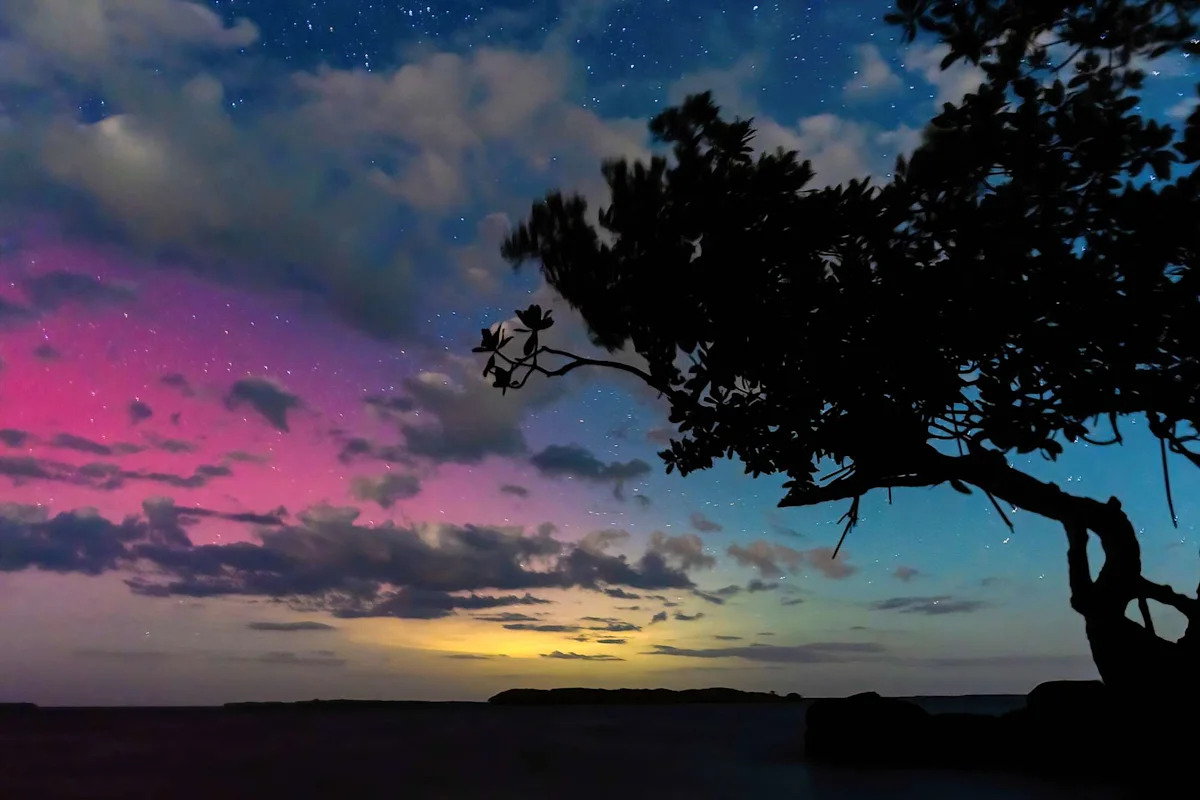
NEED TO KNOW
The northern lights may be visible in parts of the U.S. on Friday night due to geomagnetic activity
Visibility depends on factors like location, weather, and light pollution, with the best chances near the Canadian border
NOAA recommends checking real-time aurora forecasts and finding dark, clear areas for optimal viewing conditions
Tonight’s skies could deliver a rare flash of vibrant colors as solar activity sends the northern lights towards parts of the U.S.!
Forecasters at NOAA’s Space Weather Prediction Center are seeing the possibility of G1 (or minor) geomagnetic activity on Friday, July 24, as a high-speed stream of solar wind continues to repeatedly hit Earth.
For reference, the northern lights (aurora borealis) are a result of geomagnetic storms, which occur when charged particles from the sun collide with gases in the Earth’s atmosphere, creating brilliant waves of light in the sky.
Still, their visibility depends on several factors, including intensity and location.
Meanwhile, two coronal mass ejections — clouds of charged particles and magnetic fields released by the sun — may also brush against the planet’s magnetic field.
Still, this sky show is not a guaranteed spectacle, as everything from weak activity and summer twilight to moonlight and glow from the city lights could easily wash out a faint display.
In the meantime, read on for everything you need to know about this stellar event.
When will the northern lights be visible?
Northern Lights
Credit: Steven Garcia/NurPhoto/Shutterstock
Get ready, stargazers! The best opportunity for viewing will be after nightfall on Friday, July 24, once skies are dark.
NOAA’s forecast shows geomagnetic activity potentially returning to G1 levels late Friday evening, although the strongest activity may not necessarily align with every U.S. time zone.
Conditions are expected to weaken by Saturday, making Friday evening the better viewing window.
Remember, aurora activity can intensify or fade within minutes, so be sure to check NOAA’s 30-minute aurora forecast before heading outside.
Where will the northern lights be visible?
This is primarily forecasted for northern U.S. states, with the best chances in dark locations close to the Canadian border.
NOAA specifically notes that a G1 storm can bring aurora to high-latitude areas such as northern Michigan and Maine, while parts of Washington, Idaho, Montana, North Dakota, Minnesota, Wisconsin, Vermont and New Hampshire could also have a chance if conditions outperform expectations.
However, during a G2 geomagnetic storm, there is potential for sky watchers in Oregon, Wyoming, Nebraska, Iowa, Illinois, Indiana, Ohio and Pennsylvania, but there is no guarantee.
How to watch the northern lights?
aurora borealis
Credit: Ross Harried/NurPhoto via Getty
Find a dark location away from city lights, ideally with a clear view of the northern sky.
The darker your surroundings, the more vivid the aurora colors will appear. Remember to also keep tabs on real-time conditions using NOAA’s 30-minute aurora forecast and space-weather apps that track solar wind and magnetic field changes.
How to photograph the northern lights?
You don’t need professional gear to capture the auroras… but it’s always a plus!
If you’re hoping to photograph the northern lights, you’ll want to keep your setup as steady as possible, since the auroras are best captured with long exposures. But if you have a smartphone handy, that works just fine.
All you have to do is head to your device’s settings and tap the “Night Mode” option or “Pro Mode” with similar exposure times.
Read the original article on People