
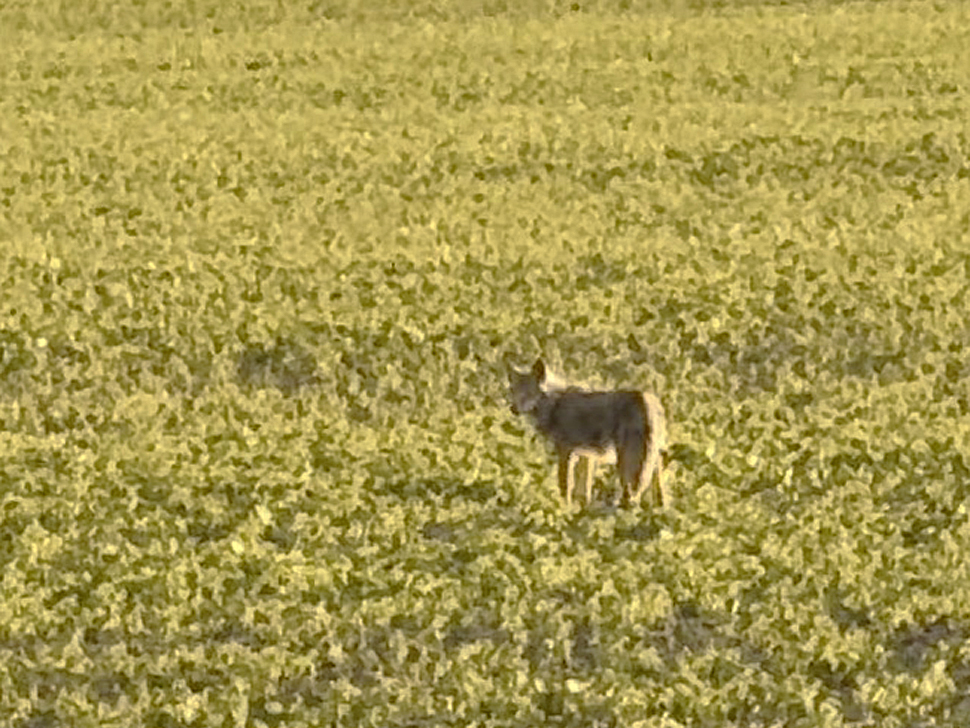
Anyone who has noticed an uptick in coyote sightings in Southern Manitoba lately is not imagining things.
Conservation officer Nick Woroniuk says the trend, which has developed over the past few years, is the result of a growing coyote population that has been venturing into communities and urban centres more regularly.
Curious at a distance, getting used to people
He says that as coyotes venture into developed areas more often, they become accustomed to seeing people, which can also encourage them to stay close.
“A coyote in an urban environment will react very differently to seeing people or activity than a coyote that lives out in the country. It gets used to seeing people, and it knows it doesn’t need to be afraid.”
A high population in Manitoba
In general, Woroniuk says the coyote population in the province has been high in recent years.
He suspects the growing numbers are tied to trends in the fur industry.
“Although I’m not a biologist, just from our observations, the fur industry in Canada, never mind Manitoba, has kind of fallen out, so there isn’t a big market for fur bearers being coyotes anymore, so we don’t have hunters, and we don’t have trappers,” he says.
Related Stories:
“We don’t have trappers taking coyotes off the landscape, so the populations are growing because of that.”
He adds that there is also abundant food for the animals in the province, which helps their numbers.
Expanding developments
Another factor in seeing more coyotes, Woroniuk says, is that land use and growing housing developments are branching out further into the region where the coyotes live.
“That’s their habitat, right? So now they’re moving closer into those more residential areas where people are going to see them more,” he says, adding that, again, the food present in areas with people is too much to resist for a highly adaptable animal that can flourish wherever sustenance and cover are available.
“Coyotes are omnivorous. They eat everything, like bird feed, dog food, garbage, (barbecued food), all of these nice smells and things that they can get their mouths on,” he says.
“Once they learn that they can get that, they have no reason to leave.”
‘It’s a very rare occurrence that coyotes will attack people’
Although coyote sightings may cause concern in the community, for Woroniuk, it is important to respect the animals and adjust to coexisting with them.
He says they do not pose too much of a risk to their human neighbours.
“It’s a very rare occurrence that coyotes will attack people. There have been occurrences in Manitoba in recent times where coyotes have nipped people, but those are very few and far between,” he says.
“Those are stemming from interactions with humans prior to that, where it’s just like a dog. If they start getting fed by people, they learn that food comes from a hand, so they will follow people looking for food.”
He reiterated that curiosity is also an important part of their behaviour.
“Just because a coyote may be following somebody doesn’t necessarily mean that it’s being aggressive. It’s just like a stray dog. A stray dog will follow you,” he says.
Tips for deterring coyotes
Although coyotes are here to stay, Woroniuk says there are strategies that can help keep them away from residential areas.
Since food and cover make the animals comfortable, the best approach is to introduce some discomfort.
“If every time we see a coyote, we run away in fear and we go and hide, those coyotes learn very quickly. It’s like, ‘Oh, I don’t need to be afraid of a two-footed person. They run away from me,'” he says.
“(However), if we are removing all the food, and when we see coyotes in those environments, in a backyard or whatever, if we go outside, we yell at them, we bang some pots and pans together, blow an air horn, a whistle, throw sticks at them, they will learn pretty quickly that this is not a good place for them.
“It’s no different than kids playing on a street, where if there’s a homeowner who goes and yells at them every time they throw a baseball into the yard, they will learn pretty quickly (not to play there).”
Rural concerns
For farmers and those who live on rural properties, Woroniuk acknowledges that while it is important to protect livestock, just because a coyote may appear does not mean it is a threat.
Nonetheless, to keep them at bay, he says the same strategy of creating discomfort works in this setting as well.
“If a coyote’s out near your yard, honk your horn at it. Drive towards it, make sure that it’s uncomfortable,” he says.
Putting chickens in the coop during the night, calving closer to home, and removing pet food from outside also help.
Since coyotes seek cover in dark, enclosed spaces like decks, Woroniuk says it is also a good idea to cover these structures.
He notes that if farmers still have concerns about losing livestock, they can apply to the Manitoba Trappers Association for a trapping program to remove trouble coyotes.
More advice: Keep the dog on a leash
The conservation officer also recommends being vigilant during late evening walks, when coyotes are more active, and keeping pets leashed during these walks.
“(That) will help as well, so the animals aren’t chasing them, and that, you know, in turn, the coyote won’t have to defend itself,” he says.
“If you yell at them or throw things at them, they’re more than likely going to turn the other way.”
‘I would just encourage people not to live in fear’
Woroniuk says spring and early summer are also busy times for wildlife, so the increase in sightings is to be expected.
“You’re going to see coyotes a lot this time of year as the young pups start to venture away from their den and there are nesting waterfowl,” he says.
“Ducklings and goslings are easy pickings for young pups, so as they learn to be adult coyotes, you’re going to see them moving around the landscape.”
He adds that while it is “inevitable that wildlife will stay in the area, finding ways to live alongside one another is best, especially because there is not much to be concerned about when it comes to how coyotes interact with humans.
Woroniuk notes that even if they seem more visible now, the canines have always been around.
“I would just encourage people not to live in fear. If you do see these animals, (make) some loud noise. We have to learn to live together with wildlife as opposed to without it, because they’re here to stay and so are we,” he says.
With files from Shannon Dueck, Candace Derksen, and Robyn Wiebe