

Listen to this article
Estimated 4 minutes
The audio version of this article is generated by AI-based technology. Mispronunciations can occur. We are working with our partners to continually review and improve the results.
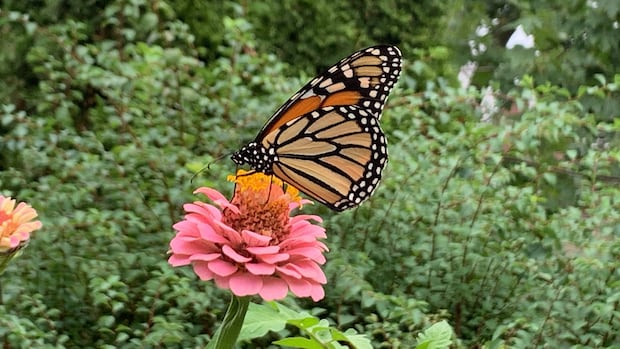
If you feel like you’ve seen more monarch butterflies in parks and neighbourhoods in southern Ontario this summer, you’re likely right.
The butterflies with their distinctive orange and black wings with white polka dots had a good winter in Mexico — World Wildlife Fund (WWF) Mexico estimated in March there was a 64 per cent increase in species population — and that has translated into more of the next generation of butterflies here.
Ryan Norris is a biology professor at the University of Guelph. He says while exact numbers aren’t known yet, things are looking good.
He says they boosted their numbers quite a bit since the journey from Mexico started. The first generation of monarchs laid eggs in the southern U.S. states of Texas and Oklahoma which had a “knock-on effect on subsequent generations until we see them up here.”
“We’re seeing third, fourth, fifth generation monarchs in Ontario” right now, he said.
The generation that will spend its fall in Canada will eventually migrate back to Mexico by November where they’ll hibernate until March before starting the 5,000 kilometre migration process all over again.
WATCH | Why scientists are gluing microchips on butterflies:
Why scientists are gluing microchips on butterflies
CBC’s Jorge Barrera went to the El Rosario butterfly sanctuary in Mexico to learn more about a project that scientists hope will unlock some mystery around the monarch butterfly’s migration.
Track migration with your smartphone
The monarchs tend to stay the winter in one of six sanctuaries in Mexico. Last winter, about 160 monarchs at those reserves were tagged with new transmitters by researchers.
The transmitter carries a solar panel the size of a grain of rice. People can download the Project Monarch app and when a butterfly with a transmitter comes in close range, a person’s phone will ping.
Eduardo Rendón Salinas, a biologist with WWF Mexico, told CBC News in March that the information will help provide the most detailed look to date at the first leg of the butterflies’ migration north.
“It is very important to do this new type of tagging in hibernation sites, to determine how they finish hibernating in Mexico,” Salinas said.
LISTEN | Have you spotted a monarch butterfly this year? :
The Morning Edition – K-W5:13Have you seen monarch butterflies in your neighbourhood?
Have you spotted a monarch butterfly this summer? If so, you’re not alone. A few of them have made their way to the surrounding area. CBC K-W’s Joe Pavia spoke with Ryan Norris, a biologist at the University of Guelph, about the monarch’s journey north from Mexico this past spring.Help document monarchs
There are a few projects dedicated to asking people to help track and document monarchs.
One of them is Mission Monarch, a Montreal-based program run by the Space for Life Insectarium. It asks people to sign up and send data including verifying a monarch, documenting where milkweed is planted and sign up to provide other observations in the city and countryside.
The program heard from 9,000 people last year who shared observations. Now in its 10th year, they hope to reach thousands more who will submit observances on their Mission Monarch platform.
They’re holding a monitoring blitz July 31 to Aug. 9 and people are asked to search for monarch butterflies and milkweed plants in their neighbourhoods.
Maxim Larrivée, director of the Insectarium, said in a release that the blitz happens in Canada, the U.S. and Mexico with a shared goal of conservation.
The blitz “has helped build a continent-wide picture of monarch breeding habitat while strengthening the connections that unite us in protecting this iconic migratory species,” Larrivée said.
In September, the Cambridge Butterfly Conservatory will hold a tagging weekend aimed at helping to educate people about monarch butterflies and release the ones that will travel to Mexico.
‘An amazing phenomenon’
The population of monarch butterflies has declined over the last 16 years and in December 2023, they were listed by the federal government as being an endangered species.
Norris is very excited to eventually see the findings from the blitz tracking apps about the migration of the monarch.
“It’s kind of an amazing phenomenon. That’s why we don’t want to lose it,” said Norris.
“The monarch numbers look good right now, but we have no doubt they’re lower than average historically … way below the ceiling that as biologists we feel comfortable with.”