
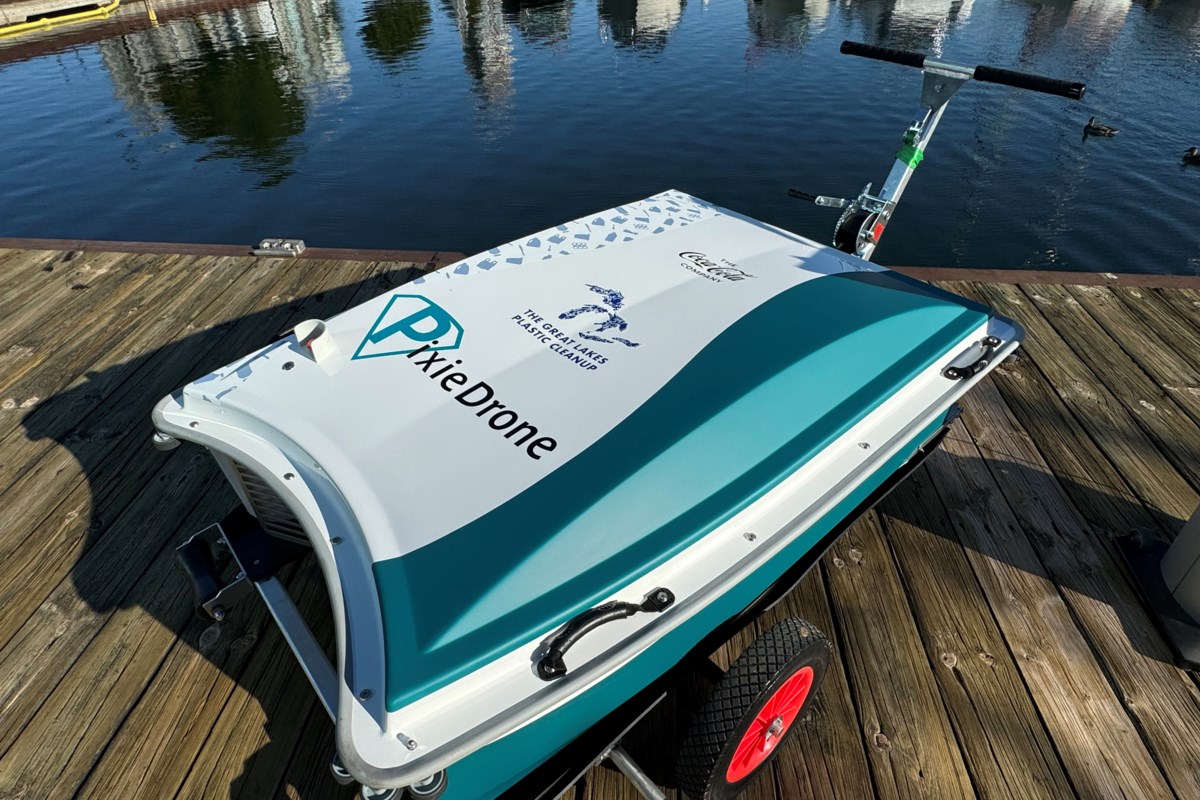
‘Here in Simcoe County, we are lucky to have the use of a Pixie Drone, which is part of the Great Lakes Plastic Cleanup,’ says letter writer
OrilliaMatters welcomes letters to the editor at [email protected] or via the website. Please include your full name, daytime phone number and address (for verification of authorship, not publication).
July is officially known as Plastic Free Month. This worldwide movement, which began in 2011, is a dedicated to raising awareness about the detrimental impacts of too much plastic in our environment.
The original movement, which started in Australia, challenged millions of people across 193 countries to make a concerted effort to start taking daily actions to reduce plastic waste. And, most importantly, to stop littering and to keep plastic debris out of our precious oceans and landfill sites.
Today, many scientists from around the world agree that plastic pollution is a planetary crisis that threatens ecosystems and human health. David Suzuki views plastic pollution as one of the most severe environmental and health threats facing the planet.
Plastics may take up to a 500 years to decompose into nanoplastics and microplastics, for example. Fishing lines may take 600 years to decompose, according to Infographic.
These microplastics are now found everywhere on Earth, from the highest mountain to the deepest trenches in the oceans. Sadly, marine animals are dying from restricted mobility, starvation or suffocation when they mistake plastic for food
Unfortunately, as our climate crisis worsens, extreme weather events such as forest fires break down plastic at a much faster rate, spreading plastic particles into our food chain, according to National Geographic.
Unbelievably, a Consumer Reports chemicals food study in 2024 showed microplastics have been found in more than 1,300 species of plants including veggies we eat every day — like carrots, radishes, lettuce, onions, tomatoes, wheat, barley and apples, contributing to the disruption of our food webs.
And, unfortunately, minute plastic particles have been detected in the brain tissue, lungs, blood and arteries in the human body, according to Beyond Plastics in February 2025. But, scientists cannot pinpoint the exact level of danger posed to human health. This continues to be an evolving field of study.
More than 500 million tons of plastics are produced every year. And, it turns out less than 10 per cent are recycled, says the Organisation for Economic Co-operation and Development (OECD).
Some easy, daily habits you can adopt to help reduce plastic waste are to forget about grabbing a plastic bottle of water, but instead use a reusable bottle. Plastic water bottles are a major source of nanoplastics and microplastics found in our bodies, says the National Institute of Health.
Most people, I believe, when shopping now automatically bring their own cloth bags. As well, buying in bulk will reduce the number of plastic containers and avoid pre-packaged produce.
Suzuki points out 99 per cent of plastics are derived from fossil fuels like oil and gas. Consequently, plastic is connected to the climate crisis because making plastic creates high levels of carbon dioxide emission.
Humans are responsible for the plastic debris littering most of the world, but luckily humans are also responsible for making a concerted effort to reduce the plastics found in our oceans and elsewhere. Today, hundreds of nonprofits, businesses and global agencies are actively working to reduce plastic pollution in our oceans using a great variety of approaches.
One of the most aggressive and effective cleanup systems is the nonprofit Ocean Plastic Cleanup. It employs a massive U-shaped barrier to pick up plastic debris choking the oceans in what’s known as the ‘Great Pacific Garbage Patch’.
This nonprofit also uses solar-powered interceptor vessels to catch the plastic debris in rivers that are heavily polluted before it even reaches the ocean. The goal for Ocean Plastic Cleanup is to make the oceans plastic-free by 2040. What a laudable goal!
Here in Simcoe County, we are lucky to have the use of a Pixie Drone, which is part of the Great Lakes Plastic Cleanup. It’s an autonomous, aquatic robot which skims the surface of Lake Simcoe and collects debris, plastics, and even oils to prevent the pollution from reaching the Atlantic Ocean.
It is hard to believe a plastic bag carelessly left floating after a picnic at Centennial Beach could cause an agonizing death of an Atlantic bottlenose dolphin 50 years from today!
So, next time you go for a hike and see plastic scattered on the ground, you can get extra exercise by picking it up and know in your heart you might just have prevented the death of a seabird, a dolphin, or a sea turtle.
Gwen Petreman
Barrie