

Listen to this article
Estimated 5 minutes
The audio version of this article is generated by AI-based technology. Mispronunciations can occur. We are working with our partners to continually review and improve the results.
In a spare room in his Ottawa home, Kevin Bosch keeps boxes upon boxes of Lego sorted by body type, clothing colour and hair. “It kind of looks like a rainbow,” he says.
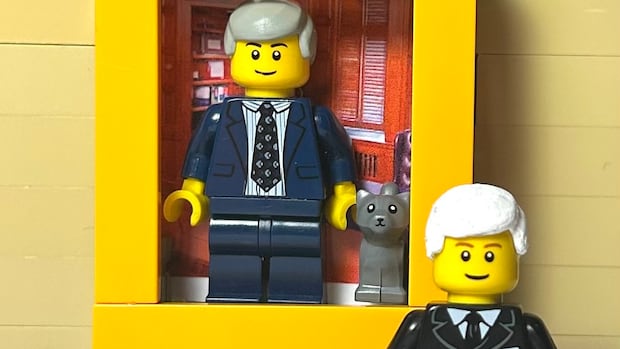
That room is where he assembles the tiny political vignettes he posts online under the name ‘PoliLego’: major news moments recreated with the plastic minifigures, printed photo backgrounds and, when needed, and sometimes a little paint job on the pop-on Lego hair.
Recent PoliLego scenes depict astronaut Jeremy Hansen, the first Canadian to go to the moon, and Maggie Helwig, Toronto author who won the Shaughnessy Cohen Prize.
Some posts do better than others, Bosch says. For example, his post showing Queen Elizabeth II walking toward the pearly gates — “you can see her handbag, her crown” — received more than 1,500 likes. A more recent Stephen Harper post, depicting the unveiling of his official portrait in Parliament, received about 700.
Bosch did not set out to become Ottawa’s Lego chronicler of political life. Growing up in Calgary, he liked Lego “as much as the next kid,” he says, but never imagined he’d have a dedicated Lego room one day. His real love for Lego came from his children — in particular, his son Ben, who was building complex sets before he could even read.
Around that time, Bosch was working on Parliament Hill for the Liberals, when Justin Trudeau was opposition leader. One of Bosch’s earliest political Lego scenes depicted Trudeau’s charity boxing match against Conservative senator Patrick Brazeau in 2012. Bosch gave the figurine to Trudeau, who displayed it in his office. When Trudeau became prime minister in 2015, Bosch says, he brought the piece with him. “I thought that was quite sweet,” Bosch says.
During the 2015 Canadian federal election, Stephen Harper’s haircut became the subject of online memes. “He had this helmet hair, like a traditional Lego minifigure,” Bosch says. For a political staffer with a house full of his children’s Lego, the memes sparked Bosch’s imagination.
In 2016, Bosch reserved the ‘PoliLego’ handle on Twitter, now X. He began posting regularly, and to date, he’s made around 800 posts, with accounts across Instagram, TikTok and Bluesky.
After 19 years on the hill with the Liberals, Bosch still works in politics; in 2021, he was listed as one of the Top 100 lobbyists in Canada by the Hill Times. Today, he’s the co-founder and managing partner of government relations firm, Sandstone Group. “I love politics,” he says. “With my job, you’re obviously following the news very closely, and you get to know a lot of the politicians on all sides.”
Bosch does not shy away from political commentary. In one scene, a grimacing Donald Trump holds up a ‘51’ sign, a reference to Trump’s repeated comments about Canada becoming the 51st state. Usually, his commentary amounts to what he calls a “gentle ribbing” but says that “Donald Trump might get it worse than most.”
Everything that Bosch posts on PoliLego is physically assembled, he says — there’s no AI or image editing. He prints photo backgrounds on paper, then builds the Lego scenes in front of them. The toy company’s growing diversity of figures has made the work easier, he says — but still, the resemblance doesn’t have to be perfect.
“They don’t even have noses, for God’s sake,” Bosch says of Lego. “I just have to be approximate, and people are like, ‘Oh yeah, it looks exactly like that person.’”
Bosch says people are “generally happy to be immortalized as three centimetres tall.” He’ll sometimes give a Lego scene to the person being depicted, especially if they ask — although he jokes he cannot give away too much Lego, otherwise “I don’t have it to work with anymore.”
Bosch’s 800 vignettes have not gone unnoticed. The organizers of Politics and the Pen — an annual fundraiser and political writing award — give him the winner’s name a few hours in advance, so he can post their Lego counterpart once the announcement is public.
“I’m well aware I’m playing with dolls,” Bosch jokes — but in a political world that can often feel hostile, he hopes that PoliLego can bring some fun and whimsy. “There’s a lot of seriousness in the world, there’s a lot of trouble,” he says. “Here’s something where we can all just have a laugh.”