
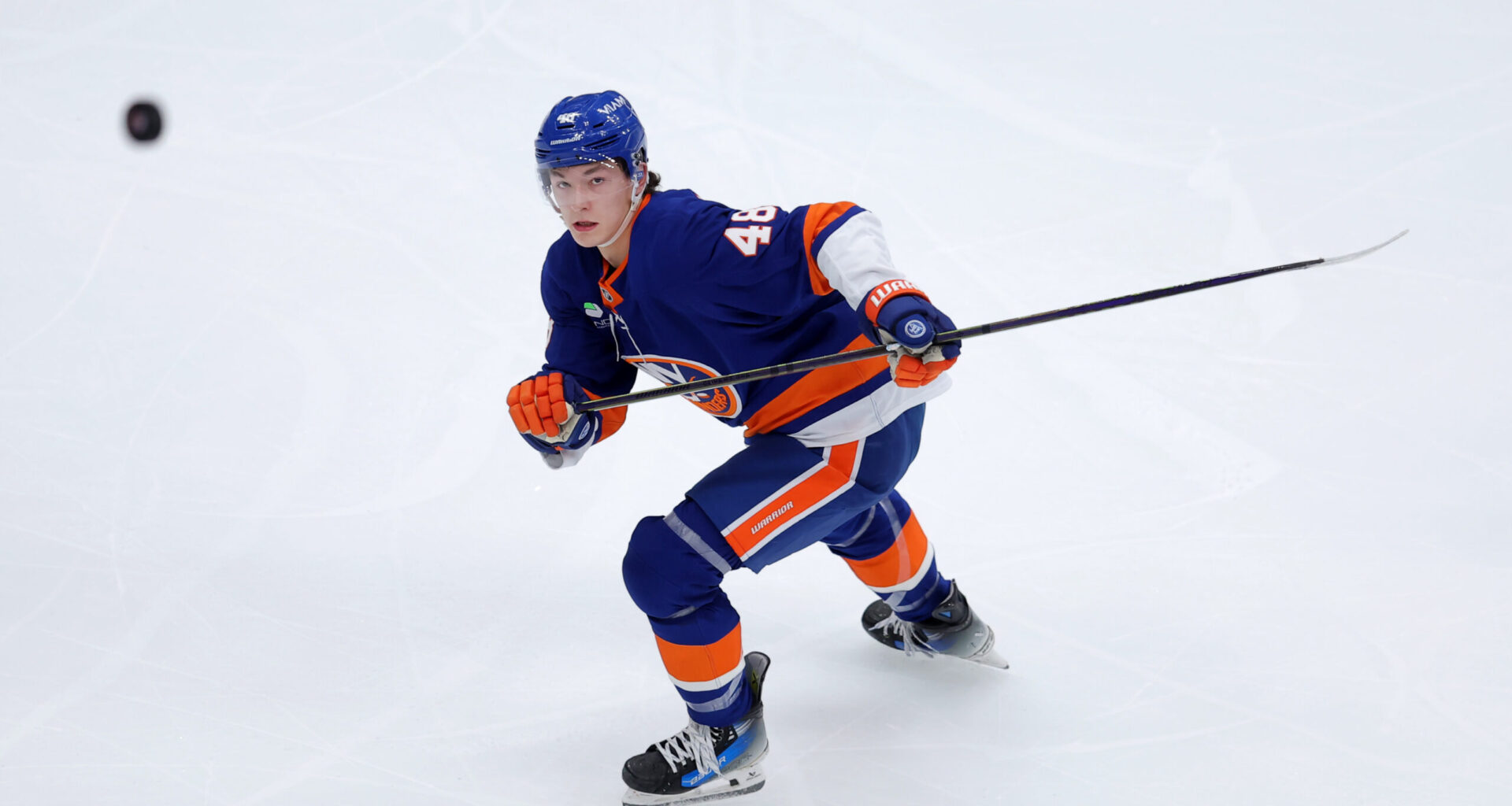
Hey all, Alex here covering for Puneet today. I thought I would use this opportunity for an exercise in how we look at a player’s stats. When looking at a player and their stats, we come in with the pre-conceived notion that the player is good/bad, lucky/unlucky, and when looking at the numbers those tend to tell us exactly what we want to see. Today, I’m going to run through the numbers on three players, showing you how I can make the numbers look good or bad depending which way your pre-conceived notions point you. Then we’ll try it without the name of Mystery Player D.
I put it out to my BlueSky followers and a few league-mates asking for some players to use as examples. First up, Matthew Schaefer:
Here’s the positive spin on Schaefer’s numbers…
Schaefer started his career with a bang, putting up 59 points while playing all 82 games, registering 23 goals, 222 SOG, and some other reasonable peripherals en route to the Calder Trophy. He also posted 18 PPPs despite the Isles boasting the third-worst power play conversion rate in the league. His scoring and shot rate remained generally consistent throughout each quarter of the season too, which bodes well for him maintaining or improving on those numbers in future seasons.
Schaefer’s team shooting percentage at even strength was a little under 10%, which means there is some room for improvement as the team around his rebounds from a bit of bad luck last season. His IPP and secondary assist percentage are fairly close to those of other top-scoring defencemen, and both show that he should be considered in that category, and that he didn’t run into too much luck. Schaefer’s deployment also shows that he wasn’t sheltered, with only 53% of his zone starts in the offensive end, and having faced the second-highest quality of competition of all the Isles’ blueliners.
With the rookie 60-point season complete, it should be viewed as a stepping stone to an even more productive season in 2026-27.
Now for the negative spin on Schaefer’s numbers…
Matthew Schaefer is coming off an extraordinary rookie season, and is at risk of a sophomore slump derailing his fantasy value this coming year. After he was eased in with lower minutes in Q1 and Q2, Schaefer’s minutes increased in the second half, and so too did the quality of competition that he was facing. In the second half, Schaefer had fewer shots despite a solid jump in time on ice, and his power play numbers dropped drastically from 13 to five.
The power play drop is especially concerning, as the Isles’ power play was one of the worst in the league last season, does not look to have much external help this coming season, and saw Schaefer already contributing a larger than expected share of points there due to his PPIPP of 63% (Evan Bouchard, Lane Hutson, and Miro Heiskanen are all 53% or lower in PPIPP).
Schaefer’s shooting percentage was also a little high, at over 10%, which was the third-highest of the top-10 defencemen in goals last year. To add a possible decline in goals on top of heavier responsibilities, a possible decline in power play production, and with a team in front of him that got worse on paper, the sophomore slump hitting Schaefer shouldn’t come as a surprise to anyone.
Conclusion:
Convinced either way yet? That’s the idea of this, is to show that the numbers can try and prove a point in either direction depending on how you spin them. My overall thought is that Schaefer is talented enough that some of the higher percentages may just stay high, and that the extra responsibilities and minutes won’t phase him. The extra attention with the lack of a supporting cast may be tougher to overcome though, so improvement on the 59-point season may be difficult. A repeat in the same range for next year seems likely though.
Let’s try another one, with Tomas Hertl:
Here’s the positive spin on Hertl’s numbers…
Hertl has been a safe fantasy player over the last decade, pacing between 58 and 79 points, and doing so despite a large variance in roles, linemates, and some fluctuating luck metrics. He has been very consistent with a shot rate that always puts him above 200 for a full season, and solid power play contributions for the last half-decade as well.
Working in his favour next year is that Pavel Dorofeyev, who soaked up a point on 63% of the PP scoring that he was on the ice for, is now in New York, making Hertl a lock for the top PP alongside Jack Eichel, Mitch Marner, and Mark Stone. Hertl could see his PP scoring jump as a result. Hertl’s most common linemate last year was also Dorofeyev, but when they were apart in Q3, Hertl scored 24 points in 23 games.
Hertl’s even strength numbers then become the point of focus, and on those his 5on5 team shooting percentage of only 8.7% shows that he was unlucky and should be due a few more bounces next season. With that coinciding with a likely uptick in his own shooting percentage after a down year (two percent below his career average and six percent lower than the previous season), Hertl is due for an uptick in scoring across the board.
Now for the negative spin on Hertl’s numbers…
Hertl turns 33 before Christmas, and has put up his two worst seasons of the last decade in the past three years. He did so despite a career high in power play ice time and power play scoring, on a unit that just lost the player who scored the most power play goals.
Hertl’s underlying numbers do look like they might be due for some positive regression, but really they are in line with most of his career averages, where his shooting percentage is 11% and his team 5on5 shooting percentage is around nine percent – which is low, but it’s in the same range as it has been the last seven seasons.
Hertl’s ice time also dropped every quarter last season, culminating in only four points in his 19 Q4 games despite centering Marner and Dorofeyev. His offensive zone start percentage, PPIPP, and secondary assist percentages are also more likely to shift down rather than up, indicating Hertl may be due for a regression in scoring across the board.
Conclusion:
This one was easier to write the negative for, but there are some very intriguing positive aspects to Hertl’s game, and with the new coach there is a lot more up in the air. He has generally been pretty safe in the 60- to 65-point range, but I would say it’s more likely this year that we see him below 55 points than it is that we see him above 65. Those higher scoring days are likely behind him.
Now for our third player, here’s Travis Konecny:
Here’s the positive spin on Konecny’s numbers…
The past four seasons where Konecny has been treated like a top-line winger, he has scored like one, with point paces ranging from 72-82. Konecny’s IPPs ranging from 70% to 85% are elite, and show that he is carrying his line (in case you couldn’t tell by his linemates on paper or their point totals in recent years).
Philadelphia is also making an effort to get a top-line center to pair with Konecny, as evidenced by the Leo Carlsson offersheet, and hopefully that will come this season. If not, then at least the top-line magic from Konecny, Trevor Zegras, and Christian Dvorak could be a plan B, as that line saw Konecny put up 41 points in 39 games. Konecny also kept his scoring up despite a team power play that was last in the league, and on top of that crossed the 100-Hit threshold for the first time in his career.
Now for the negative spin on Konecny’s numbers…
Konecny on his own has been consistent, but he has been playing a ton of minutes and carrying lackluster centers. Now, as Philadelphia has more options at wing, and still doesn’t have a top-flight center, Konecny could see his involvement decrease a little, as the team doesn’t need him to carry as much of the load. If he loses his ice time, then the scoring might start to decline with it.
With the young wingers taking a step forward in Philly, Konecny has been tasked with more defensive responsibilities, which happened to be covered last year by a career-high team-shooting percentage. That is bound to come crashing back down, and could take up to 7-10% of Konecny’s scoring output off of his total. It’s tough for him having to be the top offensive player with so little support.
Conclusion:
A lot for Konecny depends on how the rest of the lineup is deployed, and whether a top center is acquired. If it’s Zegras and that meshes well, then 80-points is very doable. However, if Zegras struggles at all in the middle, and Konecny is demphasized on offence a bit thanks to the emergence of players like Denver Barkey, Porter Martone, and Matvei Michkov, then he could drop under a 70-point pace for the first time since 2021-22. The possibilities with Konecny are wide open, but at least he has the peripherals going for him, and Philly’s PP can’t be this bad two years in a row, can it?
Let’s try this with a Mystery Player D now, and see how it feels without some of the name biases:
Here’s the positive spin on Mystery Player D’s numbers…
After posting point totals ranging from 45 to 76 since 2016-2017, this player ran into injury troubles last season and dropped below that threshold. Now back to full health, a return to the 70- to 80-point pace that he put up the two previous seasons would be expected.
Last year, on top of trying to play through an injury, he shot a miniscule 2.0%, meaning that he’s due for a solid uptick in scoring, to go with a rebound in ice time and secondary assists, which were both low marks for him over the last couple of years. Package all of that together and he might be one of the better buy-low options available this summer.
Now for the negative spin on Mystery Player D’s numbers…
It’s not hard to find the negatives in a 17-point season for a player who saw his ice-time cut by four minutes, his shot rate drop by a third, all while his scoring numbers cratered. Could they be a sign of things to come more so than just a player trying to play through an injury, sure, but do you want to be the manager holding him this fall when we find out?
Despite the massive drop in scoring, this player’s PPIPP was actually inflated, to the point that the six PPPs should have actually been three or four, and with a moderately inflated even strength team shooting percentage on top of that, the decline in scoring is worrisome as it might have been even worse if it wasn’t for the good luck.
Oh, and on top of all of that, he was knocked off the top power play, and then a replacement was brought in this summer to specifically fill that role, so those are points that he’s unlikely to get back.
Conclusion on this one?
Well first off, I didn’t tell you his age or his position, which would be important pieces of the puzzle. He’s a defenceman who turns 36 in December. What can we learn from that one? Well first off, he’s a star player, and sometimes those players hang on a little longer than others, but on the flip side once the age-related decline hits it can hit hard. It’s tough to know whether Victor Hedman‘s season was derailed by the combination of injuries and mental health struggles, or whether those masked a decline that was coming anyways. Hedman is going to be one of the toughest players to project for drafts this summer, and if anyone tells you they know for sure how it will play out, well they’re just making things up. I will say that Hedman is unlikely to be on my teams this year, as I would prefer to take my swings elsewhere.
*
See you on Wednesday. In the meantime, if you have any fantasy hockey questions or comments you can find me on BlueSky @alexdmaclean.