
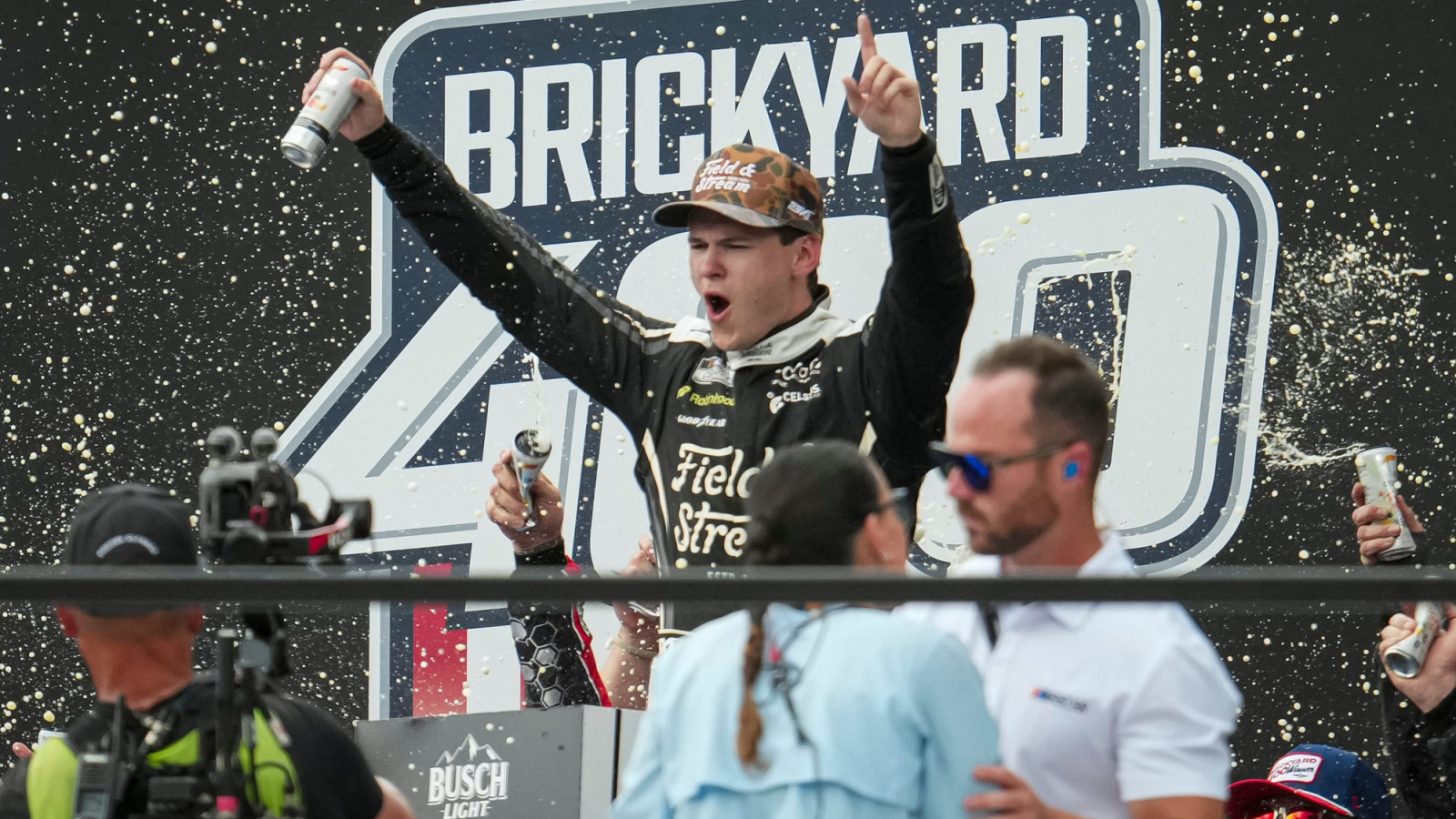
There’s no way to pretend that Sunday’s Brickyard 400 was a particularly enthralling race, because it wasn’t.
There were no passes for the lead aside from those that took place as a result of pit stops, and passing for position was incredibly difficult thanks to dirty air, which made for an anti-climactic finish despite both Christopher Bell and Joey Logano being within striking distance of Corey Heim in the closing laps.
Indianapolis has never put on barn burners since it became a staple of the NASCAR calendar in 1994. It’s a one-groove track that wasn’t built with heavy stock cars in mind, especially not NASCAR’s current car that needs multi-groove tracks to provide a good racing product.
It’s also not the track’s fault that NASCAR’s current car races the way it does. The racing has never been fantastic on a consistent basis at Indy, but it’s never been as bad as it’s been over the last three years since NASCAR returned to racing on the IMS oval.
Some fans want Sunday’s Brickyard 400 to be the last. That’s an understandable perspective from a fan base that dedicated three hours of their Sunday afternoon to watching what was more of a 190-mph parade instead of a race.
But NASCAR deciding to once again take the Brickyard 400 off the schedule would be a rash, reactionary solution to the wrong problem.
NASCAR should say, ‘It’s not you, it’s me’ when thinking about how to better Indy
To fix the Brickyard 400, NASCAR must first fix the race car, because everyone knows the racetrack isn’t changing. The industry and fans alike also need to temper expectations for what racing at Indianapolis with stock cars looks like: it will never be as good as Darlington, Kansas or Homestead. But it should be better than it was on Sunday.
With that said, even if the racing product isn’t good at Indianapolis, there’s a reason why NASCAR races there: it’s the Mecca of motorsports; the most iconic racetrack in the world. Drivers dream of turning a single lap at Indy, much less winning there, and fans dream of walking through Gasoline Alley and letting themselves be enamored with the majesty of the venue.
And no, the crowds aren’t what they once were at Indianapolis. Two hundred and fifty thousand people used to attend the Brickyard 400 in its heyday as NASCAR’s popularity combined with the allure of Indianapolis made the race one of the hottest sporting events in the world.
Years of poor racing and the sport’s general decline in popularity have significantly whittled down the crowd. There was an estimated 70,000 in attendance at Indianapolis on Sunday, a figure one-fifth the size of the 350,000 that routinely pack The Speedway for the Indianapolis 500 every Memorial Day weekend.
The crowds certainly aren’t as big as they once were, but neither is NASCAR. The racing isn’t what it once was; then again, it looks different at nearly every track on the circuit nowadays.
But what endures at Indy is the history and the tradition that brought NASCAR back to the oval in 2024 after three years of racing on the road course. Is the Brickyard 400 a great show? Not necessarily. But it could be better if NASCAR changes its car or begins work on its next one, and the prestige of Indianapolis should be enough to keep the Brickyard 400 on the schedule even if the racing product doesn’t improve.