
 Urban Cartoon Syndicate UCS #103, the Vancouver Villages Plan
(To be updated. This version July 27, 2026, 7 pm)
Many Vancouver residents have wondered about the origins of the Villages plan since the concept emerged through the Vancouver Plan process. The City’s position is that Villages grew out of that city-wide planning process and public engagement.
But amid Mayor Ken Sim’s recent controversy over alleged “foreign interference” at the Villages public hearing, it is worth looking more closely at another kind of cross-border influence: the movement of planning ideas, policies and personnel between the United States and Vancouver.
There is an interesting and largely overlooked California connection.
One of the key senior officials responsible for Vancouver’s Villages program, Director of Community Planning Neil Hrushowy, came to Vancouver City Hall after a lengthy career with the San Francisco Planning Department. Public records from San Francisco identify Hrushowy as Manager of its City Design Group, part of the department’s city-wide planning operation. Vancouver records show him serving as Assistant Director of Community Planning by 2021 and later as Director of Community Planning. (San Francisco Planning, Department, Citywide Planning Division. Five-Year Work Program. Hearing Date November 3, 2016. Link.)
That history does not by itself prove that Vancouver’s Villages plan was completely copied from San Francisco. But it raises legitimate questions about the policy lineage of a program that is about to transform zoning and public decision-making across a substantial part of Vancouver.
Who and what is behind the Villages program?
The Villages concept was incorporated into the Vancouver Plan adopted in July 2022. The Vancouver Plan identified 25 Villages around smaller commercial and community nodes surrounded mainly by lower-density housing.
In October 2024, Council approved a staff report titled “Villages Planning Program – Scope of Work.” Neil Hrushowy was the staff contact on the report. It established an 18-month planning process covering 17 of the 25 Villages.
The report is unusually revealing about what the City intended to accomplish.
It says the program would facilitate land-use and zoning changes to increase housing and expand local commercial areas; apply a “consistent planning approach across all Villages”; and use standard zoning district schedules where possible. It also notes an earlier Council direction to explore “pre-zoning” Villages through city-initiated zoning changes.
The geographic model is equally clear. The Vancouver Plan generally defines Villages as areas within a 400-metre walk or roll of existing smaller commercial areas. The plan calls for housing ranging from detached houses and multiplexes to townhouses and buildings of up to six storeys, together with expanded shopping areas and public spaces.
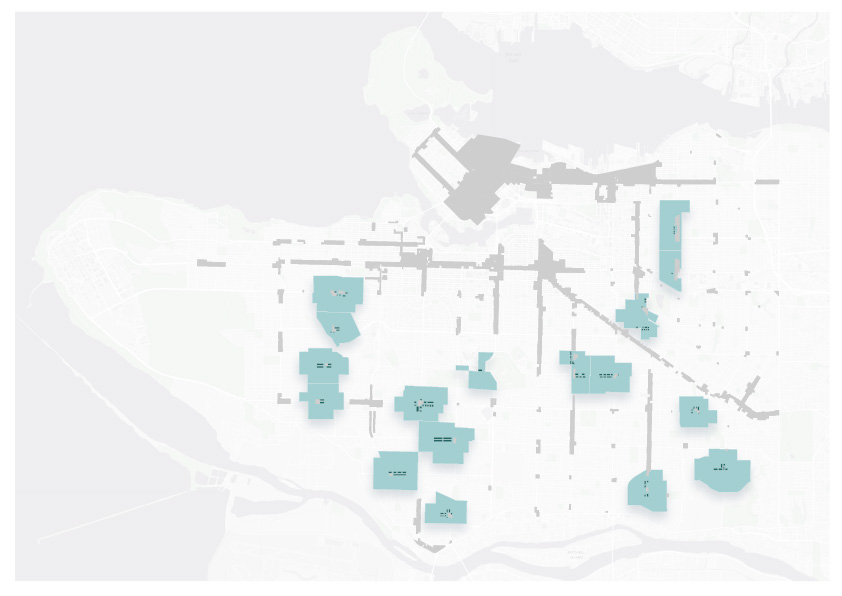 Above: The Villages Plan would upzone 13,260 land parcels, or 14% of all in Vancouver. Many of the tens of thousands of residents in these areas reported that they had not heard a thing about the plan until just a week before the Public Hearing, when a notice postcard arrived in the mail.
The City describes the objective as creating “complete, walkable neighbourhoods” with more housing, shops and services.
Critics see another side: a move away from site-by-site discretionary rezoning toward standardized zoning established in advance across large areas of the city.
That distinction matters because once land is already zoned for a proposed form of development, the traditional rezoning process—and the public hearing associated with it—may disappear.
The California connection
Hrushowy spent years in San Francisco’s planning system before coming to Vancouver. San Francisco Planning documents identify him as Manager of the City Design Group, responsible for work involving public-space and urban-design initiatives. Earlier records also list him as an urban designer on San Francisco area-planning projects. (San Francisco Planning, Department, Citywide Planning Division. Five-Year Work Program. Hearing Date November 3, 2016. Link.)
His tenure there also coincided with a major transformation in California housing policy.
California increasingly moved toward state intervention in municipal land-use decisions, greater use of ministerial or “by-right” approvals, increased housing capacity and restrictions on some forms of local discretionary review. These policies became closely associated with the state’s increasingly influential YIMBY movement.
It would be too simplistic to conclude that Hrushowy personally brought those policies to Vancouver. There is no evidence presented here establishing such a direct causal chain.
But there is a legitimate institutional connection worth examining: a senior planner who worked within San Francisco’s evolving planning system subsequently assumed a central role in Vancouver as this city moved toward standardized zoning, pre-zoning and reduced reliance on individual rezoning processes.
That is considerably more significant than simply noting where someone previously worked.
From the Vancouver Plan to mass pre-zoning
Hrushowy has been involved in several major Vancouver planning files.
In 2022, he was the staff contact for the Rupert and Renfrew Station Area Planning – Terms of Reference and Interim Rezoning Policies report. (Rupert and Renfrew Station Area Planning)
By 2024, he was the staff contact for the Villages scope-of-work report and for the City’s work on the Vancouver Official Development Plan.
The October 2024 Villages report explicitly links the program to Vancouver Plan implementation and to Council’s direction to examine pre-zoning through city-initiated zoning changes. It also says the eventual Villages land-use policy would be incorporated into the Vancouver ODP, subject to Council approval.
This makes the Villages program more than another neighbourhood plan.
Instead of processing hundreds or thousands of future development proposals through individual rezonings, Council is being asked to establish much of the zoning framework in one sweeping action.
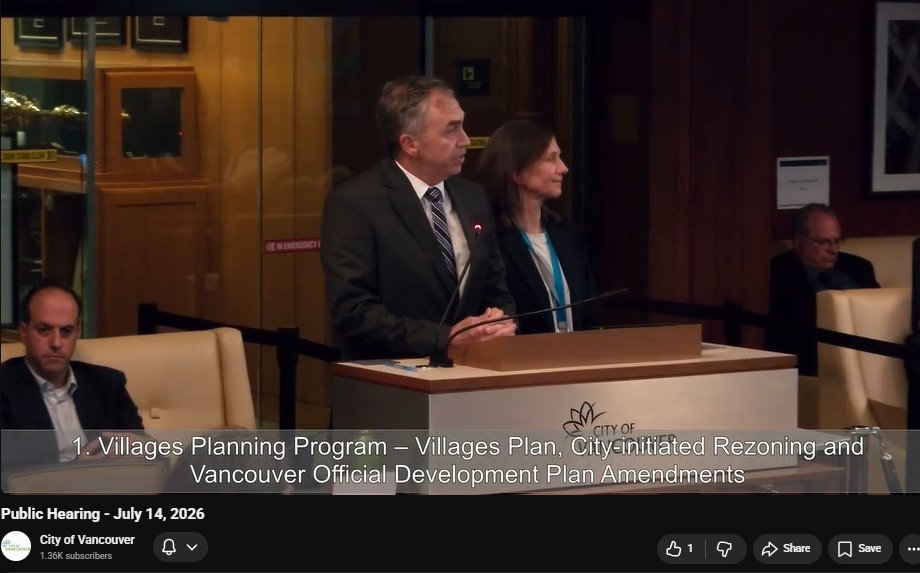 Above: Neil Hrushowy presenting the Villages Plan to Vancouver City Council in his opening presentation on the first night of the public hearing, on July 14, 2026. Seated at left is chief planner Josh White. He will likely be the one making the closing presentation on July 28 and responding to Council questions.
The current public hearing began July 14 and continued July 20 and 22. The City records 343 registered speakers, after which Council closed the speakers list and referred debate and decision to its July 28 meeting. (Public Hearing page)
That July 28 vote therefore has consequences extending far beyond the development applications immediately before Council.
What can—and cannot—be said about the U.S. connection
There are obvious similarities between contemporary planning reforms in California and those now being implemented in Vancouver and British Columbia:
Pre-zoning
Standardized zoning rules
Increased allowable density
Planning around walkable or transit-accessible nodes
Greater reliance on as-of-right development
Reduced dependence on individual public hearings
Hrushowy’s previous employment in San Francisco does not prove that Vancouver’s Villages program was devised there.
What the public record does establish is that Vancouver has recruited senior planning expertise from a jurisdiction that has been at the centre of the North American battle over zoning deregulation and housing approvals. Vancouver has subsequently adopted several of the same broad planning mechanisms. Hrushowy has occupied a senior role in developing and implementing Vancouver’s version of that shift.
That is a reasonable subject for public scrutiny.
The relevant question is not whether there was a secret meeting at which someone decided to “import the California model.” Institutions rarely work that way.
The better question is: How do planning ideas migrate between jurisdictions, and how much influence do the professional backgrounds and policy assumptions of senior officials have on the choices presented to elected councils?
Provincial legislation accelerated the shift
Vancouver’s transformation has also occurred within a much larger provincial restructuring of land-use regulation.
In 2023, the B.C. government enacted Bill 44, the Housing Statutes (Residential Development) Amendment Act, 2023, and Bill 47, the Housing Statutes (Transit-Oriented Areas) Amendment Act, 2023. These measures imposed major new provincial requirements concerning housing capacity and transit-oriented development on local governments. (BC Laws)
The parallels with California are worthy of more analysis and investigation.
For example, then-B.C. housing minister Ravi Kahlon publicly posted in August 2023 about a discussion with California State Senator Scott Wiener concerning housing and homelessness. Wiener has been a prominent advocate of California state legislation overriding some municipal restrictions on housing.
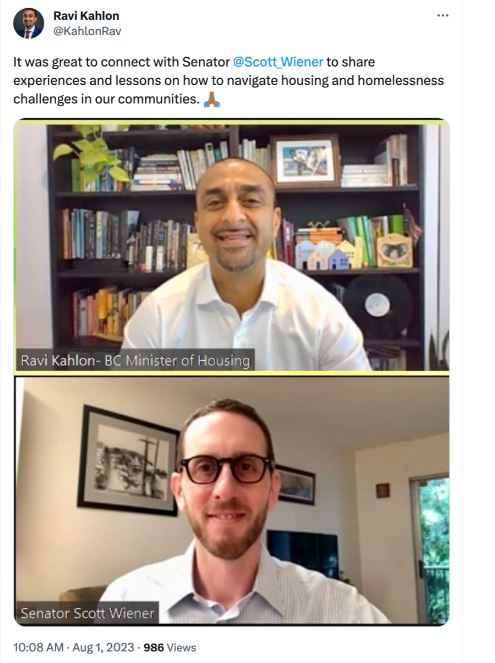
That contact is relevant context.
The provincial government was plainly looking outside its borders at housing-policy experiences while undertaking a major transformation of the provincial-municipal relationship.
The irony of “foreign influence”
This brings us back to the extraordinary controversy at the July public hearing.
Mayor Sim objected after it emerged that some speakers were participating from California and characterized the matter as “foreign interference.”
There is an obvious distinction between callers participating in a Vancouver public hearing and the much broader international circulation of planning ideas, advocacy strategies and legislation.
Canada’s new Foreign Influence Transparency and Accountability Act is scheduled to come into force on August 4, 2026. Nothing presented in this article suggests that the professional and policy relationships described here constitute “foreign influence” within the legal meaning of that Act. (Government of Canada)
But in the ordinary—not legal—meaning of influence, Vancouver housing policy plainly does not develop in isolation.
Ideas crossed the border from the United States into Canada. Upon the invitation of the Urban Development Institute (UDI) in 2016, the U.S.-based YIMBY advocacy movement and Abundance movement crossed the border into Canada. It is common for ideas and movements to cross borders, as well as consultants, academics and planners. Governments examine what other governments are doing and adapt those ideas to their own circumstances.
That is normal. But in the case of B.C.’s provincial housing legislation changes from 2022 to 2024, and their roll-out to Vancouver and other municipalities across the province, it is clear that there was a major flow from the United States into Canada. That massive flow was not made transparent to the public. In the case of the Villages Plan, not the least mention of the U.S. origins has been made publicly.
What matters is transparency about where major policy ideas come from, whose interests they serve, what assumptions they embody, and whether alternatives receive serious consideration. Such ideas deserve open public discourse and debate before they are enshrined in policy and in legislation. That due process did not happen.
The question Council should be asking
The Villages program covers 17 areas and proposes a consistent zoning framework across a large number of Vancouver properties. The City itself describes the project as an implementation mechanism for the Vancouver Plan, centred on standardized zoning and pre-zoning.
That makes the origins and assumptions of the model legitimate subjects for scrutiny.
The evidence does not justify saying that Neil Hrushowy secretly imported Vancouver’s Villages plan wholesale from San Francisco.
It does justify asking why Vancouver has moved toward a planning model with recognizable similarities to reforms pursued in California; how those ideas entered the City’s professional and political culture; and whether Council and the public have adequately debated the consequences.
The deepest irony of the current “foreign interference” controversy may therefore be this:
While City Hall focuses attention on a relatively small number of speakers calling into a public hearing from California, much larger questions about cross-border policy influence are hiding in plain sight.
In that sense, Sim’s claims of foreign influence appear to be a huge distraction.
On July 28, Council will not merely be voting on another set of rezonings.
It will be deciding how much of Vancouver’s future land-use decision-making should be settled in advance—and how much should remain open to neighbourhood-level public scrutiny, especially since many residents of Vancouver feel they were not adequately consulted or notified about the Villages planning process.
This article is part of our #Endgame2026 series

More reading
Vancouver’s Villages Plan: Born in the U.S.A. (Council decision July 28) – Endgame 2026 – https://cityhallwatch.wordpress.com/2026/07/13/vancouvers-villages-plan-born-in-the-u-s-a/
ENDGAME 2026: 3D Chess at City Hall — The Mass Upzoning, the Distraction, and the Final Board – https://cityhallwatch.wordpress.com/2026/07/26/endgame-2026-3d-chess-city-hall-mass-upzoning-foreign-distraction-final-plays/