
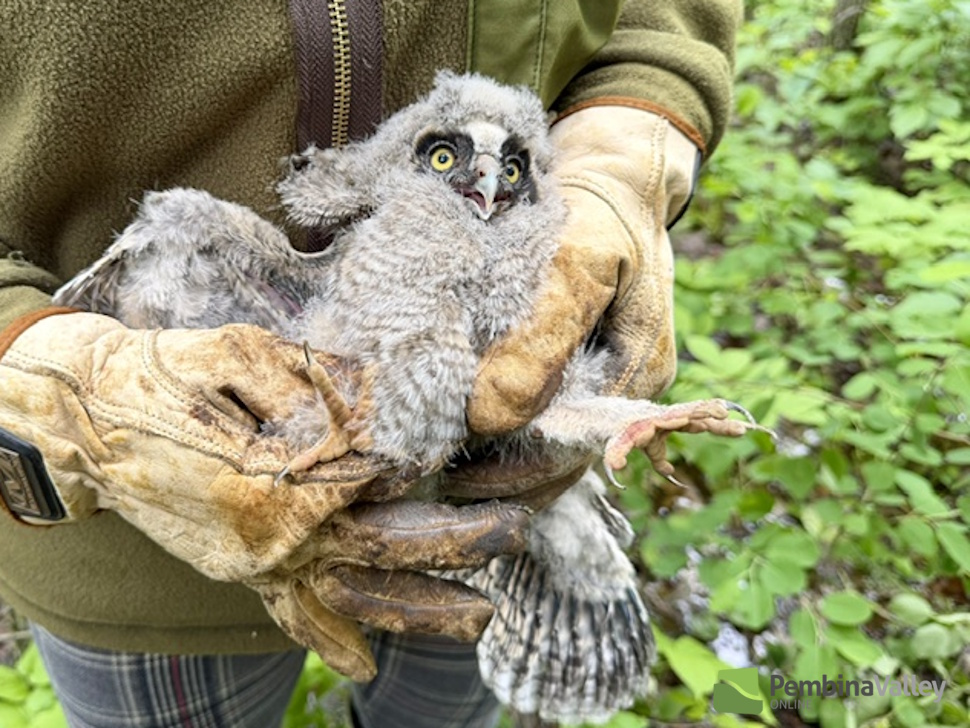
Earlier this month, through a story of rescue and survival in Morden, the community caught a glimpse of a bird that is difficult to spot most of the time: the long-eared owl.
Thanks to a family in Morden, an orphaned long-eared owlet is now building its strength at Wildlife Haven Rehabilitation Centre before it will be reintroduced into the wild.
The centre said that when the time comes, it will enlist the help of Jim Duncan — a retired biologist whose life’s work has focused on owls — to decide where to release the animal and perhaps even tag it.
A few similar scenarios
For the Morden family, the rescue began when they observed two adult long-eared owls on their property.
After the adult birds disappeared one day, they discovered three young owls left vulnerable in the bushes.
Only one owlet was ultimately recovered.
While it is impossible to know exactly what happened to the owl family, Duncan said similar situations have occurred elsewhere in the province recently.
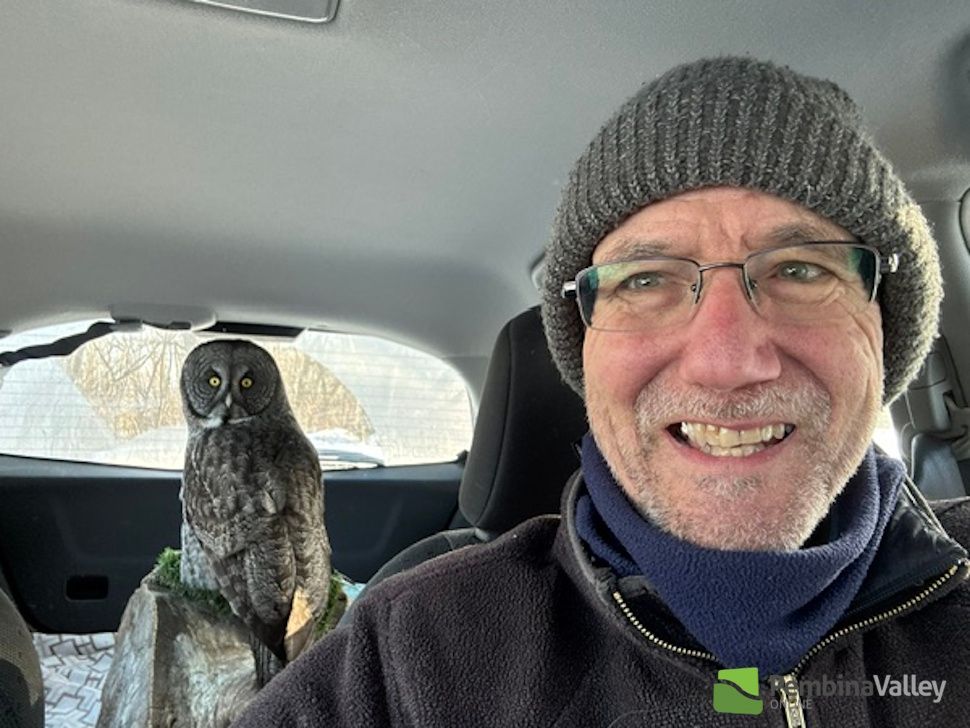 Jim Duncan, a retired biologist, with an owl.
Near his home in Balmoral, he and his wife, Patsy, who is also a biologist, were monitoring a long-eared owl nest with a trail camera for research when its numbers began to decline, as they did in Morden.
The nest contained six eggs, four of which hatched. By the time the young owls were ready to leave, however, only two had survived.
Duncan also learned of another nest north of Balmoral, where the adult owls disappeared and left two owlets orphaned.
Possible explanations
Although it’s difficult to determine exactly what happened to the long-eared owl nests, Duncan said that in and around Balmoral, the birds could have been affected by the “number of fairly significant extreme weather events” the region has experienced throughout the spring and summer.
In Duncan’s area in particular, there was overland flooding around the time the owl nests began to suffer.
“Humans are definitely impacted by these events, but wildlife is as well, so in some of these cases, it could be that the adults were just overwhelmed and abandoned ship,” he said.
“They can live to breed another day.”
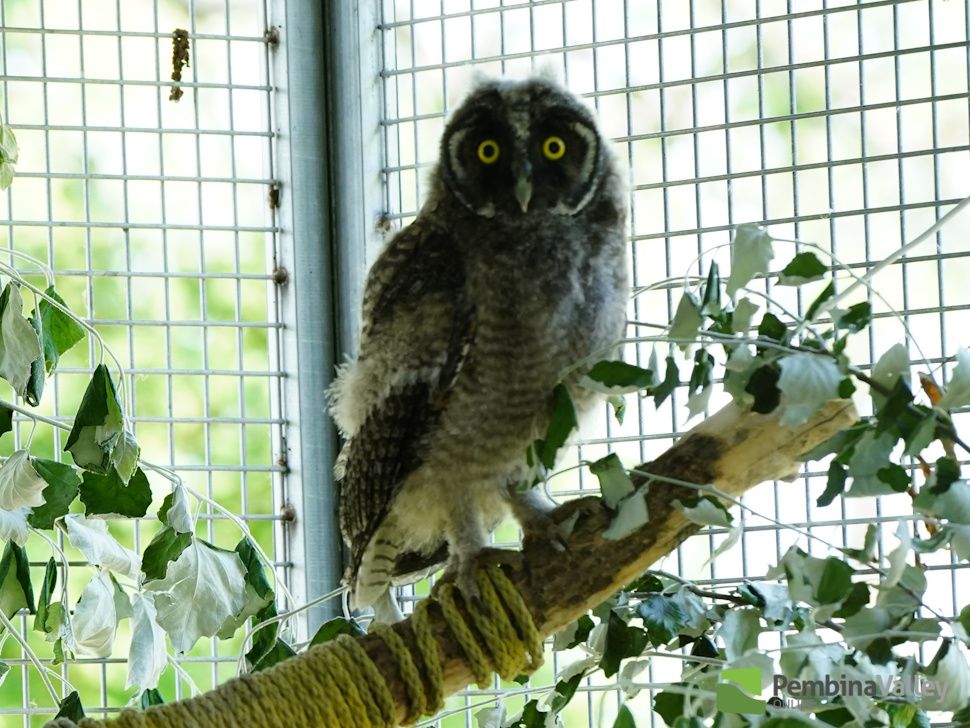 The orphaned owl from Morden, who is now at the Wildlife Haven Rehabilitation Centre. Photo submitted by Wildlife Haven.
A precarious division of labour
Duncan explained that long-eared owls rely on a “high division of labour” while nesting and raising their young, in which each parent plays an essential role.
“They form a pair bond …. The female owls are typically bigger than the males, and they’re the ones who lay the eggs, incubate the eggs, … and the female broods the young until they’re old enough to generate their own heat, which is about 14 days old,” he said.
The male is responsible for hunting to feed both the female and the chicks while she remains at the nest, a process that lasts about 45 days.
Because each parent has a distinct role, Duncan said the family’s survival depends on both parents.
“If something happens to the male, the female can’t raise the young on her own or incubate the eggs or brood the young,” he said.
“She has a role being bigger. She’s better at defending the young against threats, so if something happens to the male, the whole family is in trouble.”
The consequences of a missing female owl
The reverse also appears to be true. Duncan said that if the female owl disappears, the male often struggles to care for the young on his own.
“The male doesn’t seem to know enough what to do with eggs or young,” he explained.
Related stories:
According to Duncan, male owls may especially struggle with feeding the owlets without the female present.
He witnessed this behaviour in a pair of adult owls firsthand while monitoring a nest with a trail camera.
“Normally he shows up at the nest, he transfers the prey to the female, and she’s the one who feeds the young, [but] the female wasn’t at the nest,” he said.
“The chicks were there. They were calling for food. He had a field mouse called the vole in his bill, and he just looked at the chicks, looked around — didn’t know what to do. He flew away with the vole, … and then he flew back to the nest, looked at the chicks, flew away.
“Then the female came back, and he flew to the nest and gave her the vole. He didn’t even know how to feed the chicks.”
Other hazards
Although the circumstances surrounding the Morden owls remain unclear, Duncan said it’s very possible that the loss of one adult owl left the remaining bird unable to care for the young in the nest.
“If something happened to the female, then she’s not really there to guard them while he’s off hunting, and then other things like Cooper’s hawks can grab one, [or a] great horned owl might grab a long-eared owl chick,” he said.
He added that owlets also fall to the ground when they are learning to fly, and that animals like foxes and even cats, or water during flooding, can become a hazard.
While humans can’t eliminate natural threats to owls, Duncan said that one of the best ways to protect them is to preserve their habitat so that they have ample space to hunt and live.
To learn more about the elusive animal, visit Duncan’s Discover Owls page.