
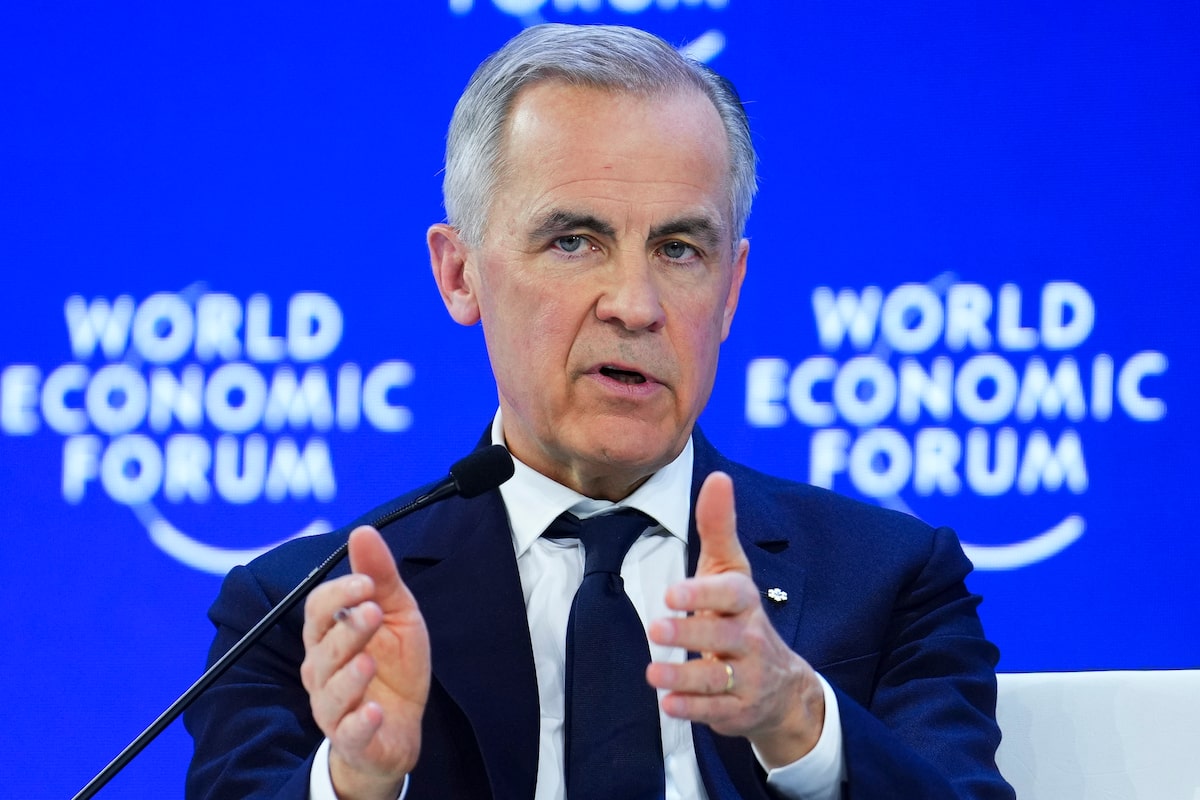
Prime Minister Mark Carney speaks at the World Economic Forum in Davos, Switzerland, on Jan. 20.Sean Kilpatrick/The Canadian Press
Perrin Beatty is the former CEO of the Canadian Chamber of Commerce. Thomas d’Aquino is the founding CEO of the Business Council of Canada.
When Prime Minister Mark Carney called for a coalition of middle power democracies at the World Economic Forum in Davos, Switzerland, at the beginning of the year, he described it as “classic risk management,” and a “hedge against uncertainty.”
Unfortunately, businesses in Canada and like-minded democracies have been slow to act on that potential. This led a group of Canadian business leaders, former senior officials and academics to call for a national hedging strategy defined as “America plus,” in a recent report. We don’t suggest the U.S. can simply be replaced. We argue instead for protecting and growing Canada’s position in North America, while vigorously deepening ties with the EU, Asia and beyond.
Meanwhile, Elbridge Colby, the U.S. undersecretary of defence for policy, dismissed Mr. Carney’s coalition concept as “a distraction,” earlier this month. He thinks the smart thing would be for other countries to align themselves more closely with the United States.
He is right in one regard: no coalition can simply replace the U.S. That’s particularly true for Canada, where our relationship will remain our most important for years to come. But when the nation that has long been other democracies’ most important friend and partner becomes a risk, countries should look to protect their independence and reduce their vulnerability.
U.S. President Donald Trump’s divide and conquer strategy worked for a time. At first, countries rushed to sign separate peace deals, regardless of the concessions demanded. Since then, however, evidence has mounted that individual agreements purchase neither respect nor business certainty. Countries increasingly understand they are stronger together.
Tony Keller: Trump is ending the American century with a bang, and a whimper
The world’s middle powers, including Canada, the European Union’s 27 countries, Britain, Norway, Switzerland, Japan, South Korea, Australia and New Zealand, hold genuine economic and political power. Collectively, they represent over 30 per cent of global GDP – more than either the U.S. or China.
A hedging strategy is what any multinational enterprise would adopt in the face of a risk to its business in a particular geography.
We believe the vehicles for the hedge already exist in the form of the Comprehensive-Economic Trade Agreement (CETA), the Comprehensive and Progressive Agreement for Trans-Pacific Partnership (CPTPP), the EU’s Security Action for Europe (SAFE) and critical minerals frameworks, but commercial take-up remains inadequate. As for the all-important United States-Mexico-Canada Agreement (USMCA) negotiations, a Canada with alternative markets holds a much stronger hand.
Diversification will take time. Memorandums of understanding are not signed contracts. Government agreements, however well-crafted, remain aspirational until business acts on them. By moving capital, signing long-term contracts and embedding in supply chains, business creates commercial infrastructure no government can easily undo.
It can’t be business as usual. To start, we recommend that Canada’s national business associations survey their members to identify priority markets, and work with government on where physical or policy infrastructure is lacking or where issues like permitting lag time must be fixed. These associations also belong to international networks they can leverage for support.
And companies themselves must reset priorities. The worst possible business strategy would be hoping we can simply go back to how things once were.
Charles St-Arnaud: How much would it take to turn around Canada’s economic malaise? It’s $5-trillion
Canada holds comparative advantages in sectors of special interest to our coalition partners. Our report identifies five primary domain priorities which would benefit from business–government collaboration and on which individual companies should focus.
Trade and rules-based commerce offer preferential access to roughly 30 per cent of global GDP outside of the U.S. along with dispute settlement through the Multi-Party Interim Appeal Arbitration Arrangement (MPIA). Near-term priorities include raising CETA utilization and helping shape the EU-CPTPP digital framework.
Critical minerals are key. Canada is a designated supply-side leader, and demand-side instruments like long-term off-takes and price floors can make projects bankable, with premium pricing for non-Chinese suppliers.
Defence industrial cooperation under the EU’s €150-billion SAFE instrument gives Canadian firms, uniquely among non-European nations, preferred access for SAFE-financed bids and joint ventures.
Technology standards and digital rules on artificial intelligence, data flows and platforms, now being written, will define market access, making data-adequacy arrangements with the EU, the United Kingdom and the CPTPP early priorities.
Alignment over climate and the EU’s Carbon Border Adjustment Mechanism supports a “clean trade pact” on steel, aluminum and critical minerals. For example, Canada’s low-carbon aluminum can command a premium within a carbon club.
A coalition offers a powerful alternative to a fragmenting global order, the eroding rule of law and falling trust in institutions. The potential for Canada is immense, but concerted action by business leaders in the coalition countries is essential to turn ambition into reality. Only business can deliver the capital, the innovation and the talent to make it happen.