

Listen to this article
Estimated 3 minutes
The audio version of this article is generated by AI-based technology. Mispronunciations can occur. We are working with our partners to continually review and improve the results.
A research centre based at Cape Breton University has received $1 million to help small scientific companies scale up to commercial production as part of a Nova Scotia government effort to grow the economy in a sector known as biomanufacturing.
Beth Mason, CEO of the Verschuren Centre, said the funding from Research Nova Scotia will help five companies move their research from the laboratory bench into larger facilities using natural ingredients to replace petrochemicals in products.
“That might be a dye in your clothes,” Mason said Tuesday. “It might be a functional ingredient, so for food. It might be a green chemical, like a plastic.
“We forget how much food colouring is out there and we know very well some of those are carcinogenic, because they are petroleum-derived. So it’s all about replacing those things.”
One of the companies that will benefit from the funding is called Lite-1, which ferments enzymes to create natural microbial dyes.
“By fermentation, we are producing a pigment, which will help us replace the synthetic and toxic chemicals,” said Prasanth Katta, a scientist with the Vancouver-based biomanufacturing company.
 Prasanth Katta, an engineer with Vancouver-based biomanufacturer Lite-1, says the company needed larger facilities to ferment an enzyme that creates a natural pigment. (Tom Ayers/CBC)
Mason said the research funding will allow the Verschuren Centre to buy some equipment and hire engineers and technicians to work with the biomanufacturers.
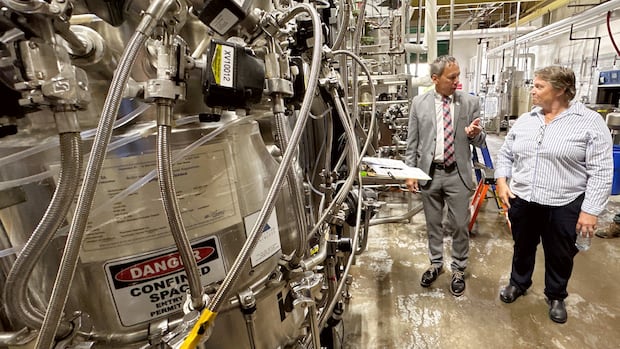
The centre, located on the CBU campus, has research labs and equipment to pilot commercial production.
It also has a facility in the Sydport Industrial Park with larger commercial-scale equipment.
The research is intended for Canadian companies, but much of the benefit stays in the province, even after the companies launch commercial operations, Mason said.
“The next step after Cape Breton is Dartmouth and the Neptune [BioInnovation] plant there, which is contract manufacturing at massive scale, so they stay within Nova Scotia,” she said.
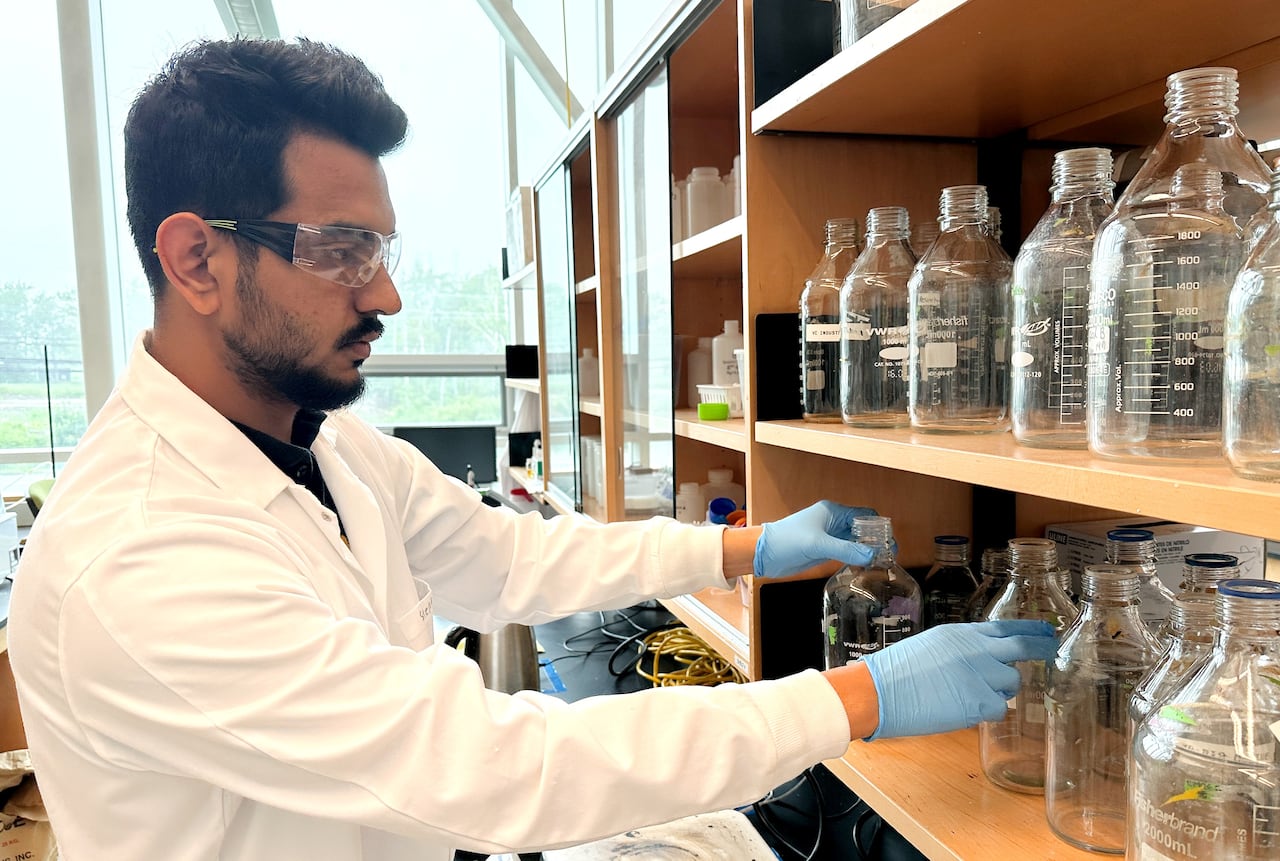 Mahammadashraf works in the laboratory at the Verschuren Centre on the Cape Breton University campus. The centre has received $1 million from Research Nova Scotia to boost biomanufacturing. (Tom Ayers/CBC)
Mason said past results have shown each of the five companies that will benefit from the early stage funding will likely attract $50 million in investment, bringing good paying jobs to the local economy.
She also said the Verschuren Centre does not just boost those already working on products in Nova Scotia.
“We’re currently advertising in Europe for companies who have reached a certain scale, but don’t have the capacity to keep growing.
“In Europe, you have only two or three [contract manufacturing organizations] capacity places they can go and they’re booked up for years.
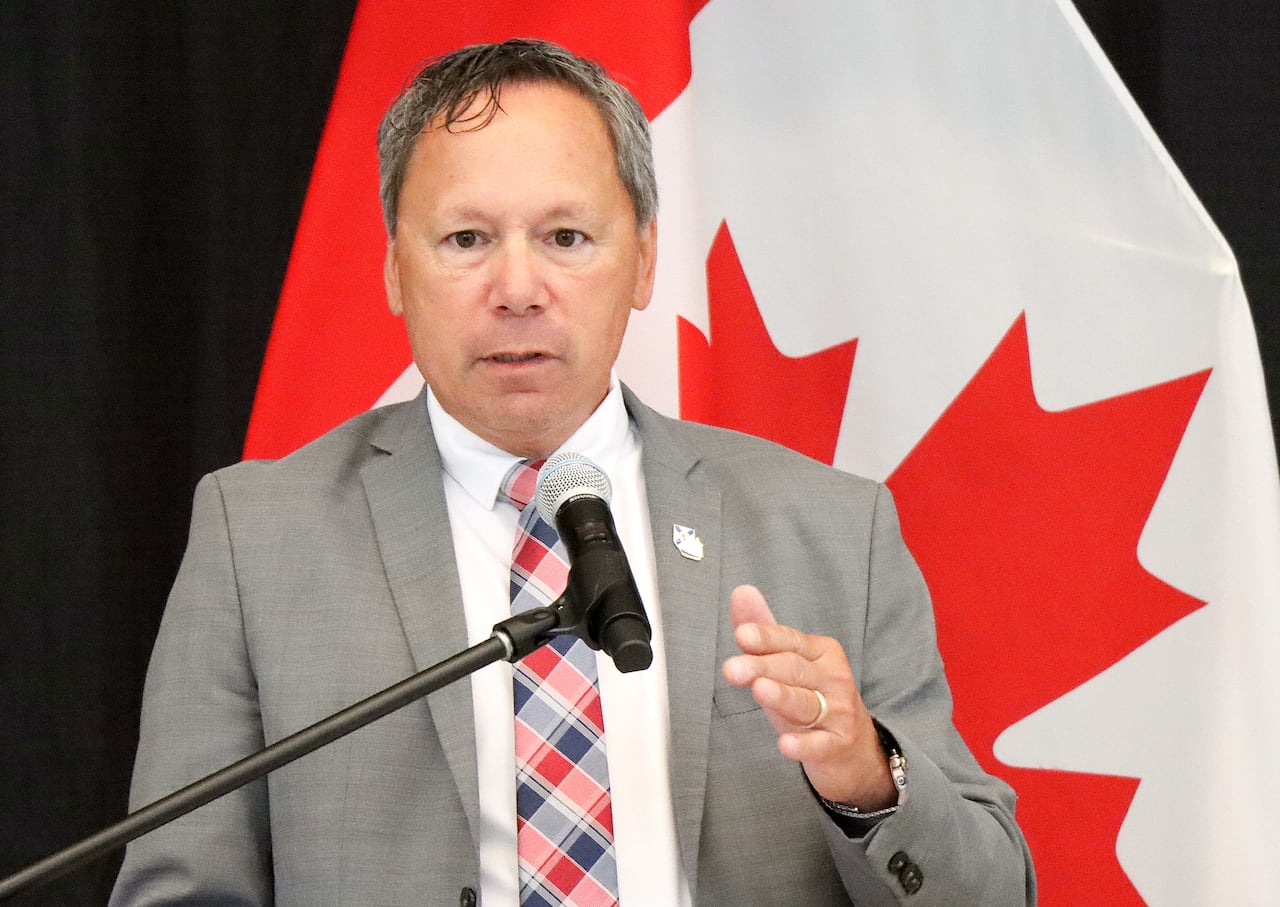 Advanced Education Minister Brian Wong says the Nova Scotia government is looking to university research centres to help commercialize scientific ideas and grow the economy. (Tom Ayers/CBC)
“So every country [has] got this bottleneck for capacity and that’s why we can attract companies from Europe and we can attract them from the [United] States.”
Nova Scotia’s Advanced Education Minister Brian Wong was in Cape Breton for the funding announcement and said the money is a good investment.
“We have to look [at] what’s going on in our research centres within our universities and find out what has commercial value and what we can actually scale up to make jobs to create money coming back into the province,” he said.
“We do know that by keeping jobs here, the spinoffs from that are massive for our future.”
MORE TOP STORIES