

Listen to this article
Estimated 4 minutes
The audio version of this article is generated by AI-based technology. Mispronunciations can occur. We are working with our partners to continually review and improve the results.
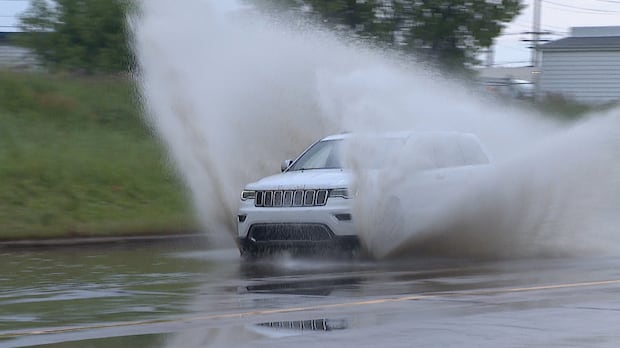
With flooded roadways in Edmonton becoming a more frequent occurrence on residential streets and cross-city freeways this summer, experts are warning motorists that driving through high water can be both dangerous and disastrous to your vehicle.
“Never drive through deep water. Always turn around, find an alternative route,” Nigel Dean, supervisor of fleet and automotive with the Alberta Motor Association, said in an interview with CBC News Monday.
Water can cover potential hazards, Dean noted.
“It can hide sinkholes, it can hide debris. You never really know what you’re driving through. It’s not worth it.”
Michael Bauman, owner and operator of Mike the Mechanic on 51st Avenue and 88th Street, also said it’s wise to take an alternative route.
“If it ingests water, the vehicle may stall out,” Bauman said in an interview Monday. “And you may cause catastrophic engine damage as a result of that.”
WATCH | Local Edmonton car mechanics warn about getting your vehicle too wet: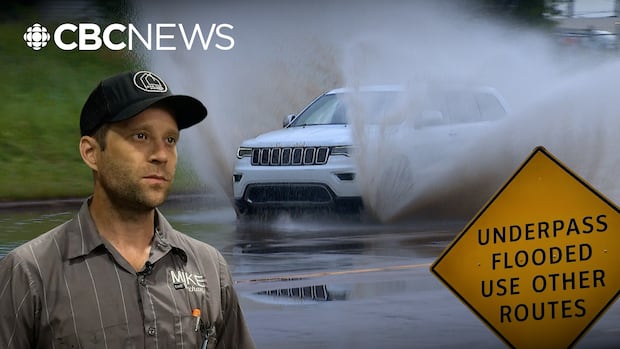
Flooding ahead: Experts say don’t drive through
Amid the wettest summer on record in Edmonton, experts are warning of the safety risks of flooding. If the road is flooded, experts say turn around and find an alternate route, or pull over and wait.
If the vehicle stalls and stutters, don’t try to start it again, Bauman says. Instead leave it and get it towed.
“A lot of times vehicles — once they’re flood damaged — they’re a write-off,” Bauman said.
“Once the electronics get water in them, airbag systems get water in them … the repair would far exceed the value of the vehicle.”
With repeated storms seeing more people driving through flooded streets, Bauman said his shop has seen a spike in requests for flood-related repairs. He estimated they are up by 200 to 300 per cent from a typical season.
Signs of water damage
Even vehicles that have plowed through several inches of water and come out on the other side might not be free of damage.
If the vehicle doesn’t stall right away, other signs may appear hours and days later, said Marty Sims, an instructor at the Northern Alberta Institute of Technology’s automotive program.
“You’ll notice the smell because of course, it almost immediately starts to become moldy and you get that musty smell,” Sims said in an interview Tuesday.
Electronics will start to malfunction if water gets inside the modules and wires, he added.
“You may notice all of a sudden that you’ve got lights on the dash, or something doesn’t function like it’s supposed to, or something doesn’t function at all.”
“Maybe your headlights don’t work or maybe you’re getting random lights on.”
Sims said depending on how much water gets in and where it’s gone, it can take a month to see malfunction.
The heat of the engine mixed with water will accelerate corrosion, he added.
“Corrosion doesn’t happen immediately, it takes some time, but you may even notice a week or two or a month later that something starts happening.”
How much water is too high?
It depends on the height of the cab and tires but an average vehicle shouldn’t drive through more than three to four inches of water, Bauman said.
Sims said three or four inches of water for a small car that rides low to the ground — or water half way up the tire — is a good measurement, but it depends on how one drives through it.
“If you go flying through it … you could still get water in places where it’s not supposed to because it shoots up underneath the vehicle,” Sims said.
In extreme cases, vehicles have gotten stuck under underpasses on expressways like Whitemud Drive and Yellowhead Trail, which creates another level of risk to motorists and their passengers.
Dean said it’s unlikely people can get out through the doors.
“The pressure from the water keeps your door closed. If it’s that kind of scenario, you kind of have to exit through the window,” Dean said. “It’s a very risky situation, especially like an underpass.”
People who can’t get out of the vehicle or get stranded on top of the vehicle should call 911, Dean added.