
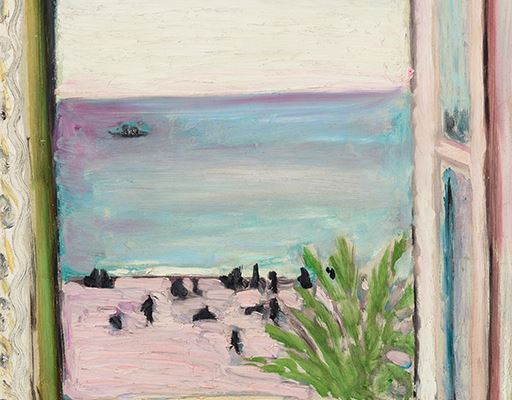
In Western art history, the window has long served as a fundamental metaphor for painting itself. Ever since Leon Battista Alberti formalized picture-making as an open window through which the world is observed, artists have wrestled with the tension between the flat canvas surface and the illusion of depth. During the late 19th and 20th centuries, however, this classical device underwent a radical transformation.
No longer merely a passive architectural frame, the window became a dynamic threshold where interior consciousness collided with external reality. For modern masters, the window was an ideal apparatus to interrogate light, spatial structure, emotional displacement, and pictorial flatland. Across various movements – from early Realist studies to Neoclassical compositions and contemporary figurative canvases – the motif reflects crucial stylistic and biographical shifts.
Examining these works chronologically reveals a profound trajectory: the window evolved from an observational lens into an emotional membrane. By analyzing key compositions by Edgar Degas, Pablo Picasso, Henri Matisse, Marc Chagall, and David Hockney, we witness how the aperture became a central arena for stylistic innovation and market triumphs.
Modern Thresholds: Edgar Degas
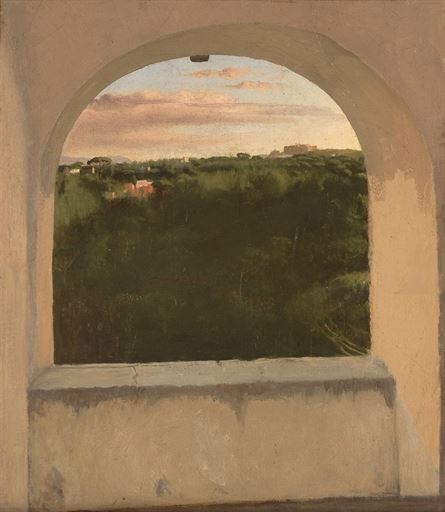
Edgar Degas, Paysage d’Italie vu par une lucarne, c. 1856-1859, oil on paper laid on canvas. Courtesy of Christie’s
The modern reinterpretation of the framed view begins with early Realist draftsmanship. In Edgar Degas’s Paysage d’Italie vu par une lucarne, c. 1856–1859, painted during his formative Italian travels, the young artist approached the window with academic precision and quiet intimacy. Rather than sweeping romantic panoramas, Degas confined his vision to a small dormer window overlooking an Italian sky.
The composition relies on strong geometric framing, where the interior dark borders of the skylight enclose a bright, sun-drenched landscape. This stark contrast highlights Degas’s lifelong fascination with sightlines, voyeurism, and spatial compression. The canvas presents an early glimpse into his psychological interest in isolated observation.
Historically, this early oil-on-paper work highlights Degas’s transitional phase before his Impressionist breakthroughs. Its provenance is equally distinguished: held in the collection of Yves Saint Laurent and Pierre Bergé before appearing at Christie’s Paris in 2009, the piece realized €457,000, showing strong market demand for rare, early-career works.
French Riviera Interiors: Pablo Picasso and Henri matisse
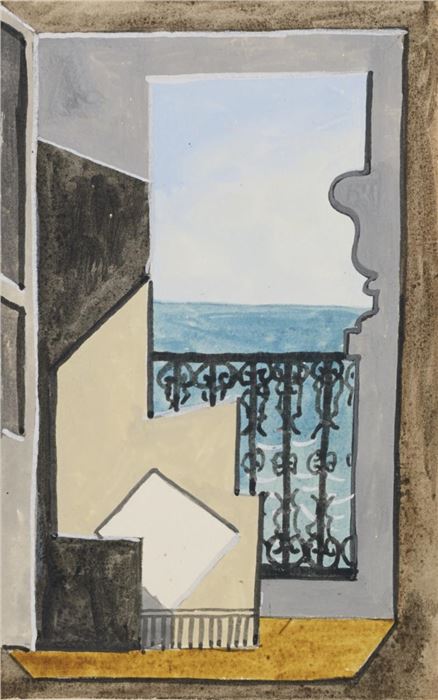
Pablo Picasso, Balcon sur la mer, 1919, gouache on paper. Courtesy of Sotheby’s
Six decades later, Pablo Picasso brought a completely different spatial logic to the threshold motif. In Balcon sur la mer, 1919, executed during a stay in Saint-Raphaël along the French Riviera, Picasso captured the Mediterranean coast through an open French window. This gouache work emerged during his Neoclassical Period, shortly after his radical Cubist innovations.
The composition balances structural rhythm with fluid lyricism. Wrought-iron balcony rails, decorative curtains, and shuttered doors create a crisp geometric scaffolding that frames the azure sea. Picasso flattened the spatial planes, allowing the interior room and the oceanic vista to sit seamlessly on the same pictorial surface.