
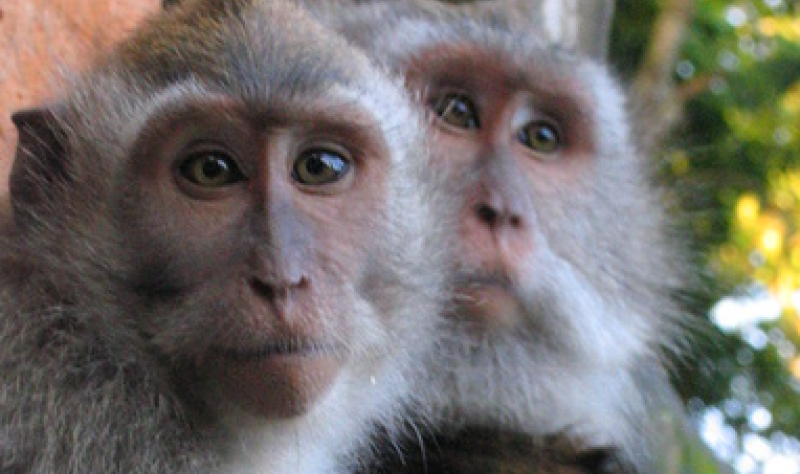
The study describes findings in seven macaques and controls for up to 7.5 years post-inoculation. While most macaques developed no symptoms in that period, one orally and one intracerebrally inoculated macaque showed clinical signs consistent with prion disease, including unsteady movement, tremors, and anxiety. “I am convinced that actually we saw signs of infection in macaques,” Schatzl said.
Standard biochemical tests failed to show prions in the central nervous system of the inoculated macaques, and histologic and immunohistochemical analyses detected minimal prion activity.
But highly sensitive protein misfolding cyclic amplification (PMCA) and real-time quaking-induced conversion (RT-QuIC) tests showed some infectious prion seeding in the brain, and in some cases, the spleen, of intracerebrally and orally inoculated macaques. No such activity was seen in controls.
“This is important because it suggests that the macaque species barrier may not be absolute under experimental conditions,” said Olivier Andreoletti, DVM, PhD, of the Ecole Nationale Veterinaire de Toulouse in France, who wasn’t part of the study.
“However, it is equally important to say that the study does not demonstrate efficient transmission of CWD to macaques, nor does it show a classical prion disease phenotype [observable indication of a condition] in these animals,” he added. “The current evidence still needs to be interpreted in the context of previous macaque studies, epidemiological data, experimental duration, exposure scenario, and the known complexity of prion strain adaptation.”
Residual inoculum or newly generated prions?
A central question, however, is whether the PMCA signal in the study reflected residual inoculum or newly generated prions.
“For intracerebral or wire-based inoculation, residual inoculum is a possibility that has to be considered seriously, especially when the signal is very low and conventional pathology is negative,” Andreoletti said. “For orally exposed animals, the persistence of inoculum for many years in brain tissue would seem less straightforward biologically, but it cannot be completely excluded without more detailed strain comparison/typing.”
It would be important to determine whether the agent recovered after macaque passage retained the biological and biochemical properties of the original CWD inoculum or if it reflects strain selection or evolution during cross-species passage, he added.
But Jason Bartz, PhD, a professor at Creighton University who wasn’t involved in the study, sees the finding of prions in the brain and spleen on PMCA differently. “It speaks strongly that these are newly generated prions in these animals,” he said.

CDC
Andreoletti also urged caution when interpreting the clinical signs seen in some macaques, because although tremor, wasting, anxiety, and behavioral changes can be compatible with prion disease, they are not diagnostic.
“In the absence of clear neurodegeneration, convincing PrP [prion protein] deposition by IHC [immunohistochemistry] or PET-blot [paraffin-embedded tissue blot], and a consistent anatomical distribution of lesions, I do not think one can firmly attribute those signs to prion disease,” Andreoletti said.
“A stronger determination would require concordant clinical evolution, neuropathology, PrPSc [scrapie prion protein] detection by conventional methods, and ideally, reproducible transmission from macaque tissues with preservation of a defined strain phenotype,” he added.
Andreoletti said it’s important not to extrapolate directly from macaques to humans. Just as non-human primates like macaques are not a single model, CWD is not one uniform agent, and passage through a new host can select or reshape strain properties, including host range and tissue tropism (affinity of CWD prions for particular tissues).
“Susceptibility is strain-dependent, and macaque PrP can even be more permissive than human PrP for some agents, such as classical BSE,” he said. “This means that the macaque is a very useful model, but it is not a perfect surrogate for the human species barrier.”
Lack of classical neuropathology
In the same study, inoculation of transgenic mice and bank voles with tissues from study macaques triggered prion disease in the rodents, achieving 100% transmission rates, which supports the presence of bona fide prion infectivity from CWD-exposed macaque tissues.
“We clearly say that the concept that there is no zoonotic potential is likely not correct,” Schatzl said. “Under certain circumstances, CWD prions actually can learn to replicate in a human organism. We do not imply efficient transmission, but we say under certain conditions this can lead to sustained activity that may remain undetected.”
If efficient transmission were documented, the findings could shed light on what CWD would look like and potentially spread in people. “In non-human primates, it looks very atypical, with low-level prion replication and subclinical disease,” Schatzl said. “But when we passaged it into other hosts [mice and bank voles], the full-blown disease was there.”
Ryan Maddox, PhD, senior epidemiologist and team lead with the Prion and Public Health Office at the Centers for Disease Control and Prevention (CDC), who wasn’t involved in the study, said that the BSE outbreaks in the United Kingdom in the 1980s and 1990s showed that eating meat from prion-infected animals can cause a similar illness (variant Creutzfeldt-Jakob disease [vCJD], a fatal prion disease) in people.