
Canadian archivist David Lemieux has spent nearly three decades preserving the Dead’s past. Now he’s helping ensure the music never stops.
One day, maybe three years ago, Bob Weir, the Grateful Dead’s rhythm guitarist, called David Lemieux to shoot the shit.
Lemieux was in the kitchen of his Victoria, B.C., home, hanging out with his teenage daughter. It was very rare for one of the band members to actually call him, even though Lemieux had, by then, spent more than two decades working for the Dead as their archivist. Not to mention that, despite the two men knowing each other for years, it was still Bob freakin’ Weir—torchbearer for the Grateful Dead’s music and a rock star unlike any other.
So, of course, Lemieux picked up.
“Bobby said, ‘Let me ask you, how do you view our legacy in the future?’” Lemieux recalls.
“I said, ‘I’ll put it this way, Bobby: here we are listening to Beethoven right now, played by other people, interpreted pretty darn close to what he’d envisioned, 250 years later, and there’s no end in sight.
“‘We’re nearly 60 years into the Grateful Dead right now. What’s another 60 years, or 150 or 300? I see no reason it doesn’t go that far.’”
The idea of a 300-year Grateful Dead legacy has been bandied about online and throughout the Deadhead community in the months following Weir’s passing in January at age 78, in no small part because Weir himself had been talking about it for years.
And Lemieux, now 55, is one of the most important people responsible for shepherding that legacy into the future.
Since taking over as the band’s official archivist in 1999, and being promoted to “legacy manager” by Weir himself in 2010, Lemieux has become responsible for roughly 10,000 hours of Grateful Dead music, including nearly 2,000 recorded live shows, plus masters and outtakes from the band’s 13 studio albums.
Lemieux works for the band as an employee of Grateful Dead Productions (GDP), the production company that has handled that band’s its business affairs since the early 1970s. Working alongside Rhino Records, he oversees the production of every archival release—the show selection, the remastering, the artwork, all of it. In a typical year, this includes a box set of unreleased music, four volumes of the eponymous Dave’s Picks series, plus reissues and 50th-anniversary editions of the band’s studio and live albums.
He’s also overseeing the digitization of the entire archive and the release of two previously unreleased shows every week through Play Dead, the Dead’s streaming service launched earlier this year.
And that’s just the audio side. Lemieux is also responsible for licensing the band’s music for film and television, as well as its imagery for third-party vendors and brand collaborations. He receives roughly 100 submissions each week. Packages pile up on his front stoop every day from vendors seeking approval for everything from hoodies to fishing reels to beer.
“It’s constant,” he says.
Everything you see, wear or hear related to the original iteration of the Grateful Dead has, in one way or another, passed through Lemieux’s eyes, hands or ears.
The Grateful Dead—the music, the culture, the lore—can absolutely consume a person. But few get to live inside it quite like Lemieux does. Few people outside the band itself have had as much influence over the listening habits and perceptions of Deadheads over the past 25 years.
“This most certainly isn’t anything remotely like a regular job,” he says. “I have a lot of fun in my job, but I take it very seriously. I really do take the representation of the Dead’s legacy seriously.
“When Bobby and I talked about it, and more specifically when Bobby passed, the weight of this job became a little more clear.”
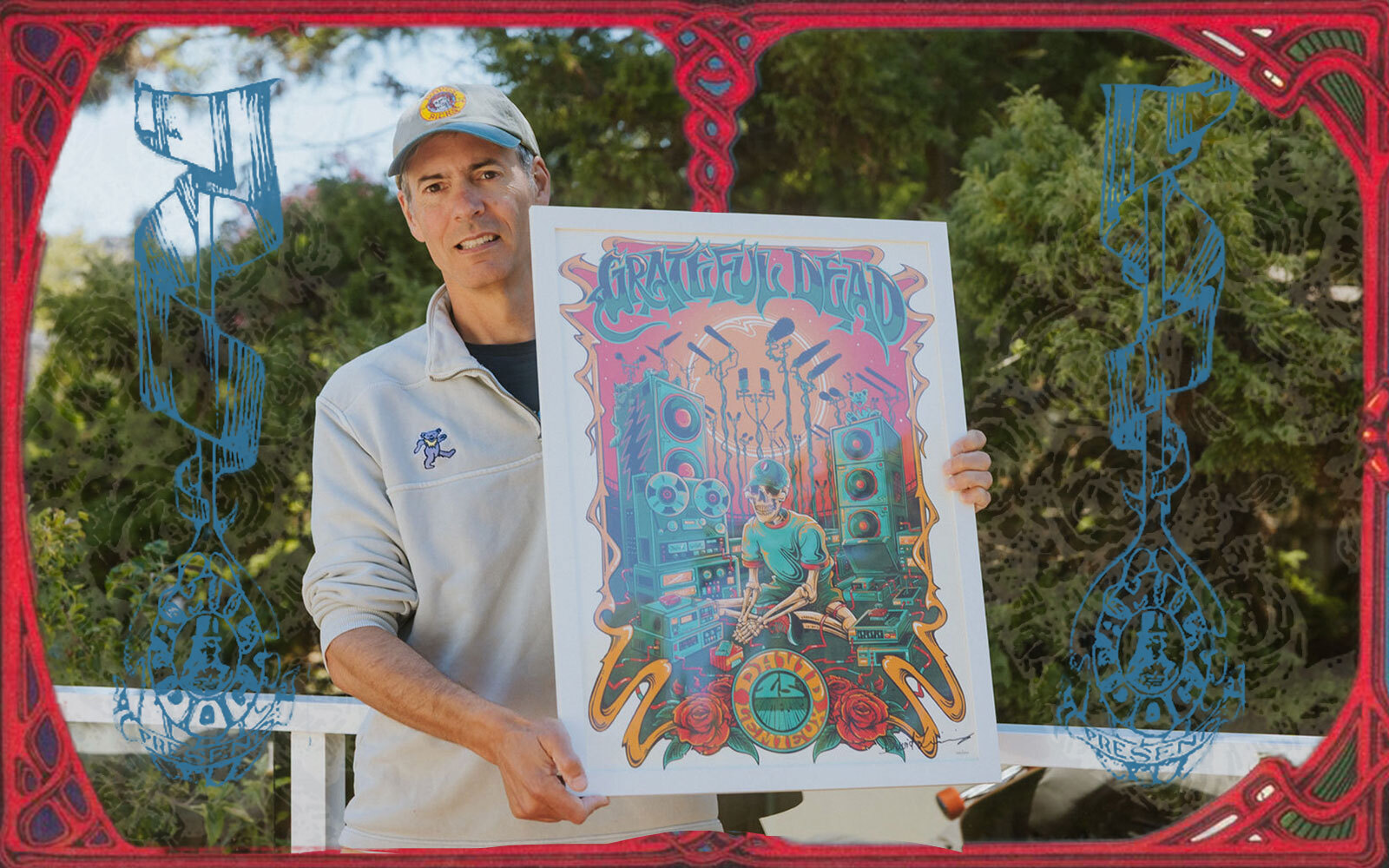
Lemieux is telling me this at his home in an idyllic seaside Victoria neighbourhood. It’s a gorgeous summer day. Baby deer, recently born in his backyard, sprint around in circles.
Being here is a genuine treat.
I’m a relatively new Deadhead, all things considered, baptized in tie-dye at my first Dead & Company show in 2018. I’ve been bopping around that rabbit hole ever since. It’s more than music—it’s a community, for one.
It’s also a journey through a mythic, psychedelic America of the mind, with detours through far-flung corners of the cosmos, where dreams and nightmares, fears and celebrations, can all come at you at once, if you’re open to it. The variety and quantity of intoxicants consumed may also play a role.
Think of it as a voyage, with Lemieux as something of a tour guide. To be invited into his home feels a little like visiting central command.
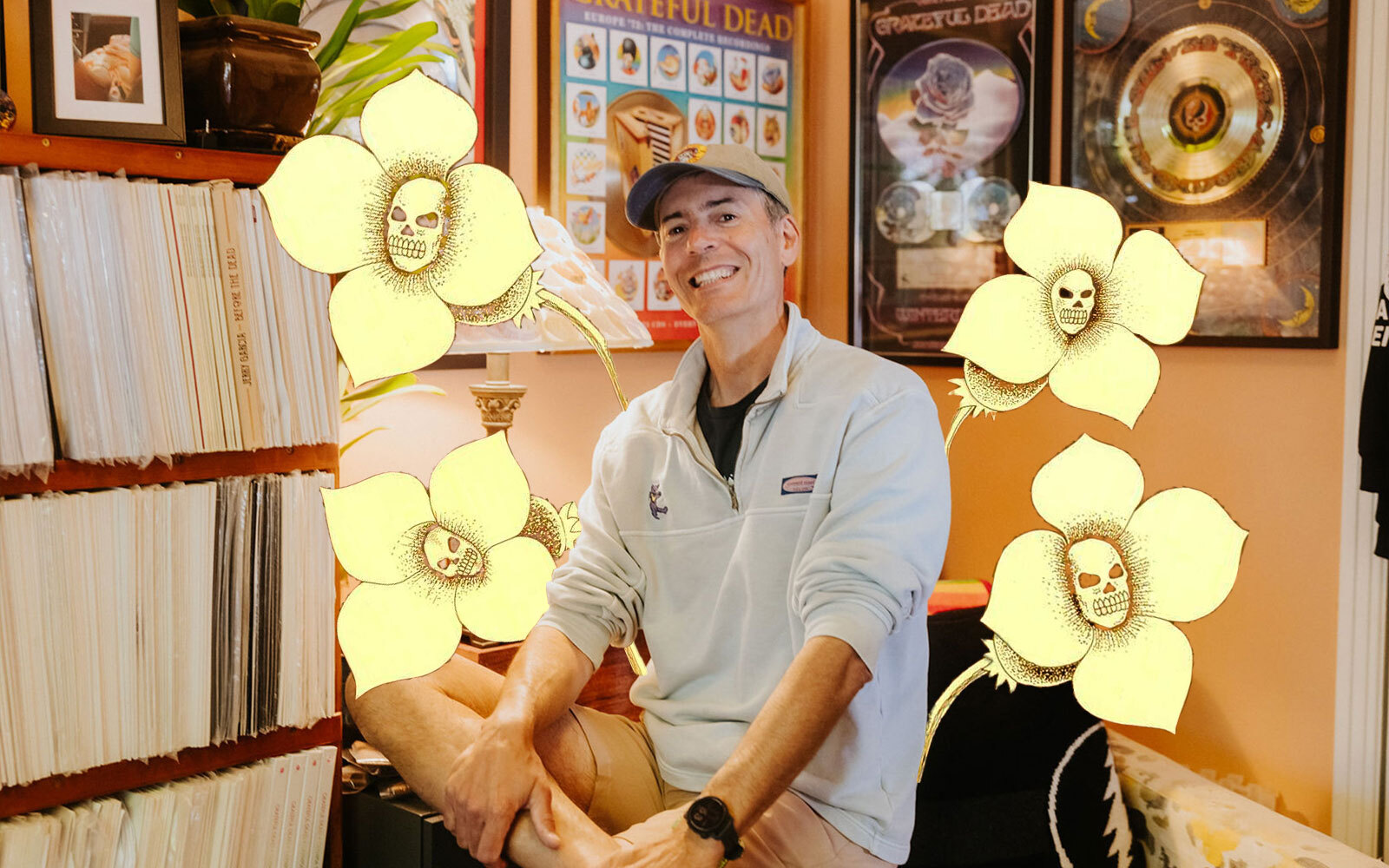
The main floor of this command centre, though, is conspicuously absent of Grateful Dead iconography. The exception is his office, a small room stuffed wall-to-wall with LPs, box sets, gold records and other ephemera so abundant that I couldn’t quite take it all in during the short time I was there.
The room is also a testament to just how popular the Grateful Dead remains in 2026—31 years after Jerry Garcia died and 61 years after the band formed—and a subtle reminder of how much of a machine the organization actually is. The Dead have long inhabited the mystical and the commercial simultaneously. Right now, business is good.
“I’ve been listening to the Dead now for 40 years, and they’re more popular than ever,” Lemieux says.
“Why do you think the music has endured the way that it has?” I ask. “A lot of stuff is so superfluous and disposable right now.”
“It’s exactly because they’re the opposite of the words you just used—superfluous, disposable, artificial,” he says. “They’re authentic and genuine, and there’s not a lot out there that is anymore.”
Lemieux was born in New Jersey and raised in Ottawa from the age of two. He was pulled into the Dead in 1985, when he was 14, and it all happened at once.
He heard some officially released live albums. Then a friend’s brother gave him 20 bootlegs on cassette. Lemieux bought every studio album and official release he could find. He devoured all of it immediately, and, of course, it wasn’t enough.
There was no inkling that, in the not-too-distant future, he would be responsible for the very music on those tapes.
He saw his first Grateful Dead show two years later.
“They announced the spring tour of ’87,” he says, “and I remember getting the atlas out—there was no internet—and I’m in Ottawa looking. OK, they’re playing Worcester, Hartford, Hampton, Chicago. I figured Hartford was closest, so that’s how I chose the Hartford show.”
His mom drove her 16-year-old son roughly seven hours to the venue. She had dinner with a friend and picked him up afterward, having no idea that the kid getting back into her car had been forever altered by the experience.
So it goes at a Dead show.
The race was on. Lemieux saw exactly 100 shows by the original Grateful Dead between 1987 and 1993. He remembers all of it: every setlist from every show, where he ate afterward, where he parked his car, where he slept and the funny encounters and events that transpired along the way.
“It always worked this way,” he says. “Some people know their baseball stats. I can do Grateful Dead.”
In other words, an important skill set for an archivist of any stripe.
Lemieux was drawn to the field, inspired in part by the work of the band’s original archivist, Dick Latvala, who held nearly the same mythical status for Deadheads as the band members themselves. Latvala championed the release of the band’s archival material, beginning with One from the Vault in 1991 and continuing through the long-running Dick’s Picks series.
He kept the heads fed.
“I remember getting a copy of the DeadBase book with all the setlists, and there was a review or something that mentioned Grateful Dead archivist Dick Latvala,” Lemieux says. “I thought, what an absolutely stunning job!”
You said it, Dave.
The short version of how Lemieux eventually got that job goes like this: After earning a master’s degree in film archiving, he was working at the BC Archives in 1998. He reached out to Latvala under the auspices of working on a master’s thesis about film archiving. He wanted to know how Latvala approached the Dead’s film holdings within what was primarily a massive audio archive.
Six weeks passed. Then Latvala invited Lemieux to visit the archive in the Bay Area.
From there, Lemieux landed a short-term contract cataloguing the film archive, which led to another short-term contract, then another, and eventually another recording some shows by Dead bassist Phil Lesh
All the while, Lemieux intended to return to Canada and his comfortable, unionized civil service job.
That is, until Latvala died of a heart attack in August 1999.
Suddenly, the band was without an archivist, and there was Lemieux, then 28 years old. Peter McQuaid, GDP’s CEO at the time, approached him shortly afterward.
“‘Well, Dick’s gone,’” Lemieux recalls McQuaid saying. “‘I’ve talked to the band. They all trust you, and they’ve asked that you stay on to be the archivist. Do you think you could do it?’”
“I said, ‘Yes. Absolutely.’”
And that was that.
Lemieux moved to the Bay Area, where he lived for the next seven years, and was pulled deeper into the Dead’s orbit. He got to know each of the band members personally, spending time in their homes, collaborating on releases and soaking it all in.
He never met Garcia, though he came close in 1992, in the lobby of a Sheraton in Hamilton, when the band was checking in to the hotel.
“They walked right past me to the elevator,” Lemieux says. “That’s the closest I ever got to meeting Jerry.”
He kept Dick’s Picks going for another six years, then launched the Road Trips series, which eventually gave way to the eponymously named Dave’s Picks. He also spearheaded the annual box-set series, beginning with the complete run of shows from the Fillmore West in 1969, which produced material for the band’s first—and arguably most iconic—live album, Live/Dead.
Lemieux says he staked his reputation on the project. GDP brass were uncertain whether a box set like it would sell at all, never mind sell out.
It did. Quickly.
“Those are the kinds of things that have given us the confidence that we should do things from a Deadhead’s point of view, not necessarily a business one,” he says.
It’s a philosophy Lemieux has carried throughout his career: the work should serve both the fans and the band.
“I make sure that everything we put out is something that the band could pull off a shelf and be proud of,” he says. “I never want the band to look at a shirt or listen to an album and think, Oh God, that’s our thing? I want them to be proud of this stuff.”
It was important work during an especially fallow period for the band, popularity-wise. This steady stream of archival releases fed the fan base at a time when the Dead existed very much outside the mainstream.
The surviving members—Weir, Lesh, and drummers Bill Kreutzmann and Mickey Hart—were playing in various configurations, sometimes with one another, keeping the songbook active and the flame alive without any real sense of where it was all headed.
Then it started to shift. The Dead’s revival was sparked, in part, by the 50th-anniversary Fare Thee Well shows, billed as the last time the four surviving original members would play together, with Phish’s Trey Anastasio filling Garcia’s role. Held at Levi’s Stadium in Santa Clara and Chicago’s Soldier Field, the shows generated widespread media coverage and reached far beyond the most committed Deadhead circles.
“Those shows sold out in seconds—like, that fast,” Lemieux says. “And that’s when I realized, OK, there’s something happening here.”
The next year, Weir, Kreutzmann and Hart formed Dead & Company with John Mayer. At the time, the pairing was confounding enough to generate even more attention. But it also pulled new listeners into the band’s orbit.
Dead & Company’s impact on the Grateful Dead’s legacy can’t be understated. The group helped catapult the music, iconography and mythology of the Dead back into the mainstream while considerably expanding its audience.
They sold out arenas consistently, year after year, often for multiple consecutive nights. The shows revived the Deadhead community in a very real way. For older heads like Lemieux, it was a kind of homecoming. For younger fans like me—those who were too young, or not even born yet, to see the original formation—it was an entry point to the live experience.
That generational handoff is at the centre of Summer Tour, a new documentary following a group of young Deadheads chasing Dead & Company across the country during the band’s 2023 final tour. The film captures a culture that has somehow continued to regenerate itself: younger fans finding their own way into songs written decades before they were born, then building their own rituals, relationships and memories around them.
In that sense, the film’s subjects are living proof of the future Weir and Lemieux once talked about.
The renewed interest has been reinforced by the steady stream of archival releases brought to fans, in all their remastered and beautifully packaged glory, by Lemieux & Co. Fans have lapped it up.
In December 2025, the Grateful Dead secured a Guinness World Record for the most Top 40 albums in Billboard 200 history, with 66 albums total, surpassing artists including Frank Sinatra and Elvis Presley.
And now, with Weir gone, there are new questions about how the community and the music will continue without its longtime torchbearer.
The answer, of course, is in an old Weir tune: the music never stops.
“You can consume live Dead in a 300-seat bar,” Lemieux says. “We’ve got a band here in town called Canadian Beauty—great name for a band—and they’re incredible. The experience of hearing live Grateful Dead music made on the spot, live—I get off on it the same way I did at a Dead show 40 years ago.
“A lot of the crowd are college kids from the University of Victoria who clearly never saw the Grateful Dead before ’95. They’re absolutely getting a live Grateful Dead experience.
“I’m not seeing Beethoven, but I’m getting off on it. I’m hearing Beethoven played as well as it would have been played 250 years ago.”
Perhaps this is exactly, or at least partly, what Bobby had in mind.
Despite his long affiliation with the band, Lemieux had never taken a picture with the Grateful Dead.
That was, anyway, until the Kennedy Center.
In December 2024, Weir, Hart and Kreutzmann were honoured by the Kennedy Center. Lesh had died two months earlier. Lemieux, recognized for his own work over the years, was invited by the band to attend.
“I am very aware of how lucky I am,” he says. “I’m a Deadhead—that’s my identity, going back to when I was 14 years old. So when I got invited to that, it meant the world to me.”
He sat with the band’s management, while the band sat above, alongside President Joe Biden, Vice President Kamala Harris, and the fellow honorees Bonnie Raitt and Franicis Ford Coppola. He watched the likes of Sturgill Simpson, Dave Matthews and David Letterman honour the music and legacy he had spent his adult life helping to preserve.
At the after-party, Lemieux and Mark Pinkus, president of Rhino Records, decided it was finally time to get that picture.
“I put my arm around Billy [Kreutzmann]. I hadn’t seen him in eight or nine years, and when he recognized me, he put his hand up to shake. That’s why we’re shaking hands in that picture,” he says.
“Billy got very emotional. We’re supposed to be looking at the camera, but he’s talking to me, saying, ‘I’m so happy you’re here. You have no idea how much we appreciate what you’re doing for our legacy, for our history.’
“And it was a very emotional moment. It brought me to tears, having Billy look me in the eyes like that.”
Lemieux shared the picture on his personal Instagram page the day after Weir’s passing.
“I did think Bobby would live forever, and certainly outlive me,” he tells me.
But at least he has that moment at the Kennedy Center immortalized: all of them together, one last time.
It’s a reminder that Lemieux isn’t just managing the legacy. He’s an active part of it.
___
As he walks me out his front door, we spot a manila envelope on the stoop that wasn’t there when I arrived two hours earlier.
“See?” Lemieux says. “There’s another one.”