
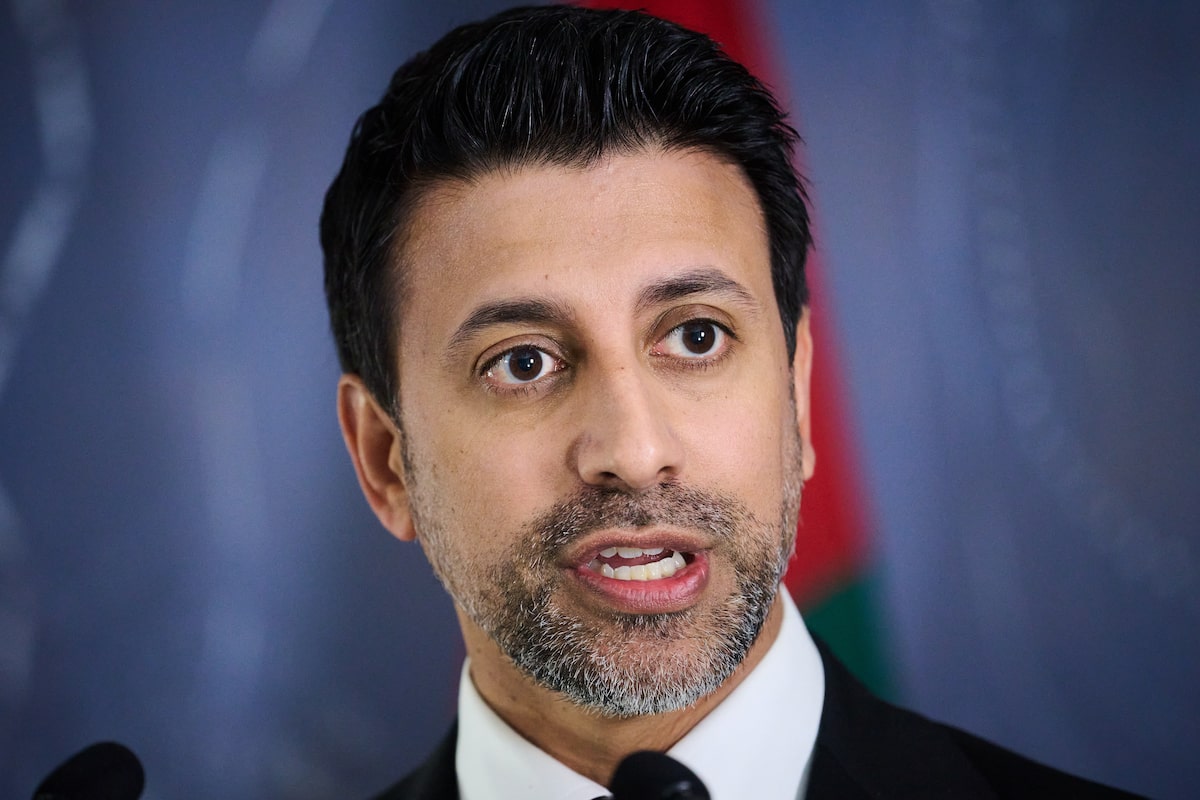
Although Ottawa already has a number of tools to help companies source foreign deals and to facilitate exports, Minister of International Trade Maninder Sidhu says the new strategic exports office will allow for better co-ordination and provide a platform for personalized deal-making.Sammy Kogan/The Canadian Press
The federal government is becoming increasingly hands-on in brokering international deals for Canadian companies as part of its broader effort to diversify trade.
On Thursday, International Trade Minister Maninder Sidhu formalized this approach with the launch of a “strategic exports office.”
The office, which was first announced in the fall budget, will be housed inside Global Affairs Canada and act as a hub for identifying and advancing international deals for companies in “strategic sectors,” including aerospace, defence, nuclear energy and infrastructure.
Mr. Sidhu also announced a new 14-member “strategic exports advisory council,” which includes, among others, Scotiabank chief executive Scott Thomson, Manulife CEO Philip Witherington, Bombardier CEO Éric Martel, Cameco CEO Tim Gitzel, and De Havilland owner Sherry Brydson (Ms. Brydson is a shareholder of Woodbridge Co. Ltd., the owner of The Globe and Mail).
Ottawa already has a number of tools to help companies source foreign deals and to facilitate exports. Export Development Canada provides trade financing, the Trade Commissioner Service provides market intelligence and makes connections on the ground, and the Canadian Commercial Corporation helps Canadian companies sell to foreign governments.
After one year under Carney, results on trade diversification are mixed
But Mr. Sidhu argued that the new strategic exports office will allow for better co-ordination between these bodies, and provide a platform for the kind of personalized deal-making that’s becoming increasingly important in a world of shifting supply chains and aggressive industrial policy.
“If you just look at France as an example, their advocacy efforts are better co-ordinated. You know, President Macron will intercept deals many times over,” Mr. Sidhu said at the office’s launch event at MDA Space headquarters in Brampton, Ont. “And so, if it’s me on the world stage or it’s another minister, we want to make sure that they’re well equipped for these commercial advocacy efforts as well.”
Mr. Sidhu pointed to a handful of recent deals that he said came together through the co-ordinated efforts of the company and Global Affairs Canada – sometimes with a direct assist from Prime Minister Mark Carney. These included CAE’s sale of flight simulators to Malaysia Airlines Group and Airbus Canada’s deal to supply 150 A220 jets to Malaysia’s AirAsia.
“It was a collective team effort that brought this deal over the line,” Mr. Sidhu said of the Airbus Canada deal. “In the fall last year, I was with the Prime Minister in Malaysia for the ASEAN summit where we met with the [AirAsia] CEO Tony Fernandes to help push for this deal to come through.”
Mike Greenley, CEO of MDA Space, which makes satellites and other space technology, said that the global trade environment has changed, and international deal-making increasingly involves broader economic and geopolitical considerations.
“Every country right now wants to do the same things: To increase sovereignty, increase defence and security, increase their industrial base and economic prosperity, and increase international trade,” Mr. Greenley, who is on the new advisory council, said in an interview after the announcement.
Financing demand in global trade markets grows as Canadian companies diversify amid tariffs
“So as soon as you start that conversation, it’s like, ‘Well, you know, I could help you with that deal. But what can you help me with?’ And so we need things like the [strategic exports office] and the government to be leaning forward in order to help us in that quid pro quo trade.”
The new office will be staffed by employees from Global Affairs, the Trade Commissioner Service and EDC, who will work on “deal teams” and help “curate and manage a pipeline of major export opportunities,” the government said. Alison Nankivell, CEO of EDC, said that Ottawa is looking to France, Germany, Japan and South Korea as models.
“It’s really bringing our best companies, our best industries, where we’re most globally competitive: nuclear, areas of defence, areas of energy … and taking some of the best approaches we have seen others deploy,” she said. “Because what you’re looking at globally is everyone is getting much more proactive in their industrial policy and their advocacy for their best companies.”
The new office is one part of a larger push by Ottawa to try to double non-U.S. exports – an increase of around $300-billion annually – over the next decade to reduce the country’s vulnerability to U.S. protectionism. The federal government has ramped up efforts to sign new trade deals, promised some $6-billion for trade-related infrastructure, and begun overhauling the regulatory and financing ecosystem for export-oriented energy and mining projects.
There are some early signs that Canada is diversifying its trade away from the United States. In May, the share of total Canadian exports heading to the U.S. was roughly 70 per cent – down from an average of 76 per cent in 2024.
Most of the diversification story to date has been about commodities. The high price of gold has dramatically boosted the value of exports to the United Kingdom, while more Canadian oil is being shipped to Asian markets through the Trans Mountain Pipeline. Of the sectors facing steep U.S. tariffs, the aluminum industry is the only one that has had much success moving products to overseas markets, mainly in Europe.