
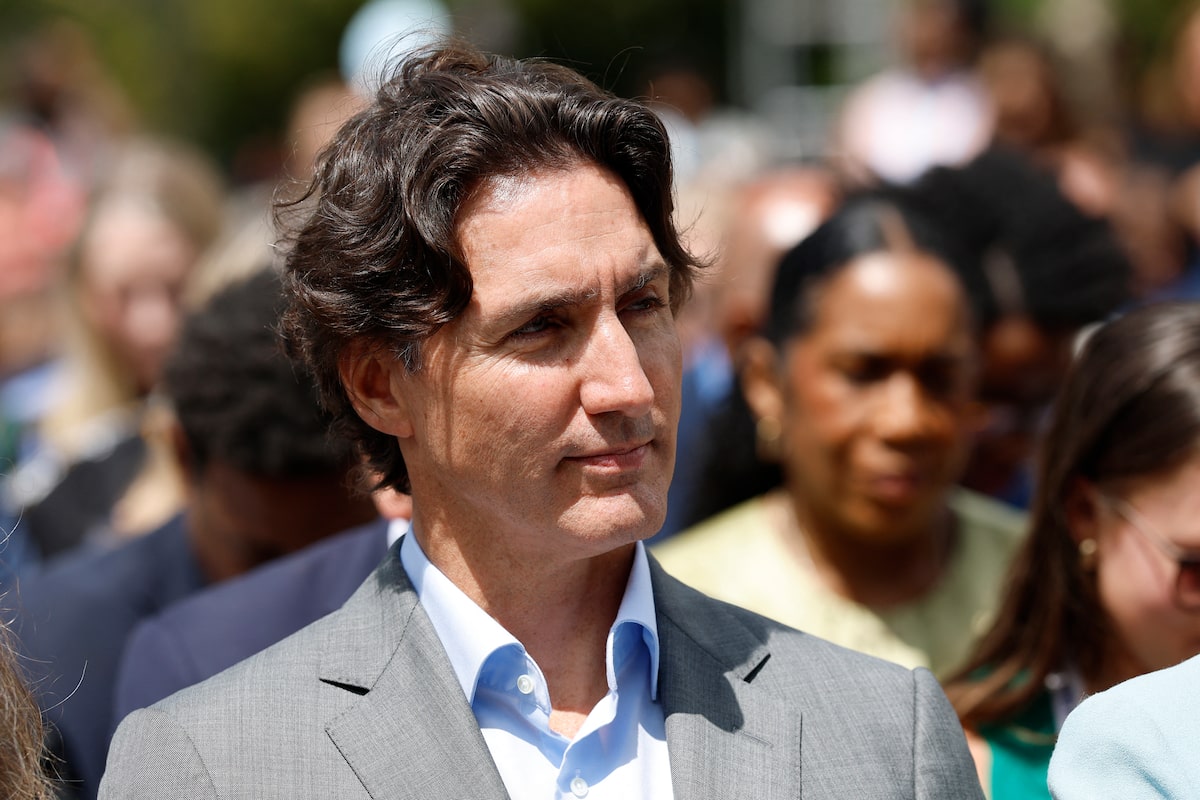
The ruling allows Democracy Watch to continue to pursue a court challenge of a federal ethics report on former prime minister Justin Trudeau’s involvement in government decisions related to the WE Charity.KAMIL KRZACZYNSKI/AFP/Getty Images
The Supreme Court of Canada says a section of the federal Conflict of Interest Act that doesn’t allow courts to review ethics commissioner findings is unconstitutional.
In a unanimous decision Thursday, the court ruled in favour of a watchdog group, allowing it to continue to pursue a court challenge of a federal ethics report on former prime minister Justin Trudeau’s involvement in government decisions related to the WE Charity.
Writing for the court, Chief Justice Richard Wagner found that the Federal Court of Appeal erred in dismissing a Democracy Watch application on the matter.
“Every exercise of public authority is subject to the courts’ supervisory jurisdiction to ensure that it does not exceed its legal limits,” Chief Justice Wagner wrote, noting the “legality review” is constitutionally guaranteed.
“Section 66 of the COIA infringes this guarantee by purporting to bar judicial review on questions of fact and law; to that extent it is of no force and effect.”
The section says every order and decision of the commissioner is final and shall not be questioned or reviewed in any court, except in accordance with some grounds in the Federal Courts Act.
Chief Justice Wagner wrote that political oversight of the commissioner is not an adequate alternative to judicial review.
Bill 21 brings Richard Wagner to the decision of a lifetime
Ian McLeod, a spokesperson for the federal Justice Department, said it is reviewing the court’s decision “in detail.”
In a statement, a spokesperson for the Office of the Conflict of Interest and Ethics Commissioner acknowledged the Supreme Court ruling.
“The Office respects the judgment of the Supreme Court of Canada and remains committed to administering the Conflict of Interest Act independently, impartially, and in accordance with the law,” said communications director Melanie Rushworth.
Konrad von Finckenstein has been the Ethics Commissioner since February, 2024.
At issue in Thursday’s Supreme Court ruling was a May, 2021, report from then-ethics commissioner Mario Dion, which found that Mr. Trudeau, as prime minister, had not contravened the Conflict of Interest Act when he participated in funding decisions related to the WE Charity.
Mr. Dion concluded that while it’s always advisable to recuse oneself and inform the commissioner promptly when facing an apparent conflict of interest, there was no requirement to do so under the act.
The Liberal government chose WE Charity in 2020 to administer a multimillion-dollar program to encourage students to volunteer for COVID-19-related community service.
However, questions were raised because of the Trudeau family’s links to WE Charity.
Mr. Trudeau acknowledged publicly that he should have recused himself from government decision-making on the matter because of the appearance of conflict.
Democracy Watch applied to the Federal Court of Appeal for judicial review of the commissioner’s decision, alleging that the commissioner made errors of fact and law in his interpretation and application of the conflict act.
The appellate court unanimously dismissed Democracy Watch’s application.
In a statement Thursday, Democracy Watch co-founder Duff Conacher said the Supreme Court’s ruling sets a clear precedent that he believes allows all future cases challenging errors in rulings by the ethics commissioner, and, by extension, all agencies, boards, commissioners and tribunals across Canada to go forward.
Mr. Conacher said the ruling will help ensure that all administrative law entities uphold and enforce the law properly.
With a report from The Canadian Press