
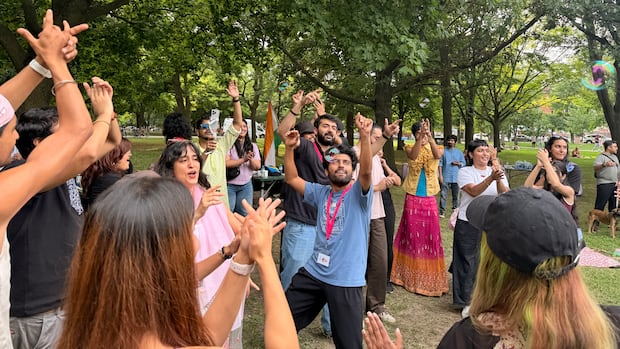
As dawn broke in Toronto on Saturday, news came of the Indian education minister Dharmendra Pradhan’s resignation — a central demand of the month-long student protest movement in New Delhi. That day in Toronto’s Trinity Bellwoods Park, under the shade of a giant tree, supporters of the Indian student movement gathered to celebrate and marvel at their success.
Titled The Sounds of Resistance, the gathering was organized to support the protestors who were demanding education and employment reform after a government inquiry confirmed that questions for a medical entrance exam held in India in May were leaked. More than 2 million students sat for the exam, which was subsequently cancelled.
The event held on July 25 at Trinity Bellwoods Park was described as an evening of music, solidarity and collective care by The Tawoos Initiative, a genre-fluid platform celebrating South Asian Music. Focussed on fundraising and raising awareness rather than chanting protest slogans, organizers sold chai and snacks to attendees.
The picnic table beside the makeshift food and chai counter became the stage for DJs, musicians and poets. A crowd of about 100 people gathered, some who had travelled for two hours coming from Kitchener. It was a spread of blankets and food, hugs and laughter, and songs and poems.
Sounds of Resistance came out of conversations between artists present at the Sonam Wangchuk Ontario protests being held outside downtown-Toronto’s Eaton Centre mall, says Pratishtha Kohli, co-founder of The Tawoos Initiative. Similar ongoing protests were held in Montreal and Vancouver, especially after the July 20th police crackdown on students in New Delhi as they participated in a peaceful march.
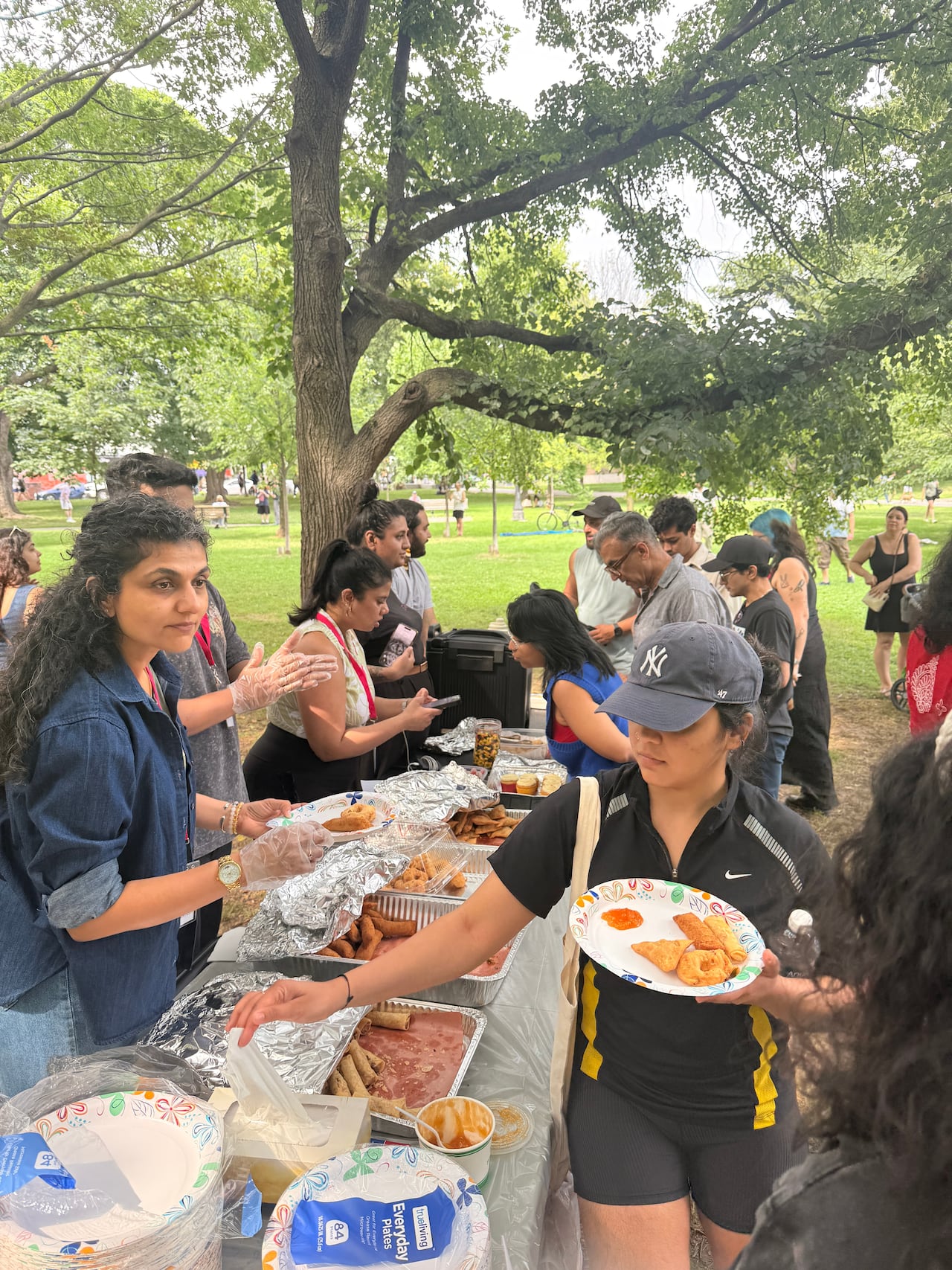 More than a protest, the event raised money medical, legal, educational aid in India through sales of food and art. (Chantelle Menezes)
“Beyond holding signs and being a space, we were wondering what we could do,” says Kohli. Her circle of artist friends and cultural curators quickly signed up to donate their art and food preparations. The group managed to raise $3586 at the event, which they will send to the Sachkhand Foundation, she added.
“The money will go towards medical aid, legal aid, educational aid. Even now that protests are over, there are a lot of folks who are still detained. And who had to experience a lot as a result of the brutality they faced during the protests. We’re still seeing that gender minorities, class minorities, religious minorities are being treated disproportionately unfairly. So all of the funds will support ongoing efforts,” she says.
The incredible creativity at the protests in India was a source of inspiration for Kohli. While previous protests in New Delhi and other cities, such as the Shaheen Bagh sit-in, anti-CAA protests and the farmers’ protests also mobilized the Indian public, the current protest became viral by bringing internet culture to Indian streets.
Even as students were facing off with the police or being detained, they took to social media mocking the political establishment. Art critics highlighted protest art ranging from graffiti to posters to even performance art at the site.
Artistic expression is similarly a foundational element of The Tawoos Initiative, says Kohli. Rather than doomscrolling in isolation, the arts offer a way to engage.
“Art is the focal point of improving mental health for youth, and it has historically been a huge form of protest,” she says. “Whether you look at [poets] Faiz or Iqbal, music has played a role even during the freedom movements within South Asia and across the world … Art is essentially a form of expression, and that form of expression is a medium to carry a message so we can engage across stratospheres.”
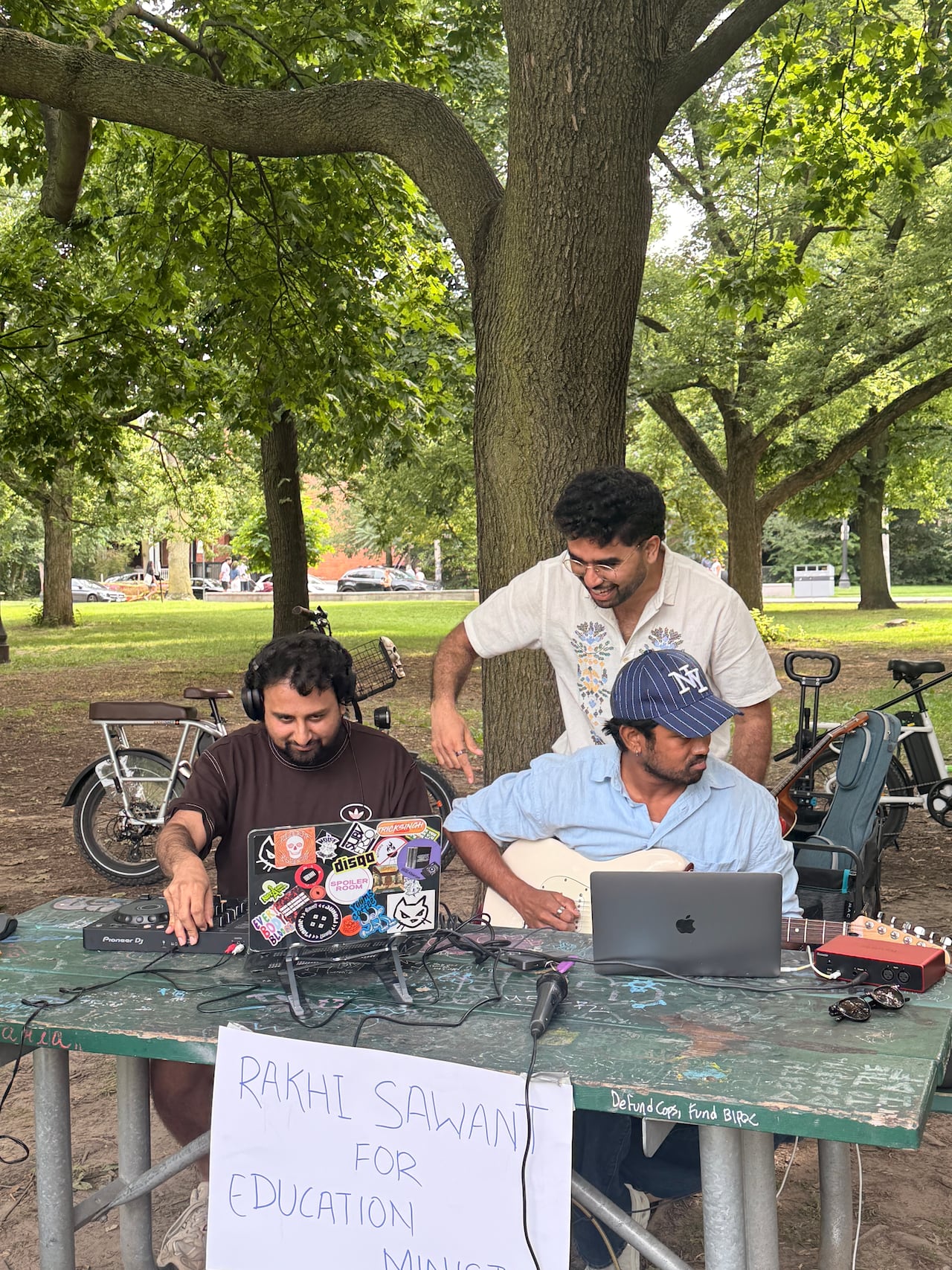 Artists performing at Sound of Resistance in Toronto. (Chantelle Menezes)
A similar idea motivated Gaurav Dhama to dedicate his Desi Comedy Show in support of India’s student movement. Like Kohli, Dhama had also participated in the protests being held at Eaton Centre. Originally from New Delhi, Dhama is a former student of one of India’s elite schools IIT Delhi and had firsthand experience of the gruelling preparation for Indian entrance exams taken by millions of students for just a few available seats. After working in the corporate sector for 12 years, he started performing and curating stand up comedy shows in 2025.
The youth movement seen in the last few weeks in India comes once in a generation, says Dhama, comparing it to previous political movements such as the Janata Party’s 1977 electoral defeat of the Indian Congress Party after then prime minister Indira Gandhi imposed an authoritarian emergency rule for 21 months.
Dhama, who moved to Canada in 2020 (CHK), had noticed a change in the air, literally and metaphorically, a decade ago. It started with Indian citizens becoming increasingly concerned about air pollution, followed by several other protest movements over the years. When the current youth-led movement started to hit a fever pitch, Dhama first thought of undertaking a hunger strike. On his way to another show last Monday evening, sitting on the TTC, he had a mental debate on whether he should add his own voice to the cause by organizing a comedy show in support.
“It came to a point that I could not not do it,” says Dhama. He asked his artist friends whether they would like to contribute their talent, assuring them it was also fine not to participate. Once he’d secured a venue, he decided to make the event PWYC. Individual tickets sold from $1 to $250 and the event raised $2000, which will be sent to a relevant grassroots organization.
At the show, traditional Indian sweets were distributed to celebrate the resignation of the education minister. People came with posters or made posters at the venue. Strangers met and hugged each other. The artists on the stage reflected the diverse states of India, all of them presenting new material in front of a new audience.
“To sharpen your content it takes months, but this topic was just a week or two old,” says Dhama, switching between English and Hindi. “But everyone was killing it on the stage … A couple of the artists had tears in their eyes as they were performing.”
As to what will happen now, since the protest is over? Dhama hopes for a sense of normalcy.
“The chaiwallah sells tea. The bus driver drives buses. The corporate employee pays his taxes. I hope people are able to live normal lives — without fear,” says Dhama. “I will continue to keep doing comedy. I have a lot of content. And I even got a few new jokes out of all of this. I have made many new friends,” he says.
“And we’ll stay vigilant.”