
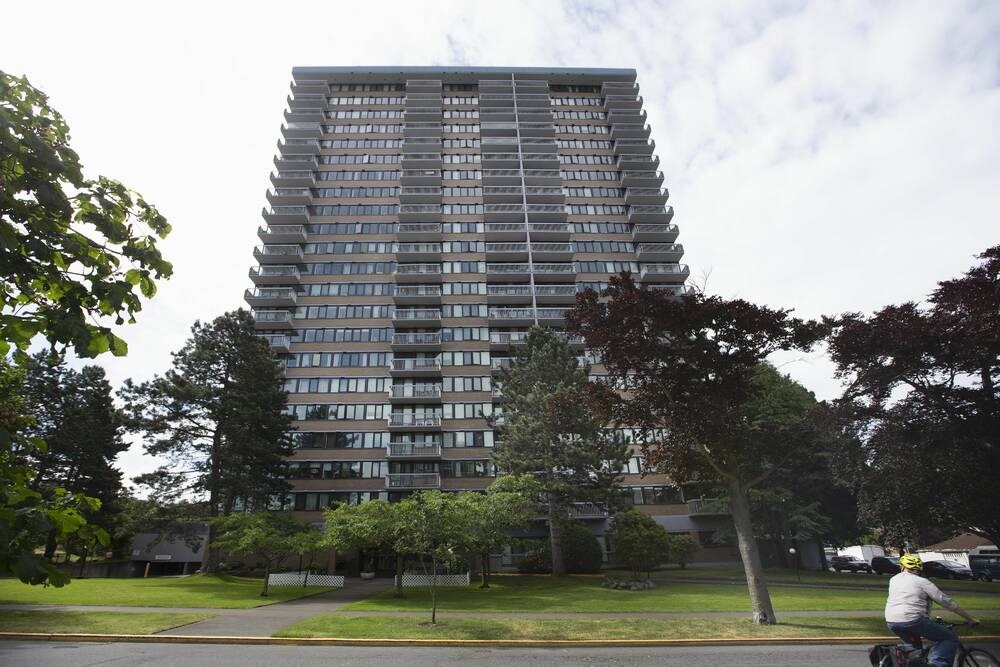
Hugh Trenchard was given two weeks to pay the expenses the company incurred fighting legal challenges related to a 211-unit leasehold building on Michigan Street.
A James Bay man who launched a legal case more than a decade ago over the cost of repairs to his high-rise building is being forced to pay $207,125 for the property owner’s legal fees to fight him.
In a July 21 letter from its lawyer, the property owner gave Hugh Trenchard two weeks to cover expenses the company incurred fighting Trenchard’s legal challenges related to Orchard House, a 211-unit high-rise on Michigan Street.
Residents of Orchard House, a leasehold building, enter into agreements with the building owner to buy the right to occupy their units for the duration of the long-term lease, which expires in 2073.
Leasehold buildings, which typically start with 99-year leases and have existed in B.C. since the 1970s, are not governed by the Strata Property Act or the Residential Tenancy Act.
Trenchard, who has a two-bedroom unit in the building, said he does not intend to pay without a full accounting of those fees, including supporting invoices, showing payments to lawyers and an explanation of why each item was necessary and connected to him.
His refusal to pay may make it impossible to sell his unit, something he’s considering as a result of significant repair costs imposed on the building’s leaseholders this year.
Trenchard is facing a bill for about $50,000 for his share of the cost to replace the fire-alarm system in the building and for a re-piping project.
The money is to be paid monthly from May of this year to February 2028.
The saga at Orchard House started in 2014 when Trenchard launched a court petition demanding that the building owner and manager, Vancouver-based Westsea Construction Ltd., provide information and documents related to the cost of a project to replace the building’s doors and windows, including an engineering report that recommended the upgrades.
After four days in court, Westsea agreed to provide the information Trenchard sought, and both parties consented to dismissing the petition.
However, Westsea argued it was entitled to recoup the legal fees it incurred fighting Trenchard in court as operating expenses under the lease agreement.
The judge rejected the argument, saying it was “contrary to common sense” because it would mean that Westsea would be entitled to recover costs from Trenchard and the other leaseholders whether they won or lost.
Westsea appealed, and the B.C. Court of Appeal ruled that the request was premature because Westsea hadn’t yet tried to charge the leaseholders.
Westsea then charged nearly $1 million in litigation fees to leaseholders and sued those who refused to pay. Trenchard’s share came to just over $5,000.
The question of whether Westsea can charge the legal fees to leaseholders was heard in B.C. Supreme Court last fall, but a decision has not yet been delivered.
Concerned about the cost of the fire alarm and re-piping projects, Trenchard wrote to Westsea on July 15 to ask for engineering reports and other documents that Westsea relied on to decide the scope and timing of each project.
He asked Westsea to explain why the timing of the two projects needed to overlap, such that for eight months, he will face additional monthly costs of $3,235.66 to pay for both projects.
Trenchard asked Westsea if it would consent to allowing him to sell his suite lease assignment while the parties await a decision from the courts on whether Westsea can charge the $1 million in litigation costs to the leaseholders.
Six days later, he received Westsea’s demand for more than $200,000 to cover the company’s legal fees for two and a half days of hearings related to the dispute with Trenchard.
renchard said the amount seems “far beyond any range of reasonableness” for the scope of the work.
He called the recent demand for more money a “distraction” from what he sees as the real issue, “which is disclosure and justifying why Westsea is keeping two major projects together.”
Trenchard said the company filed a notice of civil claim against him on July 22, asking for a court-ordered sale of his lease.
The civil claim also seeks to place a certificate of pending litigation on his lease assignment, which would prevent him from selling.
The lease is a private contract and not governed by any legislation, the company said in its July 22 civil claim.
Gerald Rotering, one of seven still-living leaseholders who has refused to pay Westsea for its legal fees, called the situation “the most appalling injustice you can imagine.”
Rotering said there needs to be a mechanism to resolve disputes between leaseholders and lessors that doesn’t begin with B.C. Supreme Court, because that’s led to the current situation, which has dragged on for years while legal fees climb.
Rotering, who has chronicled the Orchard House saga on his website orchardhouseleaseholder.ca, said he has been begging the province for eight years to create legislation to protect leaseholders, including a requirement that lessors provide explanations for the costs they charge to leaseholders, and a limit on how much money the lessor can spend and charge to leaseholders in a year.
Rotering said he asked the owner of Westsea about the reason for a $250,000 expense last year that was charged to leaseholders and described only as legal fees, and was told his question was inappropriate.
“There’s no control unless you sue, and if you sue, she says: ‘Go ahead. Hire a lawyer. And I’m going to hire one that you’re going to pay for,’” he said.
Mark Stacey, lawyer for Westsea, said he was not able to comment because the matter relates to litigation still before the court.
B.C. has approximately 2,500 leasehold units in roughly 20 buildings, mostly in Victoria and Vancouver, according to the Ministry of Housing and Municipal Affairs.
A spokesperson said the province has taken steps to increase protections for purchasers of leasehold units, such as requiring real estate agents to learn about leasehold agreements before becoming licensed.
It also encourages leasehold-building owners to increase transparency and communication with leaseholders, the spokesperson said.
MLA Spencer Chandra Herbert led an engagement process in 2024 as the premier’s liaison for renters to better understand the concerns of leaseholders in the province, the ministry said.
The 421 leaseholders who participated raised similar concerns to those of Orchard House residents, including a lack of transparency in the financial operation of the building, high monthly costs for operation and repairs charged on short notice and escalating legal costs passed on to leaseholders without an accessible dispute-resolution mechanism.
Along with Orchard House and View Towers — a 357-suite apartment complex at Quadra and View streets — in Victoria, Westsea Construction’s website lists two buildings in Vancouver, one in Surrey and one in Richmond.