
NEED TO KNOW
A premature giraffe named Milani was delivered via rare c-section after her mother’s health rapidly declined at the Tanganyika Wildlife Park in Goddard, Kansas
The Tanganyika Wildlife Park team consulted six veterinarians and nine institutions to save the calf’s life, though it was determined that there was no saving the mother
Milani remains in “critical” condition after being born three to seven weeks early and could become the first giraffe calf to survive a C-section
A rare premature giraffe was delivered safely “against all odds.”
The premature calf named Milani was born three to seven weeks early via cesarean section (C-section) on Saturday, July 11, the Tanganyika Wildlife Park (TWP) in Goddard, Kansas, announced in a press release.
The team at the wildlife park said they performed the rare C-section on Milani’s mother, Virtue, after she “gradually lost her appetite” and her health began to “decline” over the month prior to the calf’s arrival.
TWP said they trained their giraffes to voluntarily enter a specially designed chute, and were able to get Virtue to do the same to “draw blood, administer medication, give fluids, and check on her baby.”
The blood tests showed that she had elevated lactate, “an early signal that a compromised animal is failing at the cellular level,” and her unborn calf was at risk, the wildlife park said. They consulted with six veterinarians and specialists and nine institutions on how to save the calf.
A second exam taken on Virtue within 72 hours showed that her lactate had “climbed sharply,” her blood had been “showing signs of a clotting disorder” and her “organs were shutting down.” Experts at TWP determined that her “condition was irreversible,” but her calf could be saved.
TWP said in its release that the team decided to proceed with a terminal C-section, which is performed with the knowledge that the calf’s mother may not make it. The team sedated Virtue and delivered her calf surgically. She was euthanized while under sedation.
“Most people have no idea what this work actually looks like,” said Chief Operating Officer LynnLee Schmidt in a statement. “They don’t know that the keeper walking to the break room just finished tube feeding a baby giraffe, or that by 11 a.m. the Curator of Care is covered in sweat, amniotic fluid, and tears, or that the car passing them on the interstate is carrying plasma to a premature calf.”
“If they knew, I think they’d be in awe of this team,” Schmidt added.
A necropsy done on Virtue determined that she had “advanced heart and kidney disease, and a uterine cyst” and the “outcome was unavoidable.”
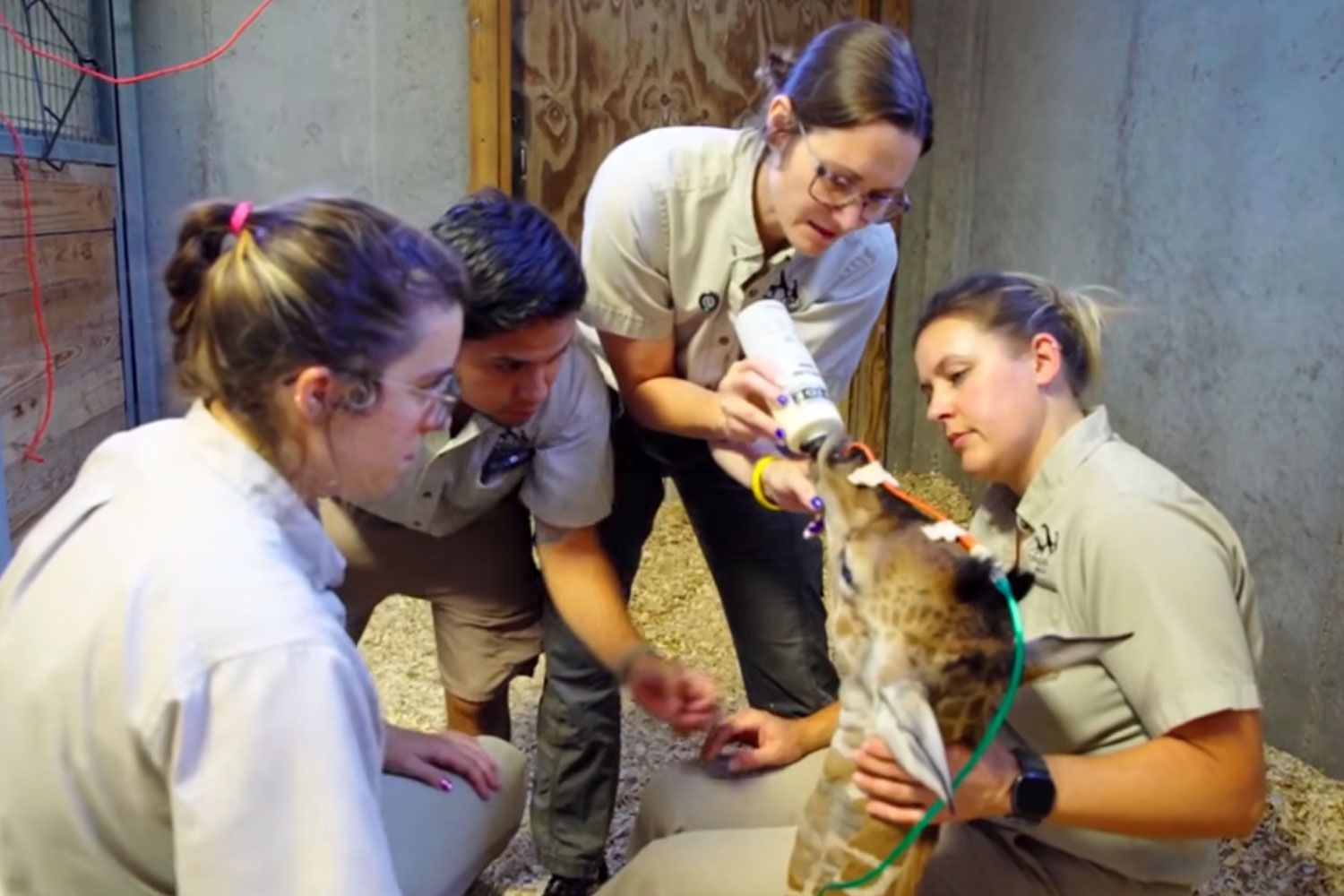
The TWP team said most calves pass through the birth canal and drop nearly six feet to the ground out of an adult giraffe’s womb, which helps stimulate breathing. However, since that wasn’t the case in this circumstance, the team had to manually suction the calf’s nose and mouth, dry her off, provide oxygen and work to stimulate her breathing.
The condition of Milani, who had been born at about a hundred pounds, “remains critical,” according to the TWP team, which also noted that there has been no documentation of a giraffe calf surviving after being born premature through a procedure.
“… She is being asked to do things her body had not finished preparing for,” TWP said in a statement. “Should she pull through, she would be the first giraffe calf known to survive a cesarean section. Every milestone she has reached so far is one that was not expected of her.”
Never miss a story — sign up for PEOPLE’s free daily newsletter to stay up-to-date on the best of what PEOPLE has to offer, from celebrity news to compelling human interest stories.
The TWP team said they are continuously monitoring Milani and administering plasma and a supplement called colostrum to replace antibodies that she was not able to get from Virtue’s milk. They have also set up a “controlled feeding regimen” and “standing sessions,” as she was unable to stand unassisted.
“Part of having and caring for animals is losing them, but it’s rare that you get the opportunity to save one at the same time,” said TWP Director Matt Fouts.
“It’s incredible to see people come together to do the unthinkable,” he continued. “Our team and all the experts we have consulted have fully embraced our Refuse to Lose core value and invested their time and talent to give this calf the best chance of survival. It makes me incredibly proud to be part of this team and the legacy of Tanganyika for preserving rare and endangered species.”
Read the original article on People