
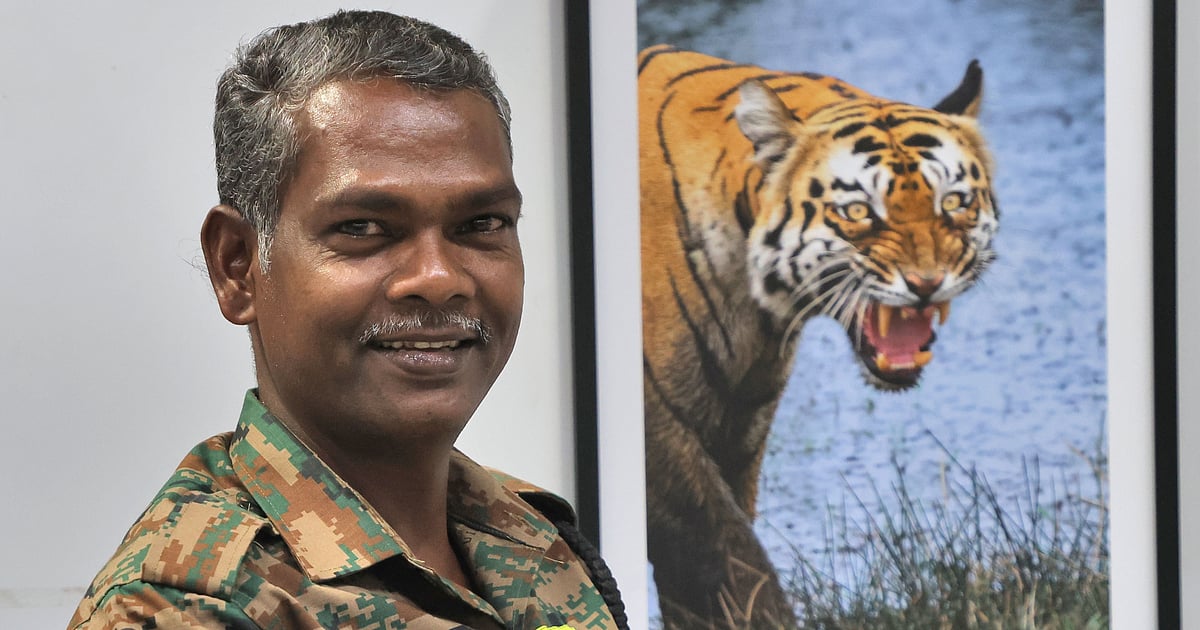
An anti-poaching watcher from the Malasar tribe, Sreenivasan entered the world of tiger monitoring and conservation, following the footsteps of his parents who were engaged mostly as elephant mahouts looking after tuskers and ensuring their well-being. Joining the forest department as a watcher at the Parambikulam Tiger Reserve in 2000, he has been engaged in tiger monitoring ever since.
“Initially we used to identify tigers through pug marks. We take measurements first. Later using plaster-of-paris, we identify the animal and features such as gender and size. There will be around 300-400 pugmarks which we could compare with, and check for different aspects to identify the animal. Depending on the surface, the marks vary. It could create confusion as the same tiger may have different pug marks.”
Later, camera-traps became the method for monitoring. “Once I spotted six tigers together. We can identify tigers based on their stripes. These are unique — no two tigers share the same stripes. Once we get the pictures, we would check for details and features like whether it’s an adult or a cub and male or female.”
There are factors that make this wild animal dangerous. Being injured, old age, having cubs or just having missed a target would make them dangerous. With constant monitoring, he can identify each tiger. Do they recognise him? “Of course; that’s why I come out of the jungle alive each time. As they have been seeing me for a long time, they do recognise me and may have understood that I’m not harmful. Maybe that’s why if I’m alone, they would just glance at me. However, if there are others with me, they’d make a certain sound and gesture with their mouth as if to express their resentment,” he smiles.
As the state witnesses a spike in human-wildlife conflict, Sreenivasan says we should respect their territories. “Each tiger has its own territory. Female tigers maintain a home range. If the territory is threatened due to some activity, they tend to move out. Since they’d be entering the territory of another tiger, there is bound to be conflict. At times, when there’s no prey base, they tend to move.”
For a man who has been observing tigers for 26 years, what’s his takeaway on tiger behaviour? “Ultimately it’s a wild animal and is bound to show traits of wilderness. We need to respect boundaries!”