
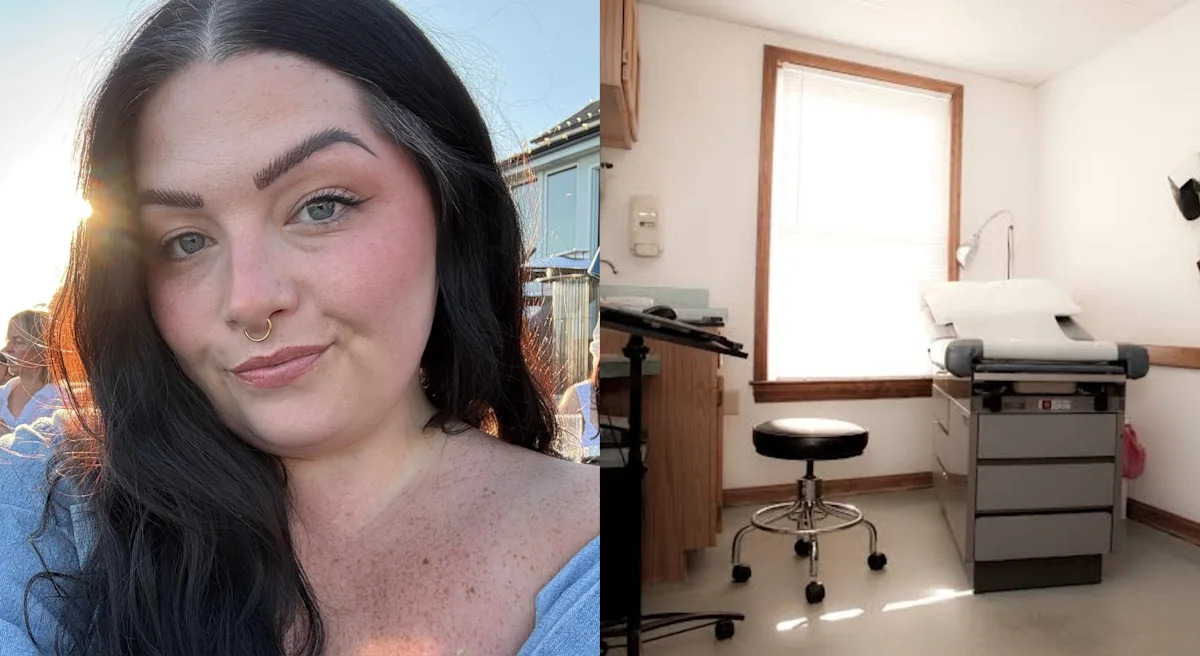
After seven years of appointments, tests and moments where she wondered if anyone was actually listening, Katie-Rose Lestrange walked into an Ontario doctor’s office expecting another uphill battle.
She had prepared herself for the questions. The doubt. The feeling of having to prove what she already knew was happening inside her own body.
But the battle never came.
Instead, she says, the doctor looked her in the eye, listened to her symptoms and told her they would work through it together.
“I didn’t quite believe it myself that it was this easy,” Lestrange tells Yahoo News Canada.
The moment came after years of searching for answers in the United States, where Lestrange says she felt dismissed and unheard while navigating multiple health concerns, including polycystic ovary syndrome (PCOS), now referred to by some as polycystic ovarian syndrome of metabolic origin (PMOS), as well as hypothyroidism and fatty liver disease.
Then, in early 2026, Lestrange shared her story on TikTok, where a video describing her health care journey has been viewed more than 250,000 times, sparking a cross-border conversation about the differences between Canadian and American health care.
READ MORE: The condition PCOS is now called PMOS. What to know about the name change and what it means for care
Many commenters praised Canada’s publicly funded system and say they understood the feeling of finally being believed.
Others pushed back, saying her experience does not reflect the reality many Canadians face while dealing with long wait times, doctor shortages and struggles accessing care.
And Lestrange says that nuance matters.
“I want to make sure that it’s very clear that Canada is not perfect,” she says. “I am just one of the few people who have experienced both.”
‘I would go home confused and frustrated’: 7 years of searching for answers
At home in California, the search for answers grew into an exhausting routine. Appointment after appointment, test after test, Lestrange says she was wondering whether anyone believed her.
She says she does not put all the blame on the doctors she saw in the U.S. Instead, she points to a health-care system where physicians are often navigating insurance requirements and layers of red tape.
“I can’t fully blame the doctors themselves,” she says. “They had a lot of red tape they had to go through.”
But for Lestrange, the process was still exhausting.
“I had many moments where I would go home confused and frustrated and scared,” she says. “Processing all of those emotions was truly, truly exhausting.”
Eventually, she was diagnosed with PCOS, now increasingly referred to as PMOS, a condition that can affect hormones, metabolism and reproductive health. She was also diagnosed with hypothyroidism, a condition where the thyroid does not produce enough hormones, and fatty liver disease.
But even after receiving diagnoses, Lestrange says she continued to feel like she was fighting to have her concerns taken seriously.
One appointment still replays in her memory.
She arrived at a new doctor’s office with a list of her previous diagnoses, expecting that the medical history she had built with other physicians would be enough.
Instead, she says the doctor focused on her PCOS diagnosis and questioned whether she had the condition.
“He looked at my face and said, ‘You don’t have facial hair, so I doubt you have PCOS,'” Lestrange recalls, adding the interaction left her shocked.
I remember that moment being just really appalled that that sentence would have come out of any health-care professional’s mouth.
Katie-Rose Lestrange
She says she left the appointment and never returned. Over the course of the seven years of hunting down hope and answers, Lestrange says she found something unexpected — an online community.
Scrolling through TikTok videos from other women describing similar symptoms, Lestrange says she finally felt seen.
“I remember watching those videos and feeling seen for the first time,” she notes. “It felt freeing that I felt like I knew what was happening.”
The first visit to an Ontario doctor: ‘Culture shock’
After moving to Canada, Lestrange had to wait about six months for her Ontario Health Insurance Plan (OHIP) card before she could start navigating the health-care system.
Once she had coverage, she did what many newcomers do: She turned to Facebook groups, searched for recommendations and found a doctor she could trust.
After difficult experiences with male doctors in the U.S., she specifically looked for a female physician.
She found one who came highly recommended and booked an appointment. Within 48 hours, she was sitting in a doctor’s office.

For Lestrange, the appointment itself was only part of it. What stuck with her was everything she encountered from the moment she opened the door.
I didn’t quite believe it myself that it was this easy.
Katie-Rose Lestrange
She remembers a calm front desk, a short wait and a doctor who met her nervous humour with compassion.
“I try to make people laugh when I’m uncomfortable, when I’m nervous,” she says. “She really met me where I was at.”
That feeling continued at a walk-in clinic attached to a Walmart, something she says was a culture shock compared with her experience in the U.S.
She waited two hours, but says it didn’t feel like the stressful health-care experiences she had grown used to.
Families came and went. Staff joked with patients, people waited and even talked to each other. To Lestrange, it felt less like a stressful medical visit and more like a normal part of life.
When she eventually saw a male physician, she admitted her guard went up because of past experiences.
But she says the appointment changed that.
“He was absolutely wonderful,” she says. “He listened to everything I had to say. He assured me that I was safe and that I was going to be OK.”
‘We have been so lucky to experience such good health care so far being here’
Eventually, Lestrange’s doctor in Ontario began further testing.
When she was told she had an autoimmune condition, she says the feeling was complicated — a mixture of relief and sadness.
“Of course, we want to assume that nothing is wrong with us,” she says. “But I also felt relief having an answer to the looming question of, ‘Is something wrong with me?'”
For Lestrange, the biggest difference was not simply receiving an answer. It was what came after. She says her health anxiety was not dismissed as something that needed a quick fix.
Instead, she felt like her concerns were met with a plan.
“It wasn’t met with a Band-Aid,” she says. “It was met with treatment options and testing options.”
TikTok video sparks debate on health care
After sharing her story online, Lestrange’s video quickly gained attention, racking up a quarter-million views and hundreds of comments with many detailing their own health-care experiences.
Some heaped Canada’s health-care system and shared similar stories of feeling cared for while others say they struggled to find family doctors, faced long waits or felt the system had failed them.
One B.C. resident shared a very different health-care experience, saying they felt supported throughout their cancer journey, including followup calls from their surgeon after three surgeries in one year.

Screengrab of TikTok comment courtesy: @garbo600/TikTok
Another Ontario resident shared a positive health-care experience, saying they were diagnosed with Hashimoto’s and fatty liver disease and started treatment within a week of seeing their doctor.

Screengrab of TikTok comment courtesy: @Claire/TikTok
This Ontario commenter says their experience depended heavily on the doctor, describing a negative relationship with a previous physician before finding a new doctor who provided a much better experience.

Screengrab of TikTok comment courtesy: @AmyAllen/TikTok
Lestrange says she knows her story is not the story of every Canadian trying to navigate the system.
“I recognize that I have been outrageously lucky and fortunate to have been given the experiences that I have,” she says.
She also pointed to differences across Canada, particularly for people living in rural and underserved communities.
“There are many improvements that need to be made to the Canadian health-care system,” she says. Her hope is that the conversation becomes bigger than Canada versus the United States. Instead, she wants people to talk about what health care should feel like.
“I want to make sure that health care is accessible and wonderful for everyone, just as wonderful as I’ve experienced here.”
For Lestrange, the journey is not over yet. She says she’s still waiting for an official diagnosis and will meet with a specialist in October. But after years of searching for answers, she says the biggest change was not just finding medical care, it was finding someone willing to listen.