
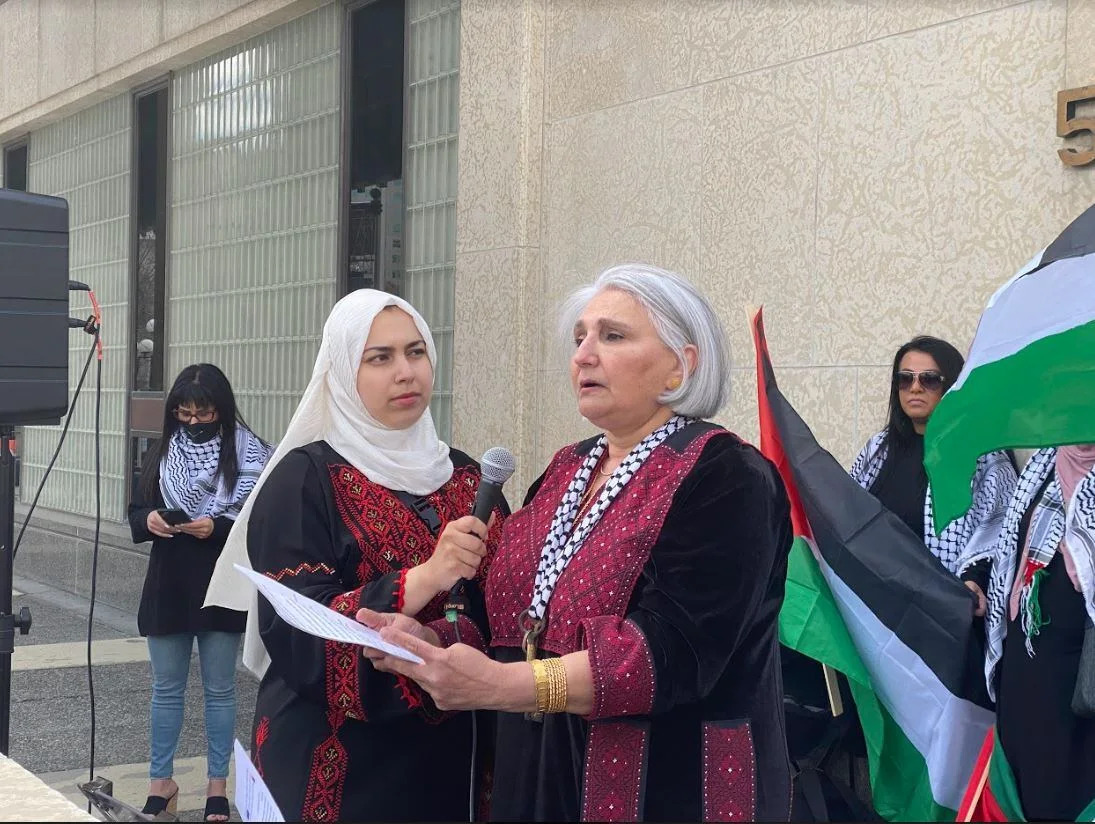
A Winnipeg woman whose family is among those featured in a controversial exhibit on the displacement of Palestinians at the city’s national human rights museum says she was disappointed the ensuing public discussion focused so much on what non-Palestinians think the exhibit should say.
“I hope that the people who come [will] see it with an open mind, whether they agree or not agree. The point is to listen, to learn, to better understand the human experiences that’s presented,” Rana Abdulla said in a recent interview with CBC.
“They can critique it, they can think whatever. But they have to reach their own conclusion.”
Abdulla said it took years for the small exhibit — titled Palestine Uprooted: Nakba Past and Present — to make its way into the Canadian Museum for Human Rights, where artifacts including a pair of keys that belonged to her grandfather and a dress that belonged to her mother are now on display.
Her grandfather kept the keys until he died, hoping to one day return home, Abdulla said. Her mother spent decades preserving traditional Palestinian items “because she believed that our heritage could quietly disappear, one object at a time.”

The collection explores the Nakba — Arabic for “catastrophe,” and the term Palestinians use to describe Israel’s declaration of independence in 1948, which led to the displacement of approximately 750,000 Palestinians.
The exhibit drew criticism even before it opened in June, including from some Jewish Canadian organizations who said there was a lack of consultation during its development, and that it fails to acknowledge Jews who were expelled from Arab countries in the wake of Israel’s creation.
A museum board member also resigned, citing fears the exhibit might fuel anti-Jewish hate. Canada’s heritage minister said the museum erred in how it curated the exhibit — comments that drew criticism themselves.
More recently, Gail Asper, a Winnipeg philanthropist who helped bring the museum to the city, said her family is pausing any financial support for the institution over issues they had with the collection.
Those include criticism the exhibit didn’t mention how Arab leaders rejected a 1947 United Nations resolution for Palestine, then under control of the British government, to be divided into Arab and Jewish states.

People gathered outside the Canadian Museum for Human Rights on June 26 to protest the Nakba exhibit. (Rudi Pawlychyn/CBC)
Abdulla, who said she’s also heard lots of support for the exhibit, said it’s been heartbreaking to see some of the public discourse, which she said amounts to elders who shared painful experiences “being ignored or treated that their stories are an error, because they do not reflect the language that non-Palestinians believe should be used.”
She said she’s proud of the exhibit, which included community contributions — among them her own about the ongoing effects of the Nakba, and historical content about how Palestinians viewed the 1947 UN resolution as “fundamentally unfair.”
She also says the exhibit followed an “independent and rigorous curation process.”
Curatorial independence key
Irina Mihalache, an associate professor in the faculty of information at the University of Toronto, said it’s important for museum curators to retain curatorial independence — and it’s generally frowned upon for politicians to weigh in on those decisions.
That’s in part because it can undermine a complicated decision-making process that someone who wasn’t involved may not understand.
“In all these public conversations about this exhibition, we forget what’s most important: that this is an exhibition about stories of people who have experienced trauma in their lives,” Mihalache said in a recent interview with CBC.
While curators are responsible to a wide variety of groups, an exhibit like the Nakba one in Winnipeg that’s centred on a specific people is particularly responsible to that community, she said.
Mihalache said museum exhibits also aren’t necessarily places that need to solve tensions. Instead, they can be “a great place to explain [to] visitors that multiple truths can exist, that are based on personal stories and personal memories.”
Nakba exhibit in Sweden
Winnipeg’s Nakba exhibit isn’t the only one that opened to controversy.
Sofia Häggman, a curator at Sweden’s National Museums of World Culture, said that institution opened a Nakba exhibit in early 2024, which had been delayed from the previous year for production reasons.
While the small exhibit got positive public reaction, some also expressed concerns — particularly about how soon it came after the deadly Oct. 7, 2023, Hamas attack on Israel.
She said while the museum also got criticism that the exhibit made no mention of Jews being expelled from Arab countries, it happened to open a parallel exhibit about Jews in Egypt shortly after the Nakba exhibit opened, which told the story of Jewish displacement.
While the Winnipeg and Sweden Nakba exhibits sparked controversy, Häggman said she thinks for people to be able to coexist peacefully, it’s important to listen to each other’s stories, memories and experiences.
“There need to be places and spaces where we can do this,” she said. “And I think museums can be those safe places where we can learn from each other and see each other.”
Journalist Bernt Hermele, whose work interviewing Nakba survivors inspired the exhibit in Sweden, said hearing those stories was eye-opening.
Hermele, who is Jewish and said both his parents were supporters of the Zionist movement behind the state of Israel, said those stories included one from a Palestinian man who showed him a jar full of earth he took from where his home once stood — which later ended up featured in the Swedish exhibit.
The man said he smelled the jar when he was feeling down, and it helped him feel better, so Hermele said he asked if he could smell it.
“I put my nose into the jar and I said, ‘Hey, this doesn’t smell [like] anything,” Hermele said in a recent interview with CBC. “And he says, ‘Well, to me it does.’ That shut me up real quick.”