
An octopus can hang motionless in mid-water, neither rising nor sinking. Researchers have now identified the earliest known cephalopod fossil showing the evolution of buoyancy control.
The fossils are tiny, with shells measuring just 0.04 inches (1 millimeter) long – smaller than a grain of rice. They were recovered from 520-million-year-old rocks in South China.

Inside those specks is a slender tube that ran the length of the shell. The team argues it is the oldest siphuncle on record, the tube cephalopods use to control their buoyancy.
How a siphuncle works
Cephalopods are the mollusks that include octopuses and squid, cuttlefish, and the nautilus. Ancient members of the group built a straight or coiled shell divided into sealed chambers.
The siphuncle is a thin tube that threads through those chambers. By shifting fluid and gas in and out, the animal can lighten or weight its shell and hold position in the water.
That system, paired with jet propulsion, let cephalopods leave the seafloor and hunt. It is one of the traits that sets them apart from snails, clams, and the rest of the mollusks.
The origins of the siphuncle have remained unclear. The fossil record thins out just as it first appears, leaving a crucial chapter of cephalopod evolution missing.
Earliest cephalopod fossil
The new species is called Eoceras shaanxiense. It comes from the Shuijingtuo Formation of South China, rock assigned to Cambrian Stage 3 and dated to roughly 520 million years ago.
An international team recovered 32 specimens from that unit. The work was led by Junfeng Guo of Chang’an University, with Zuchen Song as first author.
Co-authors came from China, the United Kingdom, and the United States. They include Bing Pan of the Nanjing Institute of Geology and Palaeontology and Jakob Vinther of the University of Bristol.
Until now, the earliest cephalopod in the fossil record was Plectronoceras cambria, from the late Cambrian. Eoceras shaanxiense is roughly 30 million years older.
The gap in the fossil record has bothered researchers for years. Molecular clocks, which estimate divergence dates from genetic data, put the cephalopod split in the early Cambrian instead.
Inside a millimeter shell
The specimens survived through phosphatization, a process in which phosphate minerals replace and coat the original shell. It preserves detail down to the scale of a few microns.
The researchers imaged them with scanning electron microscopy and micro-computed tomography. Between the two methods they rebuilt both the outside and the inside of the shell.
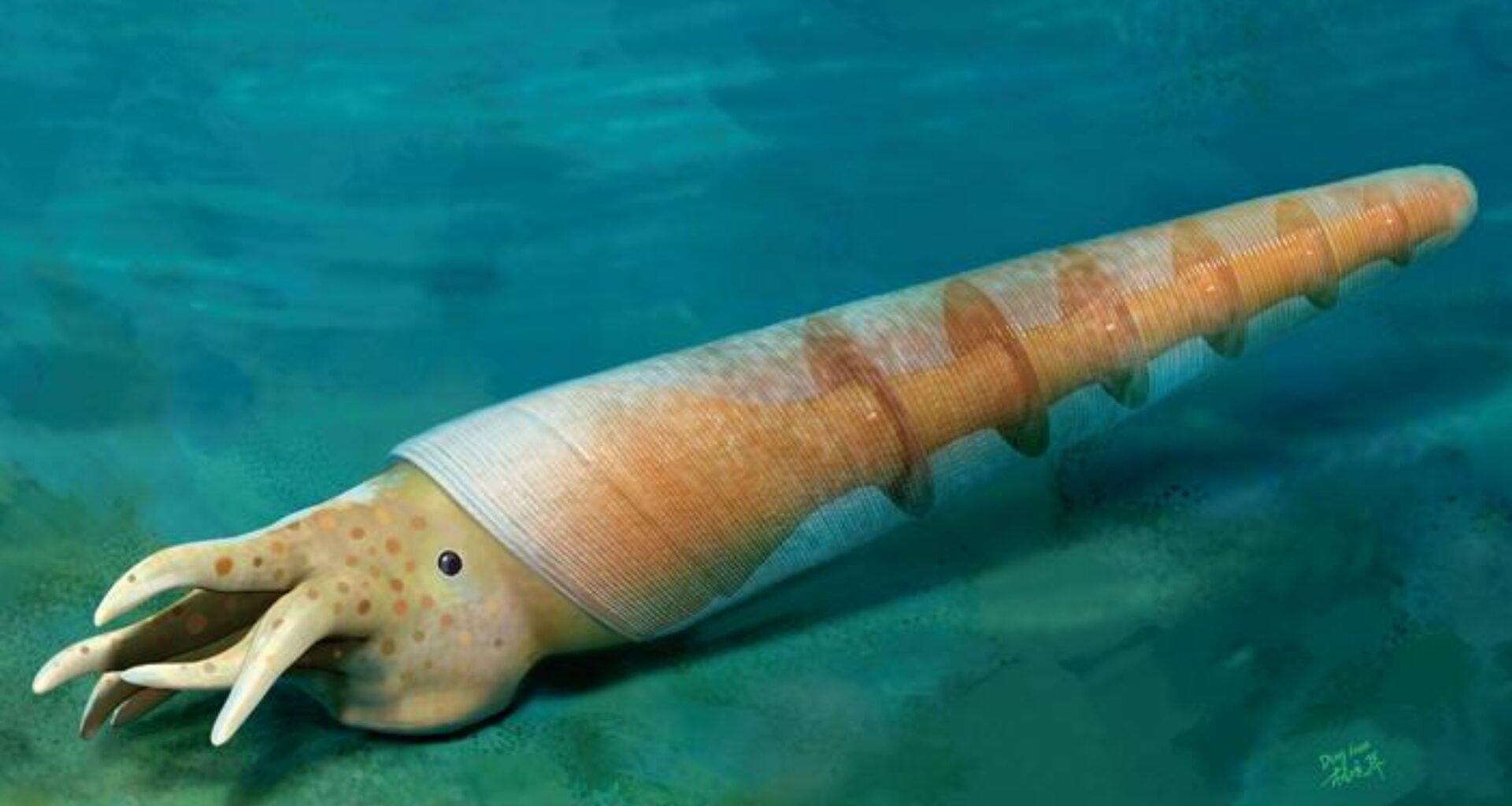
Eoceras shaanxiense had an orthoconic shell, which means a straight cone rather than a coil. Its opening sat at an angle, and the interior was divided by a series of walls called septa.
Along one side of the shell ran a segmented tube that appears to connect those chambers through minute canals. That tube is the structure the team reads as a primitive siphuncle.
A proposed path to buoyancy
The pattern preserved in Eoceras let the authors sketch how the cephalopod shell was assembled. They lay it out in three stages.
First came a straight, chambered shell divided by septa. The animal grew forward toward the opening and sealed off the space behind it as it went.
Second came a sealed, segmented tube linking those chambers, the stage Eoceras appears to occupy. Third came a true siphuncle, with septal necks and connecting rings.
That last version is the one later cephalopods used to swim. Ammonites, belemnites, and the nautilus still alive today all inherited it.
Life on the seafloor
A rudimentary buoyancy system does not buy much lift. The authors think Eoceras spent most of its life on the seafloor rather than swimming in open water.
That reading fits its size. At about a millimeter, the animal was closer to a grain of sand than to anything capable of chasing prey through the water column.
The fast, predatory lifestyle the group is known for came later, once the plumbing improved. What Eoceras shaanxiense offers is the moment before that, when the hardware was still crude.
Limitations of the study
The paper is careful not to overstate its findings.
The researchers describe the tube as a candidate primordial siphuncle and classify Eoceras as a stem cephalopod, rather than a member of the group’s modern crown lineage.
That caution has history behind it. Several earlier claims of early Cambrian cephalopods were later reinterpreted as chimaeras, fossils that combine parts of two unrelated animals.
Eoceras also lacks features seen in later cephalopods, and its soft body is not preserved. Nothing in the specimens shows the arms, funnel, or muscles that would settle the case outright.
The authors say the question stays open. More early Cambrian material is needed before the first stages of cephalopod evolution can be resolved.
Why this discovery matters
If the reading holds, the earliest cephalopod in the fossil record moves back into the early Cambrian. That is close to where genetic estimates had already placed the group’s origin.
It would also put the group’s start inside the burst of animal diversification that produced most modern body plans. Cephalopods would be part of that event rather than a late arrival.
The find changes where to look, too. Small shelly fossils, the millimeter-scale debris that fills early Cambrian rock worldwide, are now worth searching for cephalopod ancestors.
For a lineage that ended up producing the octopus, that is a modest place to begin. The record may start with something you could lose in the palm of your hand.
The study is published in the journal Nature.
Image Credit: YANG Dinghua
—–
Like what you read? Subscribe to our newsletter for engaging articles, exclusive content, and the latest updates.
Check us out on EarthSnap, a free app brought to you by Eric Ralls and Earth.com.
—–