
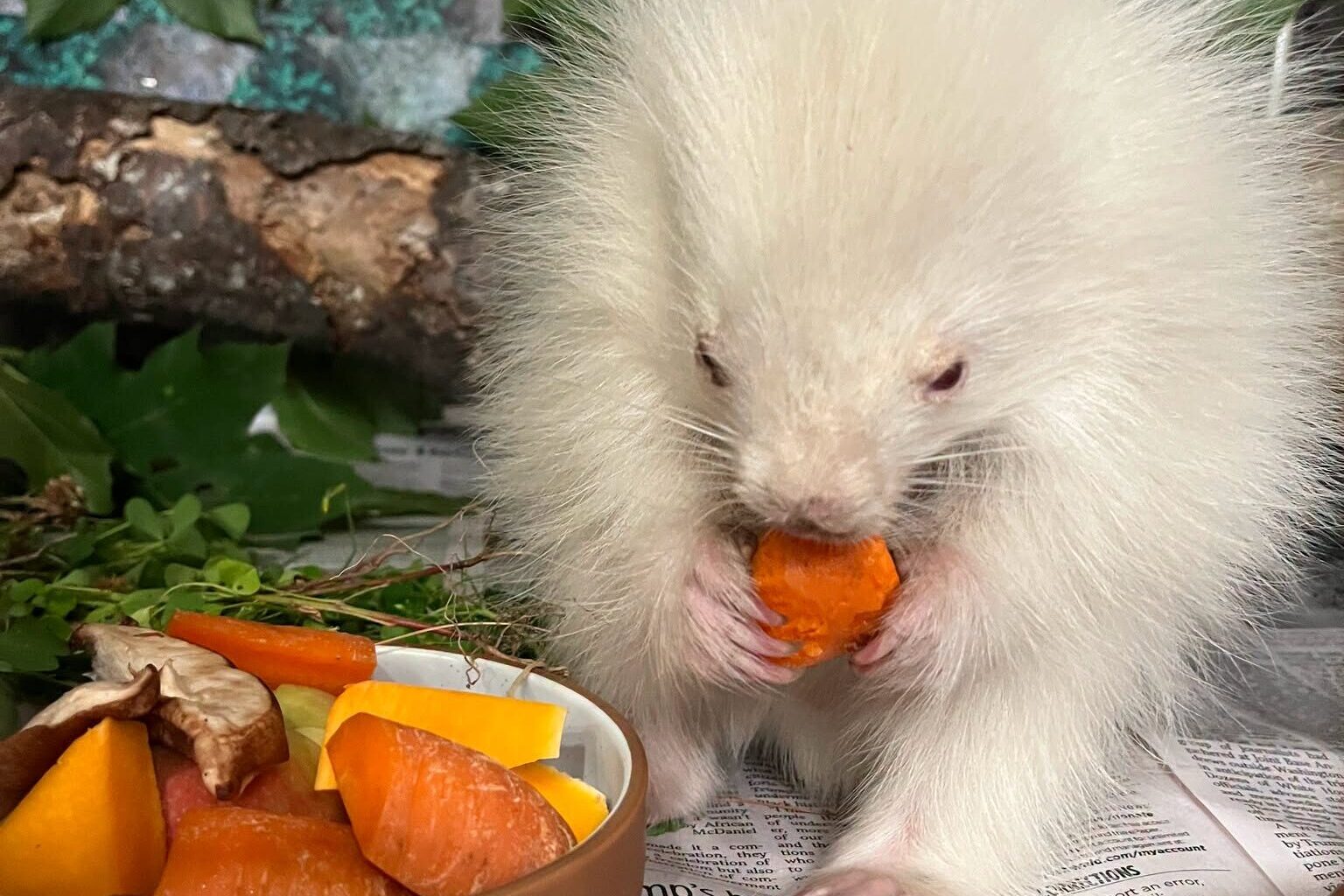
 Small albino boy. Credit: Center for Wildlife
A young white porcupine rescued after dogs chased him in southern Maine appeared to have escaped the encounter unharmed. Then wildlife rehabilitators noticed something troubling around his eyes.
Albino porcupines are remarkably rare, and this young animal’s bright white coat made him impossible to miss. That visibility may have helped save him after dogs chased him in southern Maine, where a passerby intervened and brought him to a wildlife clinic. Although he had escaped the encounter without obvious injuries, staff soon discovered that the unusual porcupine was battling a serious case of mange.
The animal, which the Center for Wildlife described as an albino North American porcupine, arrived at its clinic without visible wounds and with a healthy appetite. But crusting around his eyes soon spread to one foreleg and his front paws. Staff also noticed nasal discharge and raspy breathing. Now, the young porcupine is receiving medication and daily supportive care while staff monitor his recovery.
A Close Call in Maine
The porcupine was found just north of Kittery, Maine, after several dogs began chasing him. The person who witnessed the encounter intervened before the dogs could cause any obvious serious injuries.
“This baby porcupine was discovered after some dogs were attempting to chase it. Thankfully, his rescuer was able to step in before any serious injuries occurred,” the Center for Wildlife wrote in a Facebook statement.
Because the porcupine was young, unusually colored, and possibly injured, the rescuer brought him to the center’s clinic.
At first, staff saw no visible wounds. The young animal seemed stable enough to settle into a double-wide enclosure stocked with browse—leafy branches and plant material for chewing—along with food and water. He ate well, clearing his plate and working through the browse.
 He just wanted some cronch. Credit: Center for Wildlife
But the crust around his eyes worried the clinic team. Soon, staff noticed a similar patch on one arm. The signs pointed to mange, a skin disease caused by mites. The crusting worsened despite daily cleaning, then spread to his front paws. His nose began to discharge, and his breathing turned raspy.
×
Thank you! One more thing…
Please check your inbox and confirm your subscription.
“Our clinic team is working hard and keeping a close eye on him as they administer medication to fight off the mange infection,” the center wrote in the same Facebook statement.
For now, the porcupine remains at the Center for Wildlife, a nonprofit wildlife medical clinic and education center. Staff are cleaning away crust as best they can, giving medication and watching for signs that the infection is easing.
The Strange Luck of an Albino Porcupine
 Coconut. Credit: Northern Lights Wildlife Society
North American porcupines (Erethizon dorsatum) are usually dark-bodied animals with pale-tipped coats. They are stocky, short-legged climbers with strong tails and quills covering most of the body except the belly and legs. Adults can reach about 60 to 90 centimeters long and weigh around 11 kilograms.
According to the Center for Wildlife, only about one in 10,000 porcupine births produces an albino individual—an animal with a genetic condition that reduces or blocks the production of melanin, the pigment that gives color to skin, fur, and eyes.
 Porcupines are more likely to look like this. Image via Wiki Commons.
Albino porcupines do turn up, but rarely. In 2022, another pale youngster, later named Coconut, was rescued in Smithers, British Columbia, after residents reported that it had been chewing hydraulic hoses and electrical cables at their home.
“Our team went over there to have a look and spotted it and were able to guide it carefully into a transport box and bring it out here,” Angelika Langen, manager and co-founder of Northern Lights Wildlife Society, told CBC.
The sanctuary planned to keep Coconut through the winter while staff decided when the animal could return to the wild. “We love them,” Langen said, referring to porcupines. “They’re really cute animals to work with and craft quite the personality.”
The Maine porcupine now faces the same basic goal, but with a medical hurdle first. He has to recover from mange before staff can decide whether he is strong enough for release. His white coloring may also factor into that decision, since an animal that stands out can face different risks outside a clinic.
For now, the plan is simple: food, medication, daily cleaning and time. If the treatment works, the rare porcupine that arrived after a chase may get to return to the wild.