
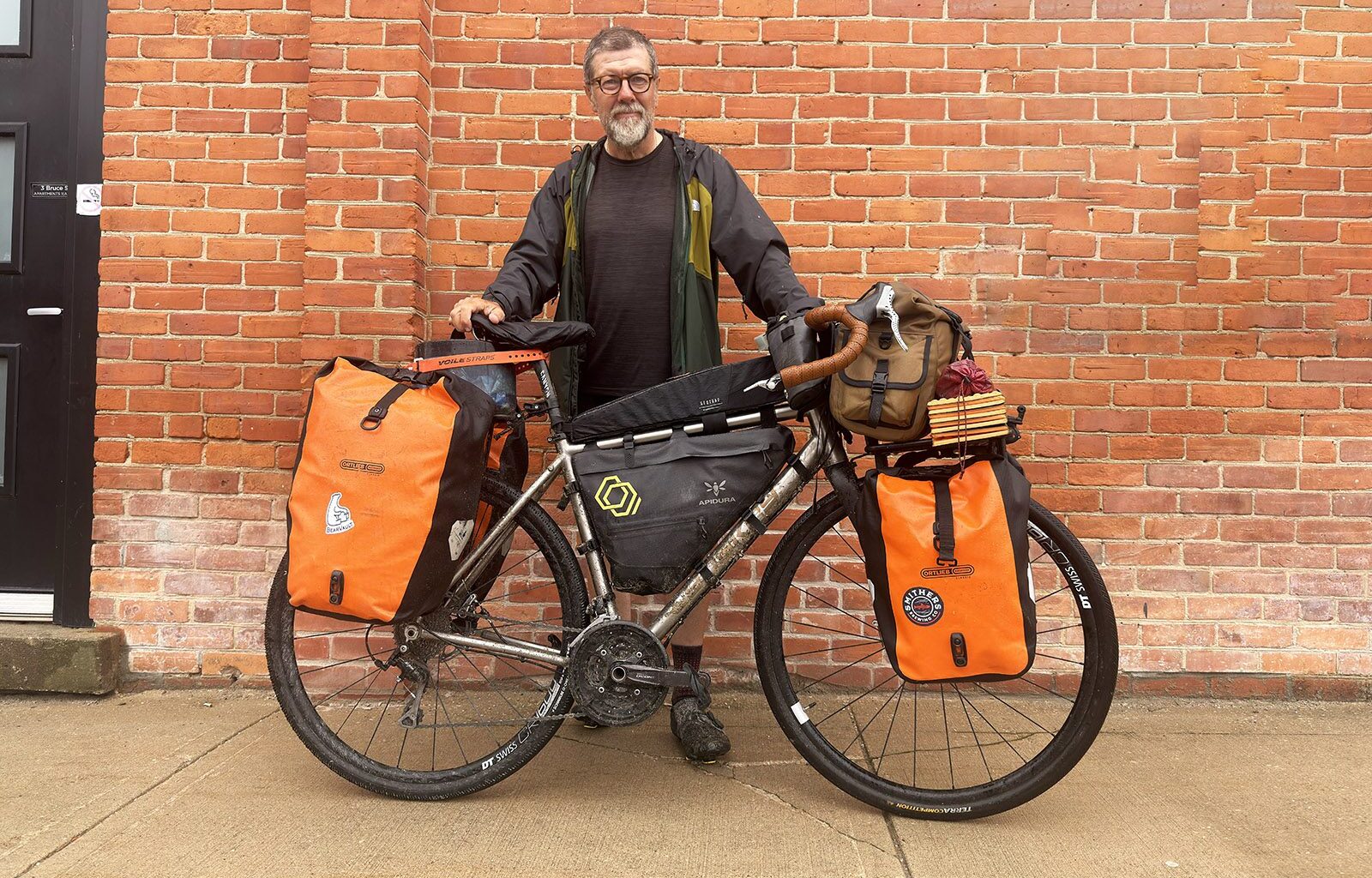
David Ward had spent months preparing to ride across Canada. He’s riding from Skagway, Alaska to Cape Spear, Newfoundland. The 55-year-old from London, England had researched bears, backcountry safety measures and packed bear spray before heading into some of the country’s more remote highways. Wolves, though, barely registered.
“They’re just so abstract to somebody from the U.K.,” Ward says. “We don’t have those kinds of animals. We’ve got rabbits, badgers and foxes.”
That changed on a lonely stretch of the Alaska Highway between Whitehorse and northern British Columbia. A large black timber wolf appeared on the highway in front of him. It was about 80 metres away. At first, Ward watched in awe. And he started filming.
A predator that would not back down
With the wolf ahead of him, he did what everyone told him to do, he whistled loudly. He stood up on his pedals to make himself appear larger and he slowly rode towards the wolf. He shouted. The wolf disappeared briefly into the brush. But as he got to where the wolf had left the highway he could see the wolf’s ears. It was looking at him. And as he came closer it came out of the brush and lunged at him. Ward instantly hopped off the bike.
“I got off the bike and put the bike in between me and it,” Ward says.
Instead of retreating, the wolf paced back and forth while studying him. It was a couple metres away.
“It felt like it was working out what I was doing in response to what it was doing.”
The encounter, which Ward estimates lasted only a couple of minutes, felt way longer.
“I can’t believe this is happening,” he remembers thinking.
When the wolf lunged again, Ward reached for his bear spray. He hit the trigger, but his first blast may have missed. Ward recalls feeling the effects of the spray himself. The wolf paced back and forth again. Then it lunged again.
“I got it that time.”
The spray sent the animal recoiling into the roadside ditch, pawing at its face. And thankfully an approaching RV arrived, pulled between Ward and the wolf and began blasting its horn.
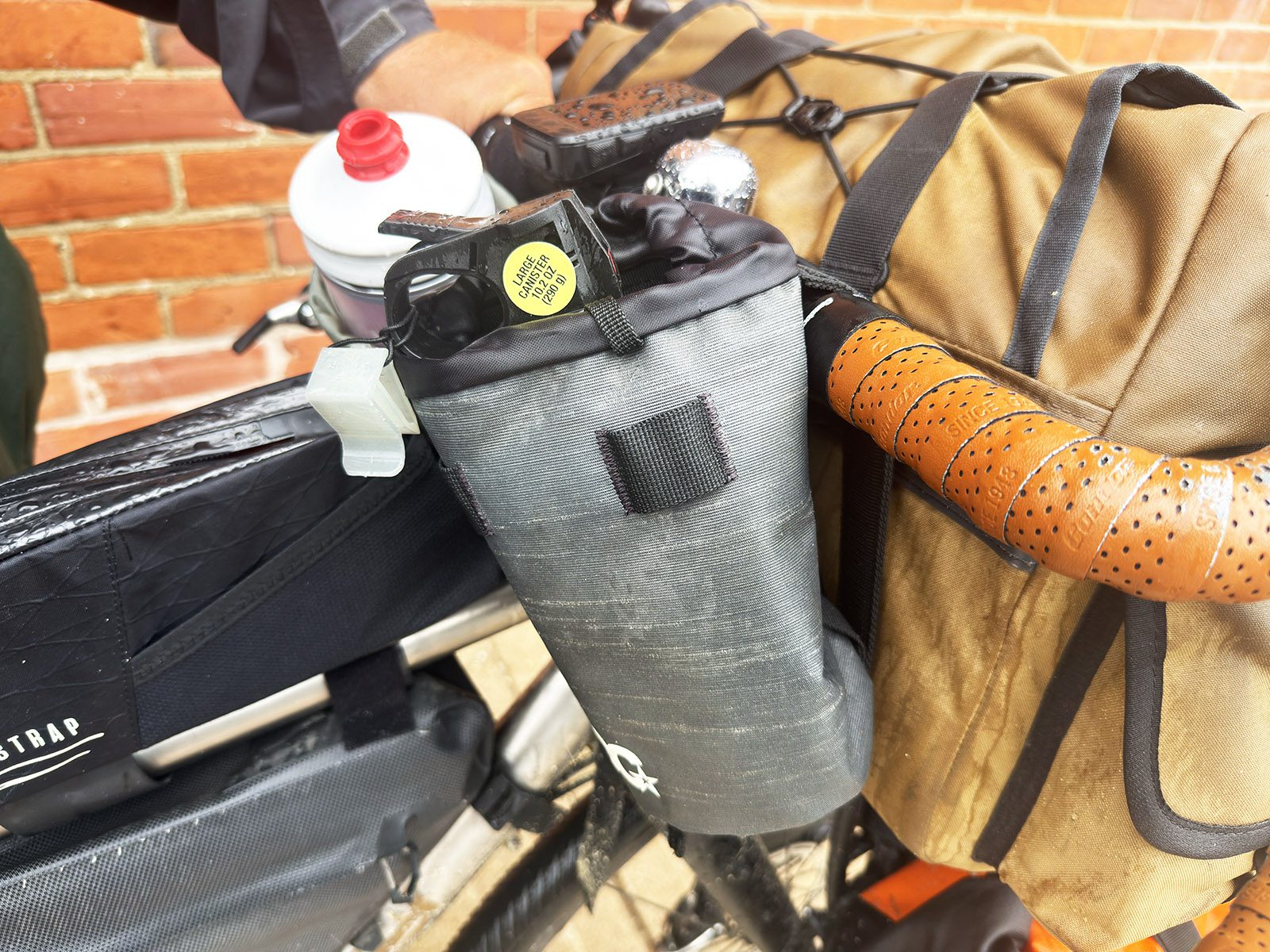 The most important piece of kit? Bear spray within reach. Even in downtown Thornbury. Colin Field photo.
The shock
The couple in the RV urged Ward to load his bike inside and accept a ride to safety. He refused. Only after they drove away did the adrenaline wear off.
“It all started to kick in,” he says. “I can’t explain or quantify it. It was just that feeling of vulnerability.”
What shook him most was realizing everything he had learned about making noise and appearing intimidating had failed.
“I thought everything that I’d learned about being big and making noises worked,” he says. “Then it just went straight for me. For two minutes I was on the food chain.”
Ward eventually reached the Continental Divide Lodge 35 km further down the highway. He was shaken.
The altered journey
The encounter altered the remainder of Ward’s ride. He had planned to continue down British Columbia’s remote Cassiar Highway, one of Canada’s classic long-distance cycling routes. Instead, he abandoned that section altogether.
“I was too switched on and affected by it,” he says. “It changed everything about the ride.”
The decision disappointed him. He had looked forward to riding the isolated highway, but the thought of camping alone after the attack proved too much.
“I was humbled by the whole thing,” he says.
So he got a ride to Kitwanga and carried on from there.
More than a bike ride
Years earlier, Ward survived a collision with a car that led doctors to discover a life-threatening aortic aneurysm. The crash likely saved his life by revealing the condition before it ruptured. His father died from an aneurysm. That experience pushed him to begin taking on ambitious rides.
“I had a bit of an existential moment one day. I woke up at three o’clock in the morning and was really thinking about mortality because you don’t do it when you’re younger. You think you’re so robust. The next morning I woke up and thought, ‘Right, I’m going to ride across America.’ I raised money for an online forum in the States that was supportive of people with heart surgery after replacement. So that’s what I did.”
That was in 2017. He rode from the Yorktown, Virginia to Astoria, Oregon. He rasied about $9000.
This trip honours his late mother, who died after complications from Alzheimer’s disease. Ward is raising money for Alzheimer’s research, saying he wanted to do something meaningful in her memory.
Looking back, Ward considers himself fortunate. Truck drivers later suggested the wolf may have been a lone animal forced from its pack or a female protecting nearby pups.
“I was just unlucky really,” he says.
The attack has not diminished his appreciation for Canada’s wilderness.
“It has given me a different perspective on nature,” he says. “The beauty of it, but also the need to look after yourself. It’s something I won’t forget quickly.”
Understatement of the year.
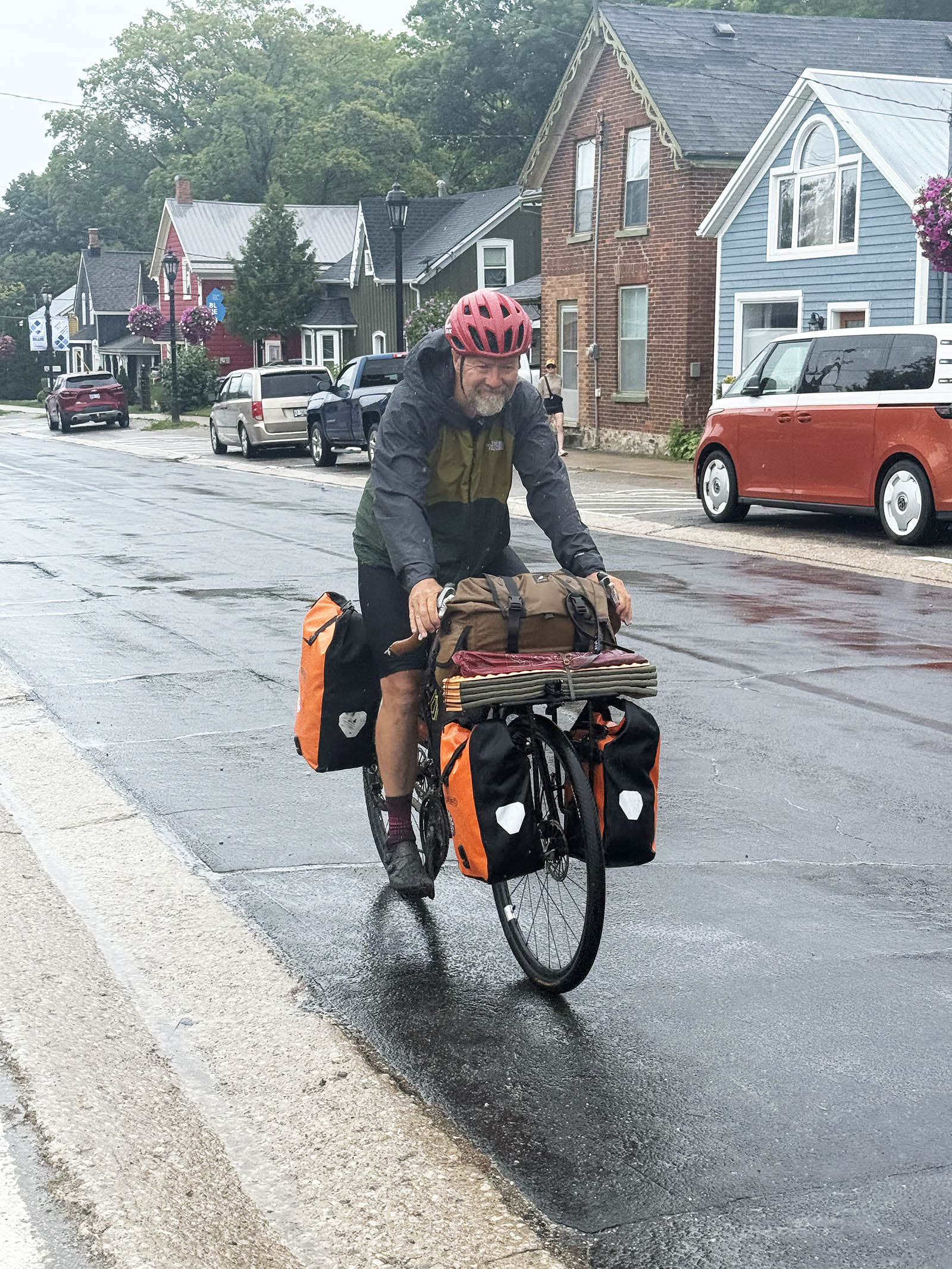 David Ward rolls into Thornbury, Ontario. Colin Field photo.
Where is he now?
Ward is currently in Ontario. He was forced into the U.S. briefly because of the Ontario forest fires, then crossed back into Canada at Sault Ste Marie. And he immediately survived another terrifying stretch of highway; HWY 17 south of the Soo.
“If I’m going to be taken out here, it’s going to be by a lorry or a car. That’s the facts, isn’t it really?” he says. “You get a decent shoulder, then suddenly it narrows right down to almost nothing on a single-lane highway. They’ve got the Great Lakes trail, but it takes you onto thick gravel roads. With road tires and a loaded bike you’re just pushing it and sliding around. My point is, if something was going to get me, it was going to be the road, not a bear.”
And apparently not a wolf either.
Ward is currently in Toronto where he’s meeting some friends and riding to Montreal (maybe with a brief stop at Parc Omega?). From there, he’ll keep heading east, and eventually get to Saint John’s where his wife will meet him.