
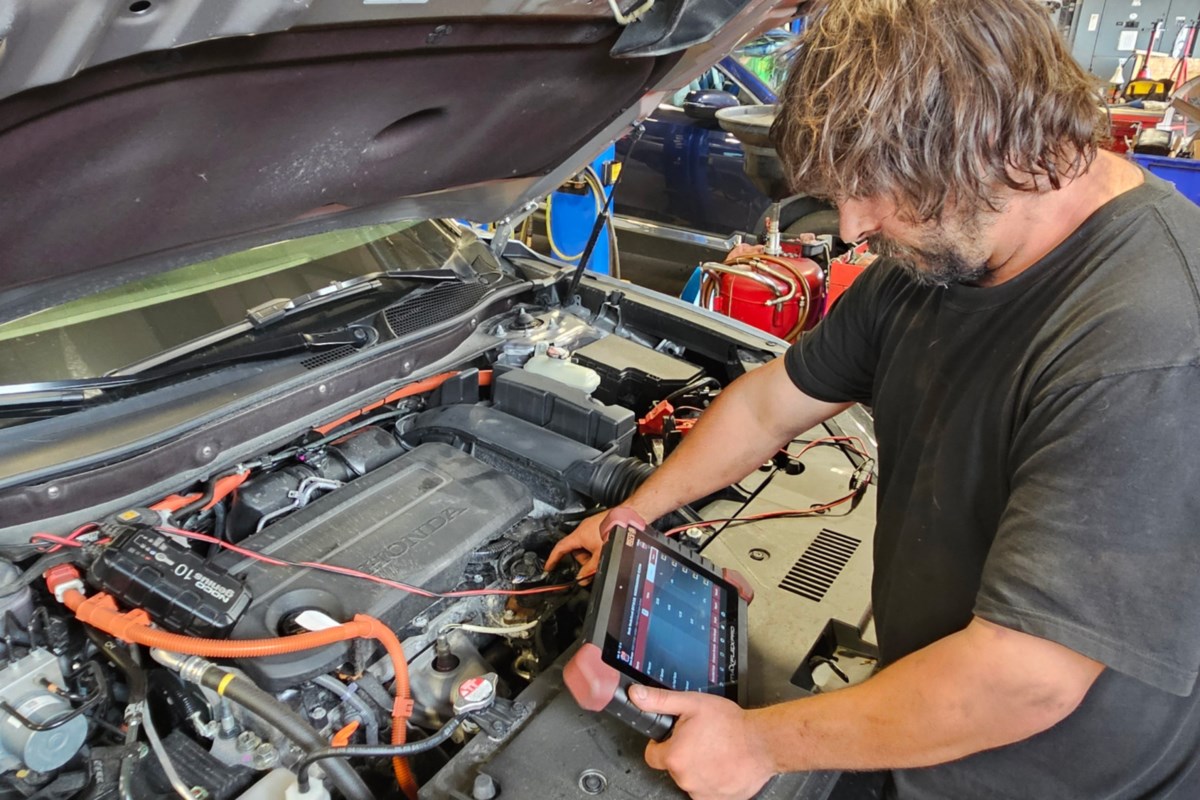
Senior technician at local car dealership says mechanics are documenting new EV and hybrid repair issues and sharing that information with the next generation
As long as people drive cars and trucks, there will always be a need for those who repair them.
Auto mechanics are needed in Sault Ste. Marie and across Canada, due in part to older workers retiring.
“We really need people. We really need skilled labour in automotive. Colleges and training schools are now revamping their training and I encourage young people to get that training,” said Eric Sylvestre, Great Lakes Honda senior technician.
Being an auto mechanic these days requires more than a patient, problem-solving mind and being good at working with your hands.
Apart from knowing how to repair gasoline and diesel-powered cars and trucks, there must also be a willingness to learn the new technology involved with hybrids and electric vehicles, Sylvestre said.
“In the last decade the technology has rapidly developed and the training has changed a lot. From the time I went to trade school at Sault College to now, the curriculum has changed immensely.”
“One of the things that we need for younger technicians is to get them up to date with this new technology. We’re shifting away from pure gasoline and diesel to hybrid vehicles and EVs.”
“Because the technology is still relatively new, you see a lot of unique problems with a lot of these hybrid and electric cars,” Sylvestre said.
Though he described his own transition to hybrid and electric vehicles as “daunting at first,” Sylvestre said young people going into the automotive trade should not be overly scared as mechanics currently in the field are sharing what they know with colleges and training schools.
“Being in a dealership, we’re the first in line to come across these problems. We’re the ones that have to figure them out. A lot of that information gets documented over the years, all of these issues. When we document these issues and how we fix them, we push that information along to other people and train them.”
Much of an auto mechanic’s work involves diagnosing problems with vehicles using computerized equipment.
“You’re basically driving a computer with wheels,” Sylvestre said.
“Diagnostic software is where the training is really going to be focusing on because the electronics and the systems in cars are incredibly complicated. If you’re good with information technology then you’re already a step ahead.”
The money is there for those who love to repair vehicles.
Beginners make between $18 and $22 per hour while experienced mechanics make between $29 and $35 per hour.
Specialized automotive technicians can earn $43 per hour.
“You could make roughly $60,000 a year but I’ve known technicians make over $100,000 a year in certain fields. Those are very efficient, very quick techs who do their job very, very well,” Sylvestre said.
Young people wanting to be an auto mechanic must find an employer to sponsor their training and register them for an apprenticeship, complete 6,500 hours of work experience along with 720 hours of in-school training at a community college and pass an exam to earn their qualification.
Sylvestre began working on small engines and cars in his teens and has been a professional auto mechanic for the last 12 years.
“I’ve always loved cars,” he said.
“I have classic cars, I have race cars. Automotive has been my passion.”
“I would recommend the automotive industry especially if you like to work with your hands and solve problems. Every day you learn something new in this job and that helps us teach the next generation of technicians to come.”