
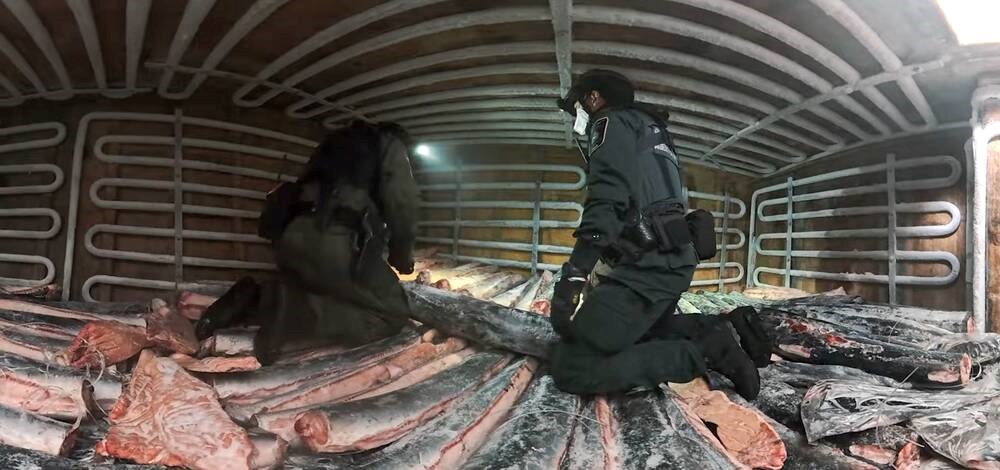
Industrial fishing vessels are rendering fish into oil, so it’s impossible to determine if the species are legally caught, while others are harpooning dolphins to use as shark bait.
Large industrial fishing ships in the North Pacific are rendering fish into oil, making it impossible to determine if the species are legally caught.
Other vessels are harpooning dolphins, their bodies cut into chunks to attract sharks.
Those sharks are caught using illegal gear and pulled on board, their fins hacked off for market, before the sharks are shoved overboard, still alive.
It’s all happening on the high seas between Victoria and Tokyo, and Canada is flexing its enforcement muscle, catching bad actors who continue killing sharks for their fins and others who take protected marine mammals, illegal catches of Pacific salmon and other species out of season.
For the fourth consecutive year, a Canadian Coast Guard ship, officers from Fisheries and Oceans Canada, and the RCMP led a multi-country mission to crack down on fishing fleets beyond the 200-nautical-mile limit.
The goal is to catch those who aren’t playing by international rules, taking too much or hiding what they catch.
Officials said Thursday it’s beginning to pay off, with the international fleet starting to expect Canadian patrols.
Operation North Pacific Guard, a two-month mission on the Victoria-based Sir Wilfred Laurier, spent 56 days on the high seas covering more than 10,000 nautical miles.
The operation involved armed Canadian fisheries authorities and other partners, including Japanese, Korean and U.S. counterparts, boarding 30 international vessels.
Satellite tracking technology was used to locate ships, while a Canadian aircraft — a DFO Dash-8 usually based in Campbell River — tracked the vessels and provided video to Canadian boarding crews.
The jet covered 42,230 nautical miles over 31 patrols and tracked 344 vessels.
The mission reported 52 potential violations of international fisheries rules, and documented poor living and working conditions for fishing crews.
Fisheries officials did not specify the country of origin of many of the vessels found with illegal catches or infractions, citing confidentiality agreements between nations. But most were part of Asian distant-water fleets, flagged in such countries as China, Taiwan, Japan, Korea and Russia.
More than 1,100 vessels are registered to fish in the high seas of the North Pacific, with about 400 operating during the time of the mission between late May and mid-July.
Some are “very significant vessels, commercial-scale, factory-size ships with 60 to 80 people on board,” Sean Wheeler, chief of international enforcement for DFO, said at a media briefing on Thursday.
“They have huge capacity, and if they are engaged in illegal activity, they could have an incredibly destructive impact.”
Wheeler said the legal catch in the North Pacific last year was more than 700,000 metric tonnes.
He said large Russian ships with fish-oil-rendering tanks on board, some exceeding 70,000 litres, were initially noticed last year and are a major concern.
“The scale of rendering is significant, and it’s impossible to inspect the oil for what kind of fish was caught,” he said. “We are trying to find how many vessels are operating this way and working with the international community to determine what can be done.”
Canada works with the ships’ flag states to support further investigations and fines, and potential sanctions on offending vessels.
Wheeler said Canada provides reports with photo and video evidence to international fisheries organizations.
He said last year, a Taiwanese fishing boat captain was sentenced to more than two years in prison for harpooning 43 dolphins used for shark finning.
“We are glad to see some punishment coming out of the investigation we’re providing and hoping this starts to increase the deterrence for these captains,” said Wheeler. “It’s a significant jail sentence, and it’s hoped it will have strong deterrence for years to come.”
DFO said there was a drop in the number of dolphin kills this season from other years, but Wheeler said it’s too early to see a trend.
“We are maintaining a focus on dolphin captures and shark violations continue to be problematic, but given the sentencing we saw, we’re hoping it will have an impact into the future.”
Canadian Coast Guard officials said Canada’s involvement in North Pacific fisheries enforcement is making a dent in the problem of illegal fishing. DFO has been involved since 2019 and has led the mission since 2021.
“We saw significant signs of awareness of Canada’s presence this year,” said Wheeler. “We were seeing ships that are adjusting their behaviour because they know Canada will be conducting enforcement in the Pacific.”
DFO said illegal fishing poses a global threat, undermining fish populations and marine environments, as well as having a significant impact on fair markets and global seafood supply chains.
The enforcement efforts protect vulnerable fish stocks, including Pacific salmon. Starting last year, fishing fleets were banned from taking salmon. Wheeler said no salmon were found on any of the vessels inspected, which was “very positive to see.”
Canadian Coast Guard officials said it was the second year that the Fisheries Agency of Japan deployed a fishery officer to the Canadian patrol vessel and the first year that a Canadian fishery officer joined FAJ’s high seas patrol.
This year’s operation included 19 DFO fishery officers, including five participating in air surveillance operations in Japan.
The mission had to make a detour for a high-seas rescue on June 26. The Sir Wilfred Laurier responded to a call from a sailboat in distress about 1,500 nautical miles southwest of Adak, Alaska. Three Canadians were on board.