
Edmonton is no stranger to heated debate about bike lanes, and this summer the issue has made headlines.
At a community meeting in Edmonton last month, community members who oppose a plan for new bike lanes in the Capilano neighbourhood were speaking with the province’s transportation minister when a herd of cyclists rolled through.
“You’re driving on a one-way road illegally. Do you realize that?” a man, standing on the street, shouted at pro-bike lane rally-goers who were travelling south on 50A Street.
“You are too, idiots. Look at you,” one of the cyclists responded.
The City of Edmonton has been growing the community’s active transportation network, rapidly building more pathways and connections over the past few years.
But bike lanes, specifically, have created tension.
Those in favour argue they create safe spaces for modes of transportation other than automobiles. Those opposed have a host of concerns that can relate to parking availability and traffic impacts, economic and business consequences, and whether the routes will be used.
The Alberta government also recently started gathering complaints about bike lanes. Transportation Minister Devin Dreeshen has previously said his government is watching a court challenge in Ontario, where a law was passed prohibiting municipalities from installing bike lanes if it means reducing automobile lanes.
CBC News reviewed municipal data to get a sense of how often Edmonton’s bike lanes are used. We also spoke with transportation and urban planning researchers to better understand the nuance of the debate.
Cyclist trips rising in Edmonton
The City of Edmonton tracks daily cyclist counts, having set up almost 50 sensors along various types of cycling infrastructure citywide, from protected street bike lanes to shared pathways. They measure the number of bikes that cross them, so the data is a better indicator of traffic volume than individual cyclists.
CBC News analyzed the daily counts from Jan. 1, 2019, to July 31, 2026. Data suggests total cycling traffic has increased each of the past four years — and nearly 1.3 million trips have happened through the first seven months of 2026.
Many of the counters are set up along the river valley and in central Edmonton. Zooming in on each location, data shows most of the traffic is concentrated around the city ’s core: between downtown and Wîhkwêntôwin, on the High Level Bridge and through the Garneau and Strathcona neighbourhoods.
But the rest, even those located deep in the suburbs, each count tens of thousands of trips per year.
“The demand for cycling is often latent,” said Raktim Mitra, a Toronto Metropolitan University urban planning professor. “There are many people who would want to cycle, but they don’t, because they don’t feel it’s safe to do so. Cycling facilities help us break that barrier.”
He said while it’s common to hear gripes about a lack of traffic in new bike lanes, it’s “an unrealistic expectation” that high volumes will develop overnight. People need to learn how to use the infrastructure safely, he said, but it also takes time for people to change their behaviour.
Missing links
According to a City of Edmonton spokesperson, through the active transportation network expansion program alone, 35 kilometres of “new active transportation connections” were built since 2024, with another 24 kilometres planned for 2026 and beyond. Other routes have been built through other capital programs, such as neighbourhood renewal.
Those connections are essential to bringing more bike traffic to peripheral routes, said Ahmed El-Geneidy, Canada Research Chair on public transportation planning.
“If you build one bike lane on one street and then it doesn’t take you anywhere, … people are not going to use it,” said El-Geneidy, who is also a professor at McGill University.
“People are going to use the bike lanes when it is a safe route for getting from point A to point B. So you have to think about it as a network.”
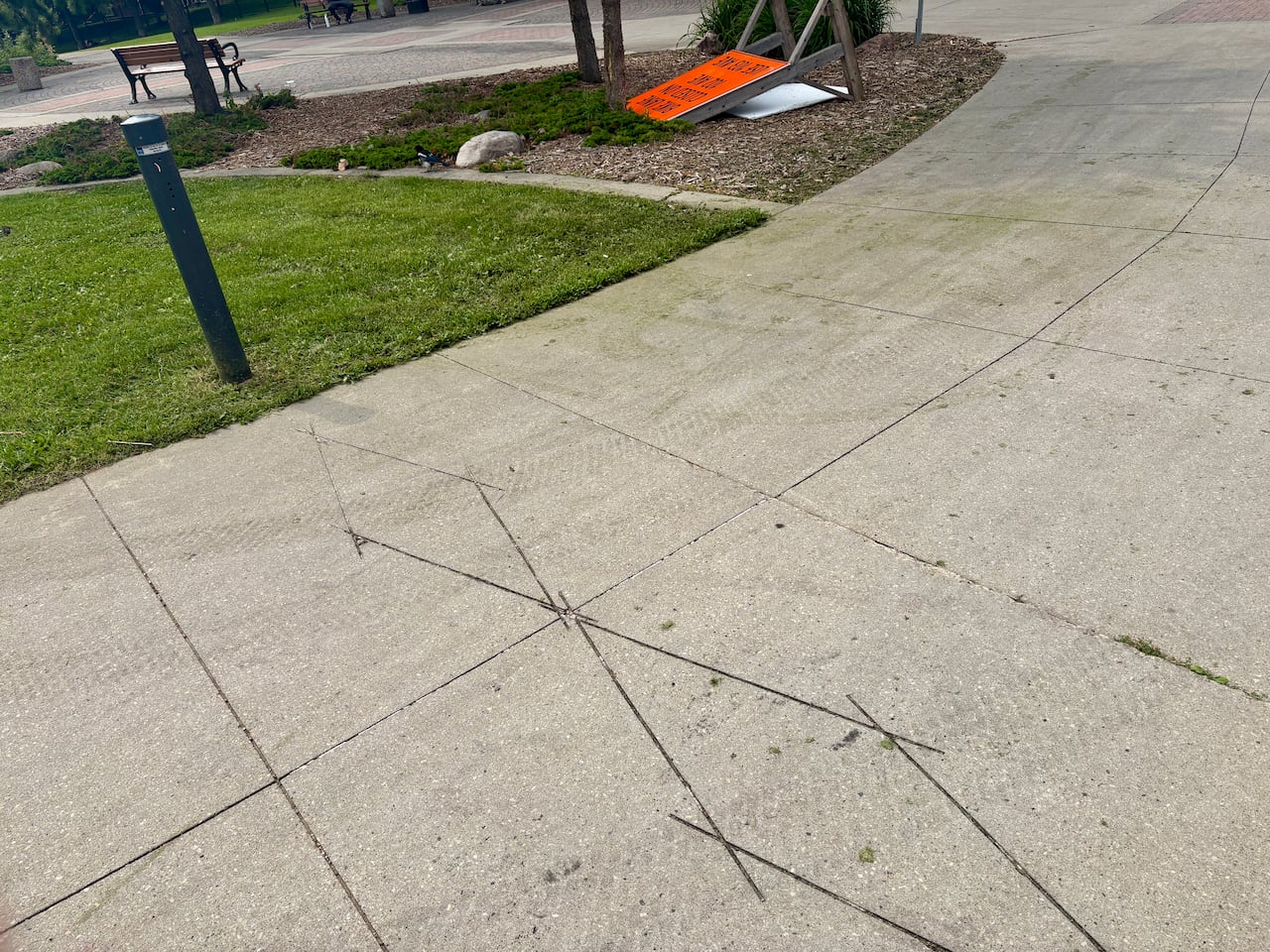 Marked with a diamond pattern in the pavement, more than 50 sensors like this one are tracking cycling traffic in Edmonton. The data shows most bike activity centres around the city’s core. (Emily Williams/CBC)
Experts like El-Geneidy say bike lanes can make the roads safer for all parties. And giving people more options for getting around is a necessary part of managing congestion in a growing city.
However, Dreeshen said in May that he believes Alberta’s expanding cities need more roads, not bike lanes.
A spokesperson for his office said the government is supportive of bike infrastructure when well-planned. Removing lanes of traffic “may reduce roadway capacity and impact the safe and efficient movement of vehicles and emergency services,” the statement said.
One year later
Advocates have said much of the backlash to bike lanes comes from people worried about change coming to their community. They argue once the lanes are in, most people enjoy them.
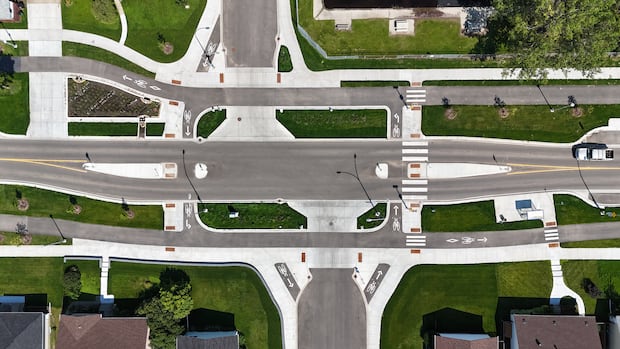
One of the more controversial bike lanes last year was a stretch along 132nd Avenue. One year later, public feedback is still mixed.
For Jeff Esteves, it means traffic coming to a halt during after-school pickup and a single-file line of cars trapped behind buses.
“Between 3 p.m. and 4:30 p.m., forget about using 132nd Avenue,” he said.
 Delwood resident Jeff Esteves says the 132nd Avenue bike lane isn’t that well used. Esteves says it’s causing the exact traffic headaches the province is worried about. (Emily Williams/CBC)
“This whole road alignment is actually worse than what I thought it would end up being.”
Esteves said he’s not seeing any more bike traffic than the community had before the bike lanes went in.
But others say it’s not all bad. Amy Hebert likes the traffic calming effect that she says the bike lanes have had.
“People used this as a secret shortcut … and cars would fly down here doing 60 [km/h] and sometimes 70 [km/h],” she said.
“I would not let my kids go down to the next next few blocks over to the next schoolyard because I wasn’t comfortable with the safety of the roads.”
Now, Hebert’s kids scoot on down to school or the park unsupervised almost every day.
“I definitely think that this is a community that needed them,” she said, adding that she believes the green space and landscaping have elevated the feel of the area.
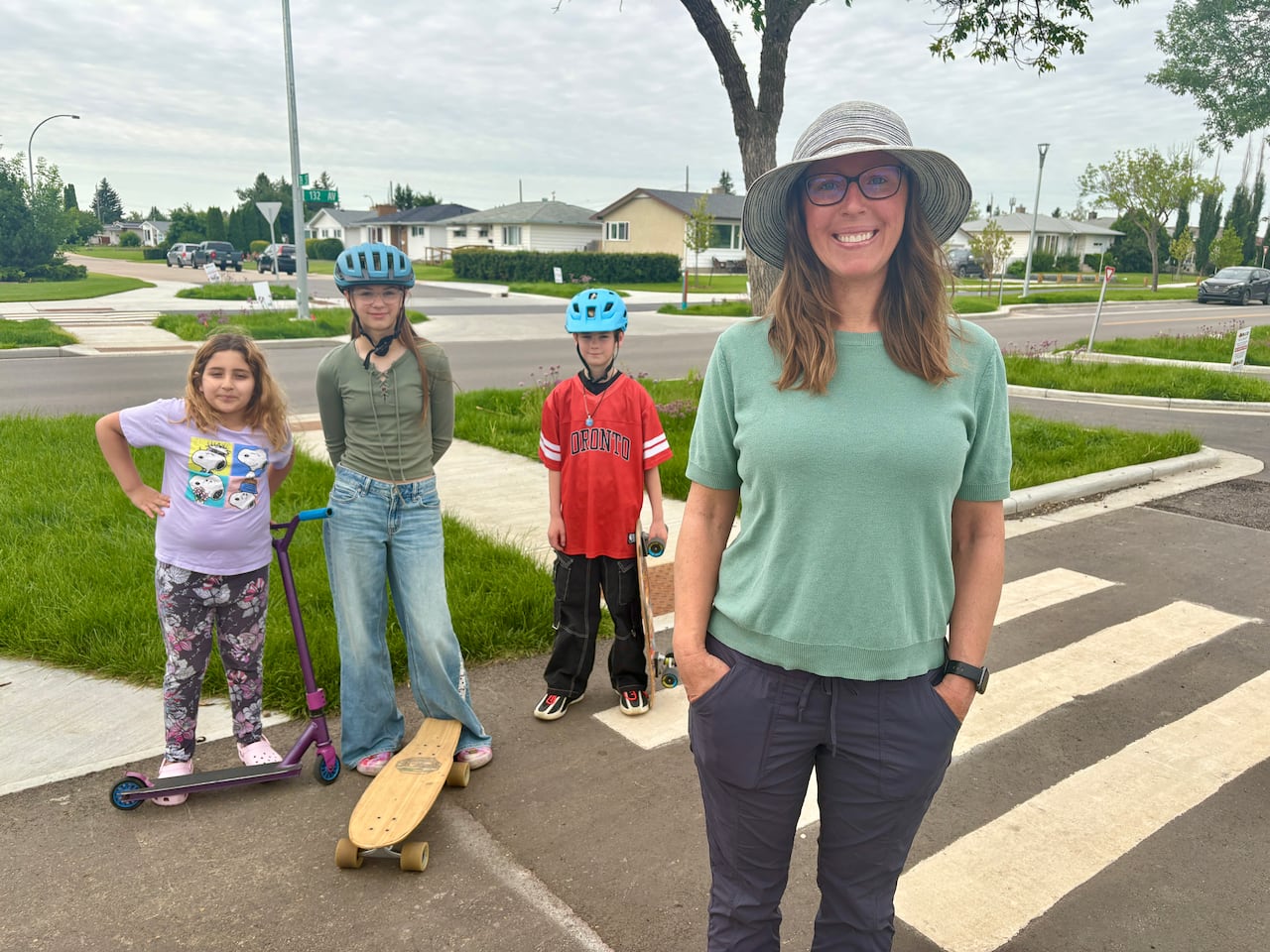 Amy Hebert and her kids Justus, 10, and Seraph, 13, plus their neighbour Thea, 9. Hebert says her kids use the 132nd Avenue bike lane almost daily to go to school or the park. She feels safe letting them do so unsupervised now that cars are forced to slow down along the narrower street. (Emily Williams/CBC)
Could 132nd Avenue be a candidate for removal under new bike lane legislation? Dreeshen hasn’t ruled it out.
Esteves said while he’d like to see the road redone, he doesn’t think that’s realistic given what the city has spent. Instead, he’s hopeful the province will step in and put a stop to similar projects moving forward.
“I think it does need to be looked at because I think the city continues down this path without consideration for some of what residents and taxpayers are bringing up as concerns.”
Meanwhile, city crews have been working full tilt to further build out Edmonton’s bike network this summer, albeit with some modifications in response to concerns. It remains unclear whether those modifications will be enough to satisfy critics, and what lies ahead for the future of Edmonton’s bike network as a whole.