
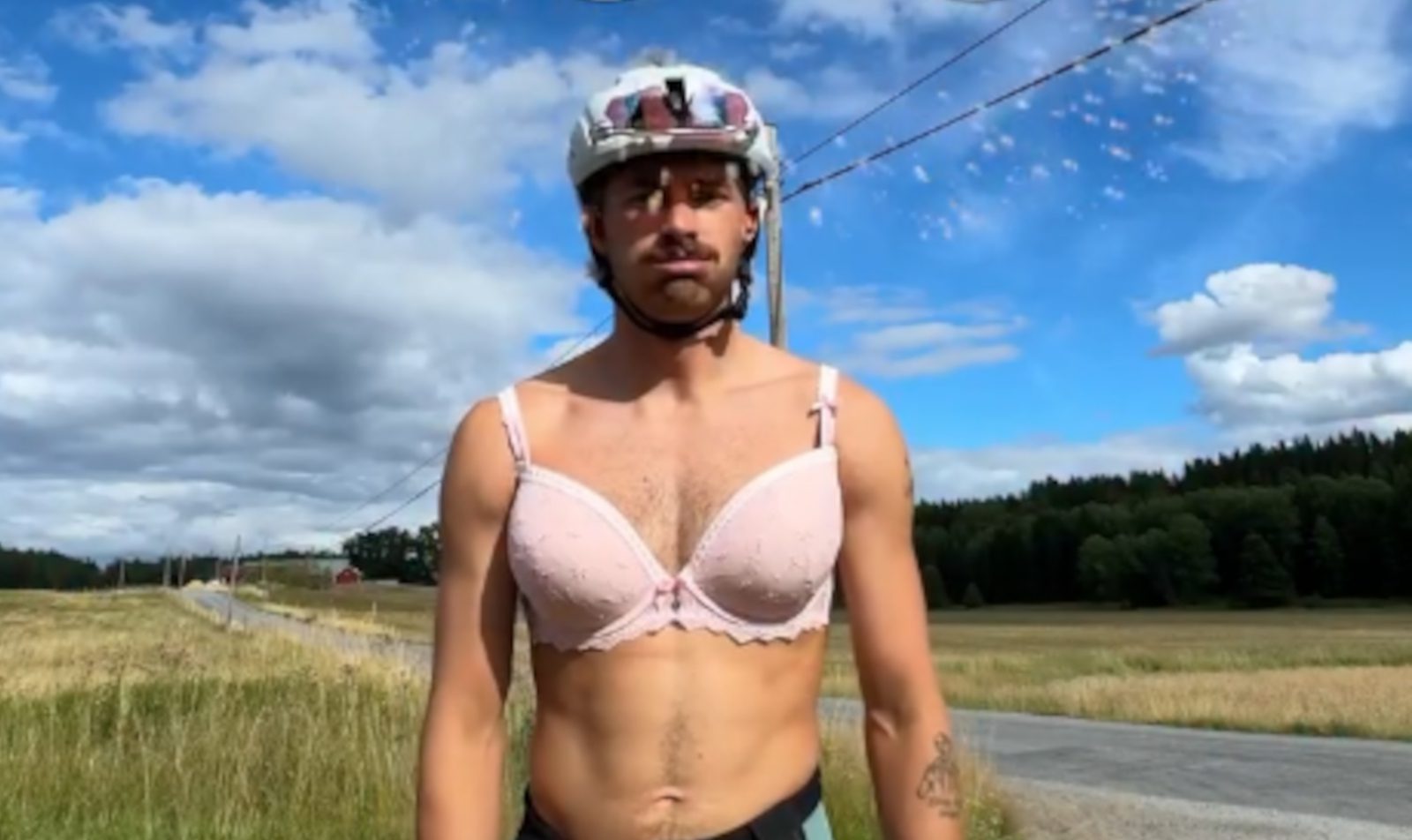
The so-called ‘bra doping’ debate has made its way from the Tour de France Femmes to the world of triathlon. (Also it was the winners at Canadian Cycling Magazine who came up with the term, for better or for worse.)
And btw, speaking of the TdFF, please check our daily coverage of the race as it’s been absolutely spectacular. The nine-day race is coming down to the wire with the finale in Nice. So please check our site for all of the coverage and post-race coverage, ‘cuz there’s been a lot.
Lundberg weighs in
Swedish triathlete Elias Lundberg decided to find out for himself whether there was actually anything to the idea that filling the space between the arms and chest could make an athlete faster. Because hey, why not?
The Swede, who’s pretty damn good, normally uses two bottles snuggled between his armar, a familiar setup in triathlon that can also provide an aerodynamic benefit. For his test, he swapped the bottles for a bra and headed out for a series of intervals. Funny story, the word for good in Swedish is bra. Serious. Väldigt bra.
The test
Anywho, the plan was six 10-minute efforts, alternating between the two setups.
After finishing the test, Lundberg checked the results and came to a rather amusing conclusion: the bra was faster.
His reported difference was around 0.3 per cent.
That is a tiny margin, but still. Lundberg’s experiment was hardly a controlled scientific study. Still, he calculated that at 40 km/h over 180 km, the difference could add up to roughly 40 seconds.
The test is similar to the thinking behind the recent controversy in cycling. Recently, researchers said they have looked at whether adding material to the chest area can smooth airflow and reduce drag. In other words, the idea behind “bra doping” isn’t completely ridiculous from an aerodynamic standpoint.
Lundberg, for his part, seemed more amused than anything else.
“Stop the cap,” he joked after declaring the bra the winner.
He then suggested trying the experiment again with bigger or smaller bras to see whether the size made a difference.
Science? Maybe not quite.
But apparently, someone had to test it.
Although this is seems like an Instagram bait-post, there’s some truth to it. In fact, major teams like Lidl-Trek admitted they’d tested padded bras–just like the men who would use bottles, or radios, or whatever, to round out their profile and be a bit quicker.
The idea behind the bra test isn’t as ridiculous as it sounds. Aerodynamics professor Bert Blocken has studied the effect of chest fairings on cyclists, has argued that changing the shape of the chest can smooth airflow and reduce drag. The Dutch dude, through his research found that an optimally shaped chest fairing could reduce aerodynamic drag by as much as 3.6 per cent. That doesn’t mean a rider is suddenly going to gain tens of seconds, but over a 20- or 30-km time trial, even a few seconds can matter.
And we all know in cycling, that counts. I mean look at the Tour de France Femmes–it’s coming down to the last day. All pro cycling is the matter of seconds, not minutes, it seems lately. I’m sure there’s a joke about every masters rider rushing to the store to get a padded bra, but let’s just focus on the TdFF.
The Tour de France Femmes wraps up tomorrow after an amazing nine days. What a race.