
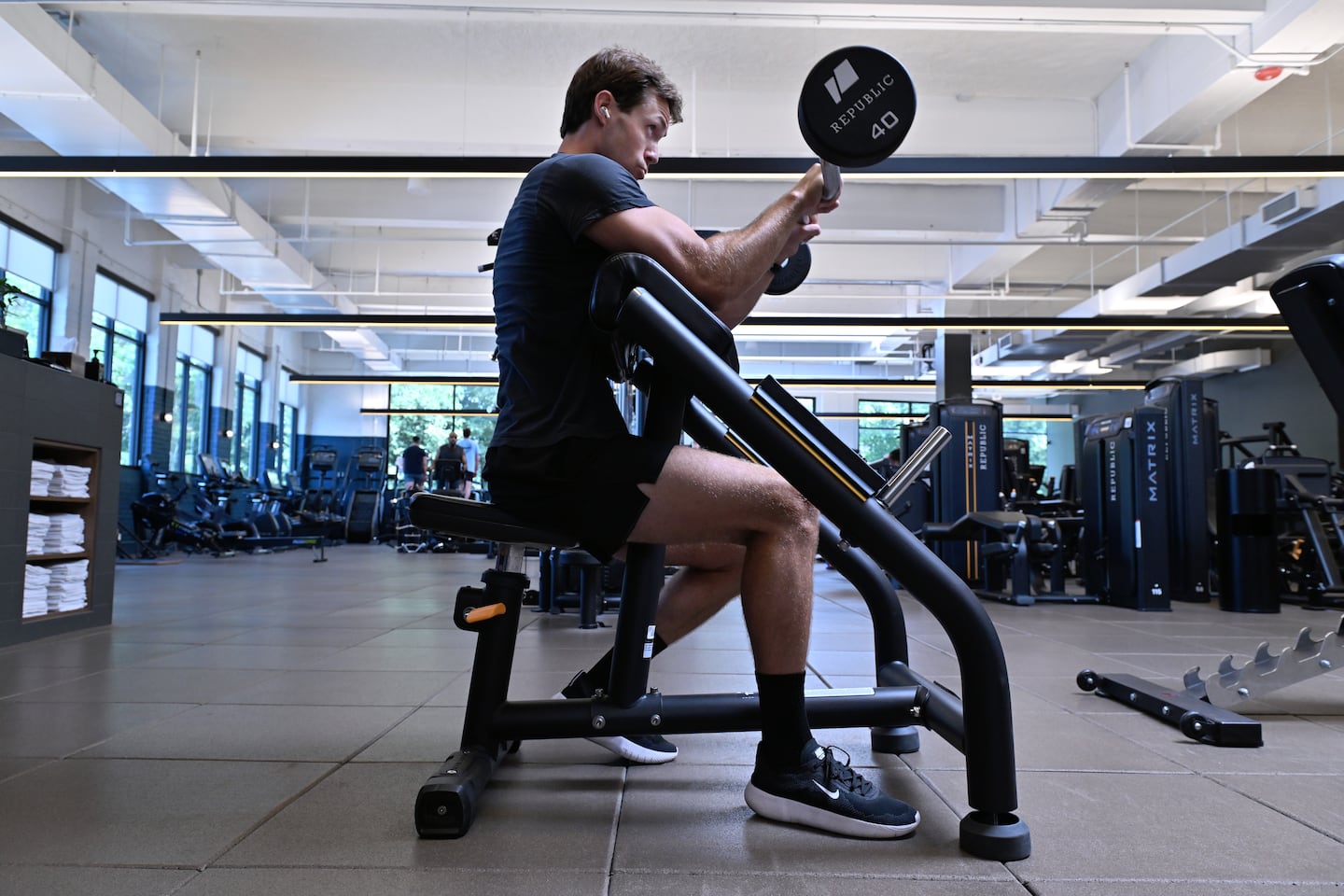
The reasons for the rebound are many. The fading of COVID-era sensitivities helped propel many fitness enthusiasts from home treadmills to public clubs. Employers’ return-to-office plans have led many employees to look for spots near work. And health-conscious young people are bringing a whole new generation of customers into the gym.
Geoffrey Janey, founder and owner of JET Boston-Brooklyn, said some of his young gym-goers are intermingling expensive lifestyle choices like high-end workouts with weekend nights out on the town.
“It’s almost like the new club is working out,” Janey said.
Since 2019, membership has grown 20 percent at Healthworks, GymIt, and Republic Fitness, making it the highest on record, according to Mark Harrington Jr., president of Healthworks Group, which operates the three gym franchises.
Healthworks has been trying to construct new gyms and expand its current locations, but it’s a difficult feat, he said, pointing to how a successful gym should be in a pedestrian-dense district and tends to require a large, costly build-out.
Even when gyms make their best attempt to persuade people to switch, loyal gym-goers often won’t leave.
Selhadin Yasin, 25, doesn’t plan on leaving any time soon from the Planet Fitness in Downtown Crossing. Yasin, an accountant, pays $15 per month for unlimited access to gym equipment.
“It’s all I need,” he said.
A few blocks away, Jeff Bissinger, a 33-year-old who works in finance, frequents Equinox for an hour or two most mornings for amenities like a steam room and personal trainer. Bissinger pays around $500 per month and lives nearby.
“It’s stupid. It’s very expensive,” Bissinger said. “But I value investing in health and wellness, and this is incredibly convenient for me.” (Equinox, a premier gym chain with five clubs open in Boston, declined to comment.)
In 2025, there were 1.9 million fitness-facility members across Massachusetts. That number is the same as in 2019, according to the Health and Fitness Association, a trade group that represents gyms. Meanwhile, the number of commercial health clubs and studios remains around 1,700 — about the same as in 2019.
Buoyed by such high demand, some of Boston’s priciest gyms cost hundreds of dollars per month even for memberships that don’t include all amenities.
Bene Stroud, a 29-year-old who works in marketing, did deep research on Equinox’s fitness instructors and their techniques before putting down almost $300 per month.
A private fitness instructor, Stroud moved from Florida around two months ago and has tried other Boston gyms. Those she frequented didn’t open early or have savvy instructors, she said.
But other operators may have somewhat lower prices, niche workout classes, and special events — providing a middle ground between low-cost and higher-end gyms.
“We’re not running it like a [private equity] firm,” said Giampaolo Nicosia, managing partner of SoWa Health and Wellness, referring to some ritzy high-end gyms.
When SoWa opened in September 2023 in the South End, it had 400 memberships. Now, it has more than 2,000 gym-goers, each paying $190 per month — the same rate as when it opened. But management will cap memberships when lines for equipment become too long, Nicosia said.
Nicosia has noticed that there’s almost no space for large gyms to come to town, and attracting customers from small boutique studios is difficult. “Most of Boston is pretty saturated right now,” he said.
Elsewhere, Planet Fitness gyms recorded $1.3 billion revenue in 2025, up 12 percent from 2024. Memberships also grew by a net 1.1 million, according to a report from February. Now, it has over 21 million members worldwide.
New York Sports Club, formerly operated as the chain Boston Sports Club, has three locations in Greater Boston after a whirlwind of legal headaches and bankruptcy erupted in 2020.
At six of Beacon Hill Athletics Clubs’ seven locations, around 35 percent of gym-goers are Gen Z, and referrals grew 10 percent year-over-year from 2024 to 2025.
Because more young people are spending on health and wellness, making gyms more of a one-stop shop has become more important than ever, said marketing coordinator Jeremy McCabe.
Household spending on alcohol is hanging around 40-year lows, and Gen Z’s spending growth for gyms is over double that of alcohol, according to a February report from Bank of America.
“People know what they want,” McCabe said, “and what they can get out of their dollar.”
Redmond Bernhold can be reached at redmond.bernhold@globe.com.