

Listen to this article
Estimated 2 minutes
The audio version of this article is generated by AI-based technology. Mispronunciations can occur. We are working with our partners to continually review and improve the results.
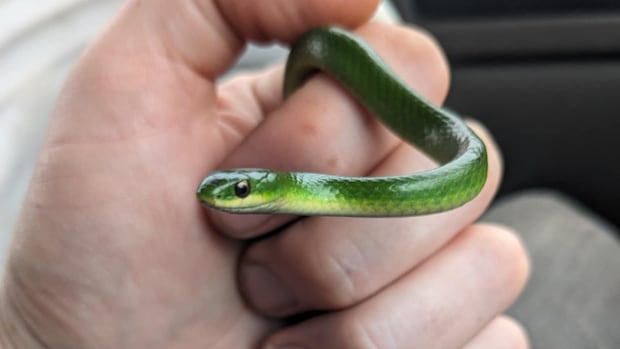
Prince Edward Island wildlife officials are asking residents to bag and freeze any dead smooth green snakes they come across to assist with conservation research.
“We’d love if you could place it in a plastic bag and put it in your freezer,” said Julie-Lynn Zahavich, a forest conservation specialist with P.E.I.’s Forests, Fish and Wildlife division. “Then contact us through telephone or our Facebook page and we’ll come collect it.”
Smooth green snakes are P.E.I.’s rarest reptile and are currently listed as “potentially imperilled.” While the province previously asked the public to report live sightings, researchers now require physical specimens for genetic testing.
Zahavich said studying dead specimens helps researchers gauge the population’s overall genetic diversity.
“That’s pretty important for the health of the population here in P.E.I., because populations with a higher genetic diversity tend to be able to adapt to things better,” she said.
 Julie-Lynn Zahavich, a forest conservation specialist with the P.E.I. Forests, Fish and Wildlife division, is asking Islanders to take home and freeze any dead smooth green snakes they find. (Jane Robertson/CBC)
Islanders who prefer not to handle dead snakes can report location details instead, though time is critical.
“It’s a bit tricky because we are competing with scavengers like crows, ravens and foxes who would see a dead smooth green snake as an easy meal,” Zahavich said. “We did have a couple calls last year, but we didn’t make it in time.”
Searchers should also know that dead smooth green snakes do not stay green.
“They’re of course known for their bright green colour, but when they die they can turn like a bright turquoise or blue colour,” Zahavich said.
Alive, the snakes appear green because light passes through a top layer of yellow pigment and reflects off a blue layer underneath. When the snake dies, the yellow pigment breaks down rapidly, leaving only the blue layer visible.
Anyone who finds a specimen is asked to secure it in a plastic bag, freeze it immediately and contact the Forests, Fish and Wildlife division.