
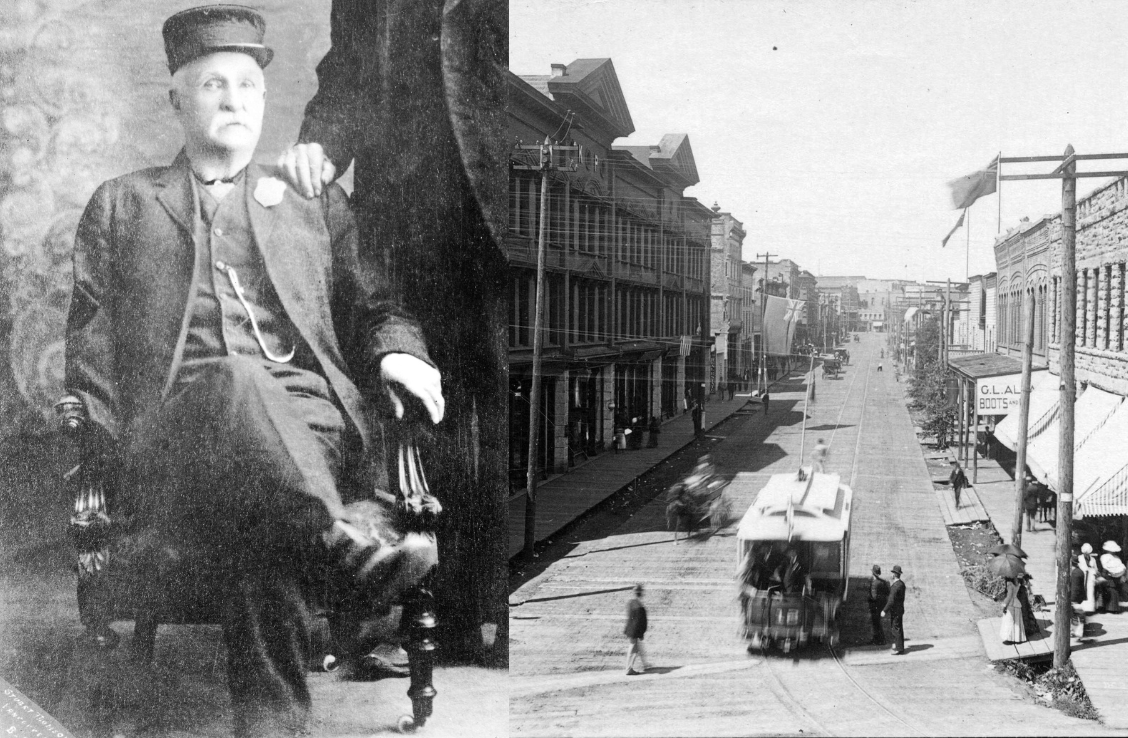
From misspelled names that became official to the one-armed lamplighter.
Roads are one of the great unifiers of a city.
While there can be some arguments between transit users, cyclists, and drivers, there are certain basics everyone is looking for, like even surfaces, clear markings and well-lit roadways.
Well, those things didn’t always exist in Vancouver.
110 years ago Vancouver had dirt, gravel, brick, granite and wooden plank roads
While most roads in Vancouver are asphalt now, that wasn’t the case 110 years ago.
It’s not a surprise that dirt and gravel roads were once common, but at times the early city also used brick, wooden planks, and granite slabs to create roads. In fact, the original road around Stanley Park was partially made from the shell midden the local First Nations had created in what is now the park.
Even in the 1930s the majority of roadways were still gravel or dirt (though at the time the majority of Vancouver was forest and farm).
L.A. Hamilton named a road after himself
Lauchlan Alexander Hamilton was the land commissioner for the Canadian Pacific Railway in Vancouver for the two years he was here, surveying much of the city and organizing its early layout.
As such, he was responsible for many of the street names in the original city area (before South Vancouver and Point Grey joined).
Among his names are the tree streets in Kitsilano and Fairview (like Fir and Oak), Burrard (he just used the name that was being used for the inlet), and Eveleigh (which Hamilton forgot the namesake of).
He also took the bold move of naming a road after himself, Hamilton Street. It should be noted that for a time Hamilton and Hastings was considered the first street corner of Vancouver.
Spelling mistakes in the names
Hamilton, and others, didn’t always nail the spelling of street names when they made it official.
Among the street names on signs that don’t match their namesakes include McLean Drive (named after Malcolm MacLean), Cardero Street (named after Cordero Channel), and Bidwell Street, which Hamilton was trying to name after Bedwell Bay.
One person to light the streets
Before the advent of electric street lights (and even a bit after, as the system grew) there was only one person who ever held the title of lamplighter in Vancouver.
John Clough was born in England and spent time driving cattle and mining gold when he was a young man. In fact, he struck it rich in California and bought a ticket home, according to his nephew in 1931. He spent some of that money on a ticket back to England, partied hard just before the trip, and lost his pass.
The ship he was booked on ended up sinking, with all hands lost. After that he came to B.C. and worked on the railway construction. One day, while blasting, he lost his arm.
After that, he ended up in Vancouver, where he was hired as the new city’s first lamplighter in 1887, lighting coal oil lamps above the roadways in Gastown.
However, the job didn’t last long, as the first electric street lights arrived in August of 1887 and oil lamps were phased out.
The signs were a mess
An archival Vancouver Sun from 1948 tells of how difficult it could be to navigate Vancouver using the road and street signs.
While there was a level of standardization, it wasn’t 100 per cent.
The biggest issue was that some signs only had the name of the street on one side (which isn’t great for a two-way road), meaning visitors driving through certain neighbourhoods had to rubberneck to keep track of where they were.
Others were actually transparent with a lamp behind (and therefore liable to burn out or break). Some signs had a lamp above, but at an angle that cast a shadow over it, making it impossible to read at night. Also, when signs had to be taken down (sometimes for months), temporary signs weren’t put up due to the expense.