
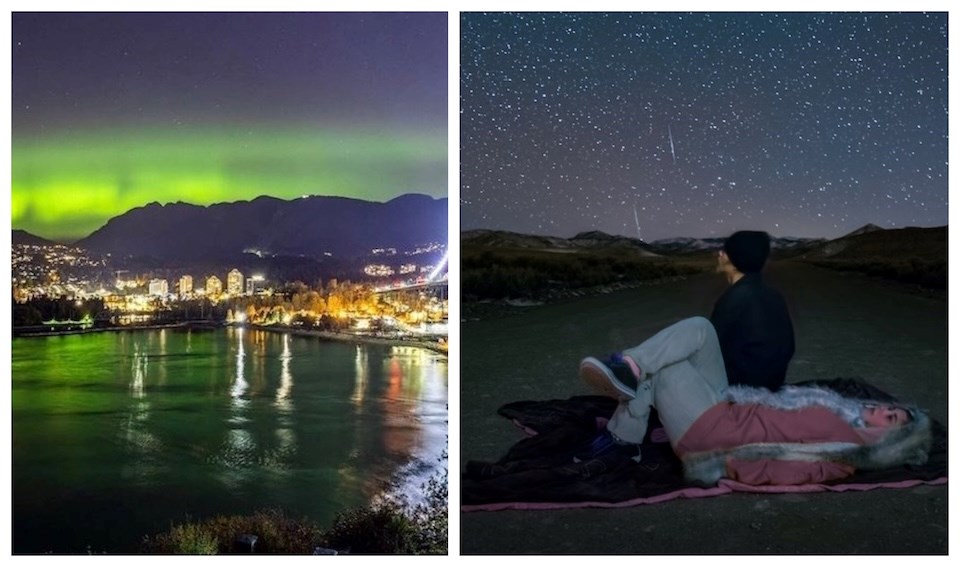
The Perseid meteor shower is one of the year’s most productive.
One of the year’s top meteor showers will peak in Metro Vancouver on Wednesday, and you might see the northern lights dance tonight.
Mother Nature is pulling out all the celestial tricks this week, and the weather forecast might actually be on our side.
The American National Oceanic and Atmospheric Administration’s Space Weather Prediction Center hasn’t issued a geomagnetic storm warning, which is typically followed by a northern lights display. But other agencies are making different predictions.
The University of Alaska Fairbanks (UAF) expects “high aurora activity” on Tuesday (Aug. 11) with displays overhead possible from “Inuvik, Yellowknife, Rankin and Iqaluit, to Juneau, Alaska, Edmonton, Winnipeg, Thunder Bay and Sept-Iles. They may also be visible low on the horizon from Seattle, Des Moines, Chicago, Cleveland, Boston and Halifax.
This means that Vancouver should see a display low on the horizon, rather than overhead.
The university’s online aurora monitor map shows what regions the aurora’s green glow will likely reach, and other areas where it is less likely. Additionally, a brief description below the map shows the aurora activity on that particular day.
The Metro Vancouver weather forecast also shows clear skies overnight Tuesday, meaning skywatchers can enjoy ideal conditions for watching the painted display.
Perseid meteor shower
The Perseid meteor shower is one of the year’s most productive, meaning you get more shooting stars per hour during its peak.
The peak will happen on Wednesday evening and into early morning Thursday, when observers under dark skies can expect to see 100 or more meteors per hour.
The shower is also famous for its “fireballs,” which are “larger explosions of light and colour that can persist longer than an average meteor streak,” according to NASA. They are also significantly brighter than other meteors.
“This year’s display should be especially good because the shower peaks close to the new moon. With very little moonlight in the sky, viewing conditions will be much better than in years when a bright moon washes out the fainter meteors,” Rosanna Tilbrook, an astronomer at the H.R. MacMillan Space Centre, tells Vancouver Is Awesome.
The Perseids are named after the constellation Perseus, from which they appear to originate. Although this constellation is visible in the northeast night sky, “you don’t necessarily need to look in this direction to spot shooting stars, as they’ll streak across much of the sky,” she says.
Unfortunately, the forecast indicates showers overnight Wednesday. But you can still see many shooting stars in the days leading up to and following the peak. On Tuesday night, you may see shooting stars and the aurora!
Vancouver skywatching party this week
Whether you just like to look up and see cool stuff or you’re a bona fide space nerd, the H.R. MacMillan Space Centre welcomes guests to its facility to talk all things astronomy for a special night named after the annual shower.
The centre is hosting Perseid: Skywatching 101 on Thursday (Aug. 13), which will be a special night to bring skywatchers together for “an evening of immersive astronomy programming featuring a planetarium show, expert talks on meteorites and space rocks, an introduction to astrophotography, and telescope observing (weather permitting),” Tilbrook says.
Have a look at the itinerary for the special evening:
Planetarium show: Perseid — A Journey Through the Night Sky. Explore meteor showers, comets, asteroids and the summer night sky while learning what causes the annual Perseids and how light pollution affects our view of the stars.
Feature talk: Space Rocks: Unlocking the History of Our Solar System. Discover how meteorites and other space rocks reveal clues about the formation and evolution of our solar system.
Introduction to astrophotography: Learn how to photograph the night sky using everything from smartphones to dedicated cameras.
Observatory tour and telescope viewing: Weather permitting, enjoy guided telescope observing and an up-close look at celestial objects.