

Listen to this article
Estimated 3 minutes
The audio version of this article is generated by AI-based technology. Mispronunciations can occur. We are working with our partners to continually review and improve the results.
After watching a broadcast about a total solar eclipse over Antarctica in 2003, Yellowknife’s Stephen Bedingfield decided he wanted to chase every eclipse he could.
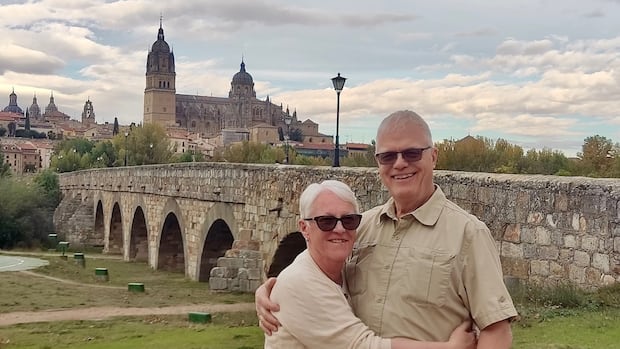
This week, he arrived in Spain with his wife, chasing his 13th total solar eclipse — 23rd when including partial eclipses — a spectacle expected to last about two minutes.
“Imagine if you could see the Great Barrier Reef, Niagara Falls … Mount Everest all in one place at one moment in time. The magnificence of it would describe a total solar eclipse,” Bedingfield said.
“There’s nothing like it.”
A total solar eclipse will be visible Wednesday across Greenland, Iceland, Spain, and northern Russia, along with a small part of Portugal.
While the total eclipse won’t be visible from Canada, there will be an opportunity to see a partial solar eclipse, where the moon will partially cover the sun.
“This is not just a terrestrial wonder. This is a solar system wonder and you see where the workings of the sun and the moon and the Earth are in perfect alignment to create this spectacle,” Bedingfield said.
 Bedingfield says he’s found a community of eclipse chasers during his two decades of travelling to catch the spectacle. (Submitted by Stephen Bedingfield)
During his travels as a solar eclipse chaser, Bedingfield has made friends and found a community.
“There’s a tribe of eclipse chasers now, people who are there at just about every eclipse. So it’s part of the excitement to actually experience this,” he said.
“It becomes a diary where you get to travel to different places in the world and you get to experience those cultures and people.”
He said while the eclipse may only last a few minutes, part of the experience is how it changes the environment.
“Temperatures will probably drop 15 C in a matter of 15 minutes. Birds will change their behaviour…. It’s just a total environmental experience,” he said.
“It’s such a spectacular sight.”
Use eye protection to view eclipse, says expert
Here’s when northerners can expect to see the partial eclipse in Yellowknife, Whitehorse and Iqaluit:
Yellowknife: Peak time 10:42 a.m. with 28 per cent of the sun covered by the moon. Whitehorse: Peak time 9:27 a.m. with 23 per cent of the sun covered by the moon.Iqaluit: Peak time 1:24 p.m. with 61 per cent of the sun covered by the moon.
Christa Van Laerhoven, the vice president of the Yukon Astronomical Society, says viewers should use proper protection to watch the eclipse.
That includes approved solar eclipse glasses and at-home alternatives, including making a pinhole projector using an empty box, a white sheet of paper and some foil.
WATCH | How to watch the solar eclipse safely:
A leafy tree and leaves with holes can also act as a natural pinhole projector, Van Loerhoven said.
“If you devise a way to look at the sun, you would see something that feels like Pac-Man. You’d see a bright crescent of the sun with a bite taken out of it.”
Van Loerhoven says there is a common misconception that the sun is more dangerous during a solar eclipse, but she says looking at the sun is dangerous at any time.
“It’s just that during a partial eclipse you’re much more tempted to override all of those warning signs and try to look directly at the sun.”