

.
When municipal planning priorities clash with the lived realities of local residents, it’s worth shining a light on the public process.
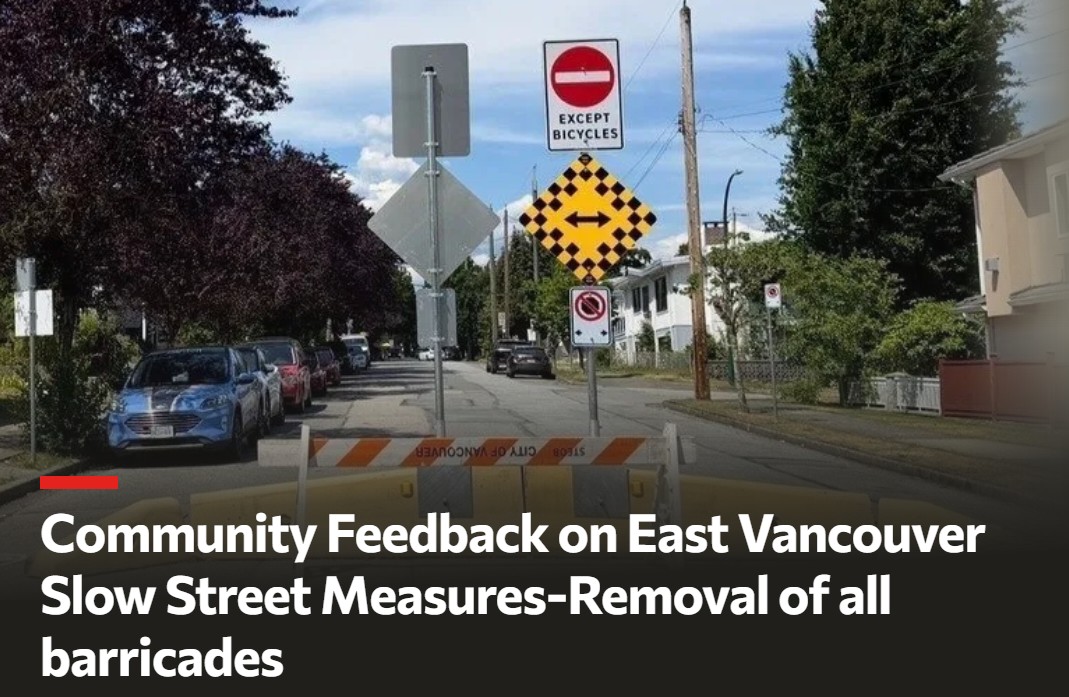
The City of Vancouver began in 2020 to roll out a maze of concrete barricades, traffic diversions, one-way switches, and street closures, especially in East Vancouver between 1st Avenue and Hastings Street and Nanaimo and Boundary Road.
Marketed as progressive “Slow Streets” and traffic calming (https://www.shapeyourcity.ca/slow-streets), these interventions have done the exact opposite and have sparked widespread frustration and safety concerns in some neighborhoods. The full road closures for all traffic, except for bicycles, is leading residents and emergency responders on a wild goose chase, just to find their way home.
Main roads are blocked and back alleys as a result have become the only way for motorists to get to and through the neighborhood and residents to get out. Traffic has been diverted onto school zones, vehicles are forced to pull illegal U-turns to get out of their streets, hundreds of parking spots have been removed and replaced with concrete in front of local residents’ homes, along with Lime Scooters, taking away much needed parking for the community.
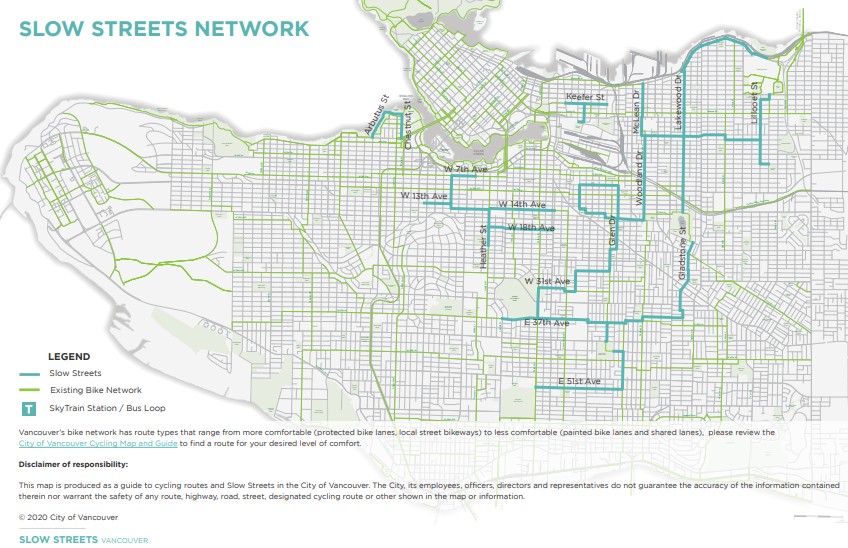
Above: Map of Vancouver’s Slow Streets Network circa 2020.
Grassroots pushback: East Van Traffic Coalition
In response to this top-down process, local residents have organized into the East Van Traffic Coalition, with a petition entitled “Community Feedback on East Vancouver Slow Street Measures -Removal of all barricades – Vancouver, Canada” on Change.org currently having over 2,000 signatures.
They meet regularly to share information and concerns, and want the City of Vancouver to “Remove the Barriers” and restore the neighborhoods to what they were before the barriers, specifically to have NO travel restrictions:
(1) between 1st Avenue and Hastings Street, and
(2) Nanaimo to Boundary Road.
CityHallWatch has not researched community sentiments in other neighborhoods affected by the Slow Streets program.
The East Van Traffic Coalition is demanding an immediate restoration of open, safe neighborhood access and meaningful public consultation.
Key concerns
Based on daily lived experience, community members say that the barriers are an issue that affects everyone, taking longer to get from point to point, creating hazards, and ultimately even costing more.
Delays for emergency responders: Concrete barriers impede first responders (fire, police, and ambulances), creating life-threatening delays in emergency response times.
More time out of people’s daily life.
Cost of goods and services increase because transportation and fuel costs go up.
Hazards due to diverted traffic, and loss of visibility: Large concrete blocks swallow up scarce street parking and create visual obstruction at intersections, leading to near-misses and vehicle collisions. Safety concerns for residents in their own back alleys and school zones, because main roads are blocked or obstructed. Rather than reducing car trips, blocked access diverts frustrated drivers into narrow residential back lanes and elementary school zones where children, seniors, and pedestrians walk.
Local businesses are affected by the closures and removal of street parking all along Windermere Street in East Van and everywhere else.
Loss of parking: Many residents (and their visitors) can no longer park in front of their homes due to parking restrictions and removals. In addition, Lime brand e-scooters have been installed in many places, without the public consent or direct neighborhood consultation, reducing available parking.
Grassroots mobilization in action
The coalition is not staying quiet. Meeting weekly on Thursdays from 7-9 pm at the park on the 3000-block Georgia Street in East Vancouver, residents are coordinating daily call-ins to 311, emailing city traffic engineers, distributing flyers, and preparing a full-scale civic campaign.
Problematic planning process and its origins
This crisis highlights a structural mismatch between modern urban planning theory and local community needs. Emerging rapidly as temporary “Slow Streets” pandemic interventions during COVID-19, these quick-build tactics were heavily championed by urban planning schools, YIMBY advocacy groups, and active-transportation think tanks across North America. Similar tactical urbanism measures were rolled out in cities like Seattle, San Francisco, Portland, and Toronto.
However, while high-level planning frameworks aim to force commuters onto already busy and overcrowded main roads, their rigid implementation often ignores local geography and daily living patterns.
Many residents from the community and beyond have been complaining to the City of Vancouver for many years about the over-densification of the neighborhood with lane way homes, duplexes, now four-plexes and six-plexes, asking the City, where exactly are all the cars going to park? They say that people and families do not move into a neighborhood without at least one car, or even one car per person in the household, so with the additional density, removal of parking and now road closures and one-way streets, the traffic congestion has left the residents feeling trapped in their own neighborhood.
Voices from the neighborhood
Signatories of the coalition’s petition share many stories of disruption, frustration, and safety risks:
Displaced safety: “Our alleys have turned into freeways because of the road closures and diversions, with cars, delivery vans, and construction trucks flying through to avoid barriers, making it unsafe for kids and seniors.” — Sandy & Mandy
Flawed planning: “Decisions that permanently alter how an entire neighborhood functions should reflect the voices of the people who live here… I see these yellow road barriers as symbols of poor planning and inadequate public engagement.” — Varian
Emergency impediment: “If emergency vehicles need to reach a resident, precious time is wasted trying to navigate this intrusive maze of roadblocks.” — R.
A factor in the upcoming election
With the petition rapidly approaching 2,000 signatures, the East Van Traffic Coalition represents a classic example of authentic, neighborhood-level grassroots empowerment.
As Vancouver approaches the municipal election on October 17, 2026, candidates from all parties will be made aware of the top-down street experiments and the harm caused to this neighborhood and beyond as residents are demanding their streets back.
E-mail for East Van Traffic Coalition: removethebarriers2026@gmail.com
Previous coverage on CityHallWatch
Slow streets traffic calming measures at West 7th and Fir – https://cityhallwatch.wordpress.com/2021/03/26/slow-streets-traffic-calming-measures-at-west-7th-and-fir/
Mini-report on ‘slow streets calming upgrades’ on Charles Street (Kamloops to Slocan) – https://cityhallwatch.wordpress.com/2020/12/06/slow-streets-calming-upgrades-charles/
Slow streets in Vancouver – https://cityhallwatch.wordpress.com/2020/05/24/slow-streets-in-vancouver/
Traffic calming improvements underway at Woodland Drive and N Grandview Hwy – https://cityhallwatch.wordpress.com/2021/12/20/traffic-calming-measures-woodland-and-n-grandview-hwy/