
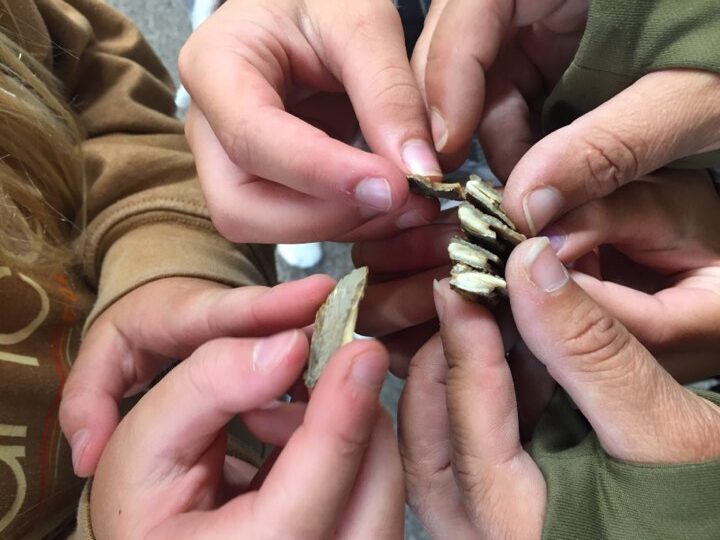
Last week at the Muenster Public library, the Adventure Wranglers came to present all kinds of interesting facts about dinosaurs to the three little girls who attended.
“When I went to Drumheller, I didn’t get to see what you guys got to see. I actually went into the back and got to talk with all the scientists,” said founder of Adventure Wranglers, Elisa Wilke. “I’ve gotten to see all the storage rooms where they keep all the extra dinosaur bones. And I got to talk with them and ask some really cool questions that kids always ask me.”
“I just looked at the bones,” one girl said when prompted to ask any unanswered questions she has about dinosaurs.
Identifying fossils
Wilke brought out a collection of fossils, some found in Saskatchewan.
“Fossils come in all different shapes, sizes, plant life, sea life, shell life,” Wilke said. “There’s a special way you can tell if you have a fossil or a rock… A fossil is going to sound different.”
She demonstrated that with the tap of a hammer. A rock will have more of a ‘ching’ sound, where as a fossil will have a solid thud sound, as if a fabric is draped over the rock.
“This is called an ammonite,” Wilke said, showing one of the fossils. “It used to be living, but the pressure and mineralization of years, millions of years of all of that pressing down has created a fossil.”
“Canada has the best ammonite found in the entire world. It is the most sought after.”
Finding fossils
If you do find a dinosaur bone, it’s protected by the government of Canada. You can’t keep the findings. They must be sent to a place like the Royal Tyrell Museum or Drumheller. If it’s a common find and they have lots of it already, they might let you keep a little. The fossils Wilke shared were given to her in the same way.
“A paleontologist’s most valuable tool is actually not what people think,” Wilke said. “It’s not the chisel and it’s not the hammer. It’s this right here. It’s glue. Because dinosaur bones are fragile. Oftentimes when a dinosaur bone is being taken out of the earth by a paleontologist, they actually have to stop, do some work on the bone to make sure it stays one piece and then continue on, which is why it can be such a process.”
Wrangler Elisa described the discovery of Black Beauty. This T. Rex was found black instead of the usual brown. Its full skeleton will never be fully recovered because where they found her is now underwater, but she was very complete already, which is rare.
“Not all the time do you have a complete skeleton,” Wilke said. “Because the earth moves, water moves things, wind moves things, the dirt moves, so bones can move too.”
Pachycephalosaurus
Wrangler Pixie came out with a Pachycephalosaurus puppet.
“This giant noggin was so important to them. Think of what’s an animal that likes to hit each other with their head.” Wilke said. “Goats are really good at this. And if you actually look at the head structure… This big nog in here was actually for ramming into other dinosaurs to protect themselves or to protect their young as well.”
Their beaks showed that they were vegetarian dinosaurs, but that they wouldn’t have stopped eating a leaf if it had a bug on it, so they weren’t strictly vegetarian.
Another puppet came out.
Triceratops and Stegosaurus
“Triceratops, that’s right. Now how many horns did the Triceratops have? Many people think it’s three, but actually, if you count, there’s horns all across their crest. And then some of the Triceratops species also got horns on their cheeks as well. So, they could have up to 17 different horns,” Wilke said.
Next came the Stegosaurus puppet. The way we know a Stegosaurus is because of the plating on his back. These plates were used for protection as well as built-in air conditioning for when they got too hot.
“Now, we can’t guarantee for sure… We can only guess on what the functions might have been based on scientific research,” Wilke said. “So, we base it on the bones that we find and the science.”
Fossil fun
Wilke then asked a silly question. “If I had 24 hours and I got a million dollars at the end, what animal would I choose to be chased by for 24 hours?”
The participants made their own choices of slow animals – a snail, and a turtle. Yet, Wrangler Elisa had an even slower one inspired by the fossilized coral she was showing.
“A sea anemone. Because they move about one inch every 24 hours. All I have to do is take a step,” she said.
A lot of fossils can be found underwater, like the Spinosaurus tooth she pulled out.
“Remember, you’re holding something that’s over probably 90 million years old,” she said to the kids.
Related Stories:
A new fossil came out with a lumpy shape.
“My suggestion is we don’t lick any fossils… That is my hint to you of what it is,” Wilke said.
“A turd? She got it… That is actually fossilized dinosaur poop.”
“Ew! Disgusting!” the kids exclaimed.
“My son has paid over $400 for dinosaur poop,” Wilke said. “A measly 10 pieces of dinosaur poop.”
Fake fossils
The next fossil was crocodile teeth.
“Often times when you find prehistoric crocodile teeth, they’re not near the crocodile. Do you know why? Crocodiles can actually lose multiple sets of teeth in their lifetime. An alligator today will go through about 3,000 teeth in their lifetime,” Wilke said.
Paleontologists use very powerful microscopes where they can actually see the tiny makeup of the cells of the tooth to tell if it’s real or not.
“Many, many people try and get away with fake fossils to try and sell to people thinking that they’re real fossils,” Wilke said.
She brought out pyrite, also known as fool’s gold. She also had fossilized lava, an Orthoceras fossil, and a fossilized clam shell.
Tyrannosaurus and Brontosaurus
Two of the more famous dinosaurs came out as puppets. First, came the Brontosaurus, part of the family of the sauropods.
“Most people don’t know this, but most sauropods we don’t think would have ever been able to swim,” Wilke said. “They would have never been able to go deeper than their legs, because if they had gone underwater, scientists do believe that the pressure would have been too much on their lungs.”
The next dinosaur to come out was the infamous T. Rex. Wilke emphasized that the proper spelling is with a period after the T and not a hyphen, and that it’s best to look at printed material over social media posts for accurate information.
“Books are going to be more factual because before they are published, they have to go through many different processes. They have to go through a few different people that go, oh, that’s not the correct information. Let’s correct that spelling,” she said.
Velociraptor
To finish off the presentation, the Wranglers brought us to their minivan where a giant dinosaur puppet lay in the back. Its name was Tiny.
“He is a Velociraptor, but he is created in the size of a Utahraptor.”
Tiny needs a puppeteer to stand inside him and hold his 80 pounds up on their shoulders.
“Well, I’m 70 pounds,” one girl said.
“The dinosaur is heavier than you,” Wilke said.
When asked what their favourite fossil was, one of the kids replied, “It’s not the poop.”