
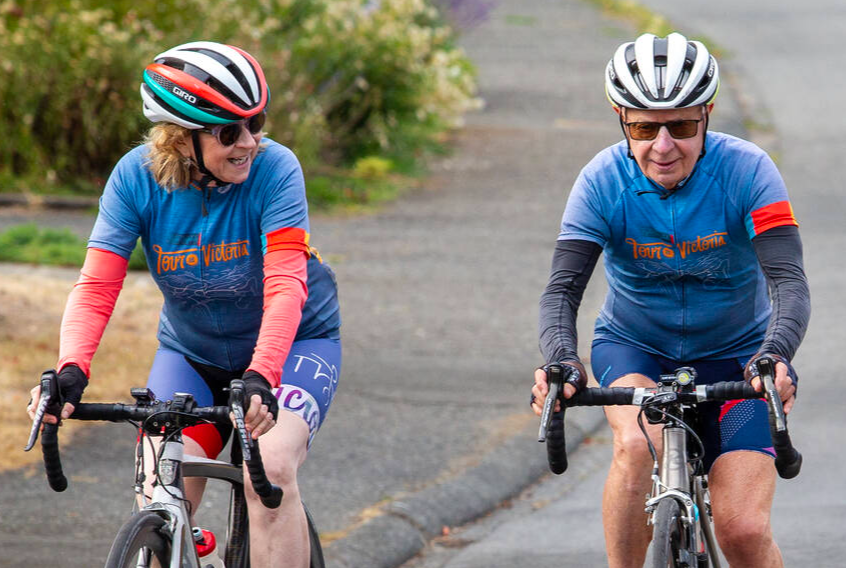
The mass participation event, which features 11 routes, gives cyclists of all abilities the thrill of a world-class ride.
When a teenage Barry Lycett realized how quickly a bicycle could transport him from a dirty job as an apprentice mechanic in the coal fields in West Yorkshire, England, to the seaside town of Scarborough, he was hooked.
At age 15, cycling delivered freedom, speed and travel.
“It was a way of getting away from the village because back then, people stayed in the village. They didn’t leave it,” Lycett said. “They drank their beer there, and that’s it. But riding a bike got me to see other areas, and it was love at first sight.”
Lycett joined a cycling club and went on to win four national track cycling championships in the U.K., compete internationally, coach Canada’s velodrome track team for the 1976 and 1984 Olympics, run the Gastown Grand Prix in Vancouver for almost a decade, find the love of his life, and create employment as a bike fitter.
Now Lycett, 87, will be the oldest participant in Ryder Hesjedal’s Tour de Victoria on Saturday. The youngest registrant is two.
He said it’s his favourite day of the year, beating out New Year’s Day and Christmas.
“The roads belong to us,” he said. “The cars are secondary. Your friends are in town. It’s a wonderful day.”
The Tour de Victoria is a mass-participation ride — not a race — offering eight routes of different lengths, plus a kids ride. Riders start and finish in front of the B.C. legislature in downtown Victoria.
Hesjedal, who is 45, became the first Canadian to win a Grand Tour at the 3,500-kilometre Giro d’Italia in 2012.
Now, he and Tour de Victoria director Seamus McGrath, 50 — who has cycled in both the Olympics and the Commonwealth Games — encourage everyone to celebrate with them the joy of cycling and the beauty of southern Vancouver Island.
Almost 2,000 people from all over North America have signed up for this year’s event. Friday is the last day to register online.
In founding the tour in 2011, the pair wanted to recreate — in a non-competitive event — the magic they felt competing in “world-class events where you have everything catered to you,” including traffic-controlled roads, mechanical and first-aid assistance, food and refreshment stations and the thrill of fan support.
“It’s hard for the average person to experience that, so what we’re doing with the Tour de Victoria is we’re bringing a professional-level race experience to a ride format to suit any type of cyclist,” McGrath said.
All ages and abilities, “not just your Tour de France wannabes,” with all types of bikes — from road and mountain bikes to e-bikes and toddler push bikes — are welcome, he said.
Routes range from 15 to 160 kilometres in length, with options for children starting at 200 metres and topping out at 6.5 kilometres.
“You can’t say it’s too long, or it’s too hard — we have a distance for every type of rider, regardless of your experience or fitness level,” McGrath said.
Lycett, who moved to Victoria in 2003, will ride the 60-kilometre distance with his wife, Sharon O’Dornan, a retired speech-language pathologist.
“We try to ride together, and we keep it fun,” said O’Dornan, who is 64. “We enjoy all the snacks at the rest stops. We enjoy a burger and a beer at the end. That’s my favourite part.”
Lycett’s participation “shows the depth of what we’re doing here” in attracting all ages and abilities and reminding them of “the beauty of the bike,” McGrath said.
Hesjedal, a Belmont Secondary grad who grew up riding around Highlands and the West Shore, turned pro as a mountain biker in 1999. He competed in three Olympic Games, and placed fifth overall in the 2010 Tour de France.
The sensation of coming through a race chute or “when you come across that finish line and the people are there cheering for you and you know you made that achievement … that’s it,” said Hesjedal, of a high that never leaves a cyclist.
“I was able to do that all over the world at the highest level — sometimes first, sometimes 100th, but it’s the same sensation. You took on the day, and you got through it,” he said.
“All I know is when you’re on the bike, and you’re out there, it’s just a great feeling, and a day in the Tour de Victoria definitely fills what I experienced all my career.”
Routes travel through Victoria, View Royal, Colwood, Langford, Metchosin, Sooke, Highlands, North Saanich, Saanich and Oak Bay. The first riders depart at 7 a.m., with road closures around the legislature starting at 4 a.m. and ending at 8 p.m.
The tour is supported by 35 police officers, 100 certified traffic controllers, and 100 ride marshals, said McGrath, noting the tour has a volunteer base of 250 and supports four charities.
“We’ve been doing that for 15 years, so our safety is rock solid — I think we’ve set a super high bar in that regard,” he said.
As for Lycett, he maintains aging is a state of mind greatly enhanced by a positive attitude, a great mate, sleep, moderation and plenty of activity.
“If you’ve got energy, you can do anything,” said Lycett, who joined a gym at age 80. “Everything we do in life either gives you energy or takes it away.”
O’Dornan said Lycett and his sister, age 92, have “a positivity gene.” His mother rode her bike until age 86 and lived until she was 99.
Lycett said he and his wife have previously completed the longer Tour de Victoria routes, and in future might go for the 45-kilometre ride, noting every route is beautiful.
Like life, said Lycett, “it’s a ride, not a race.”
For more information on the Tour de Victoria, including route maps and road closures, go to tourdevictoria.com.