
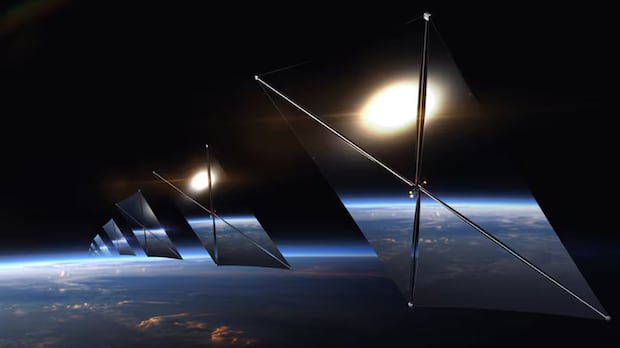
Some New Brunswick astronomy experts and enthusiasts are joining a chorus of opposition against a U.S.-based company’s big goals of using mirrors in space to provide artificial sunlight to people interested in paying for it.
The company, Reflect Orbital, calls its project proposal “sunlight on demand,” and would sell it as a service.
It said this “sunlight” could be used for a variety of things like agriculture or solar power infrastructure, for search and rescue efforts, construction projects and other benefits.
“It’s kind of a disaster,” said Mount Allison University astronomy professor, Catherine Lovekin.
“It would basically kill ground-based astronomy and backyard stargazing, which is already in trouble from the huge number of satellites that have been launched — and they’re not nearly as bright as these.”
The company was founded in 2021. The U.S. Federal Communications Commission gave the project its approval in July, despite hundreds of public voices speaking out in opposition.
The approval is for one mirrored “demonstration” satellite which, the company said, will be used to test its technology and safeguards.
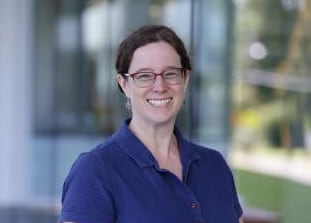 Mount Allison University, Catherine Lovekin, says the Reflect Orbital project will have negative impacts for ground based astronomy, sleep cycles and more. (Mount Allison University.)
The company’s goal is to put 50,000 of the satellites in space by 2035. They would be used to reflect sunlight that would span five kilometers back down to Earth, including potentially at night.
“With 50,000 of them, that’s basically going to make the night sky invisible even for our big telescopes,” Lovekin said.
The project also comes with a number of risks and potential impacts to anything that relies on a steady day and night cycle, she said, including circadian rhythms, nocturnal ecosystems and wildlife.
She also isn’t the only one speaking out.
Astronomy group says light pollution is getting worse
Stéphane Picard, who owns an astro-tourism organization called Cliff Valley Astronomy, shares Lovekin’s concerns.
Picard said the province currently has four dark-sky sites. These are areas largely free of light pollution — like light coming from street lamps, cars or city buildings — that allow an unhindered view of the natural night sky.
He said the province hired him to add eight more sites to the list by next year, which according to Picard, would make New Brunswick the province with the most dark-sky locations.
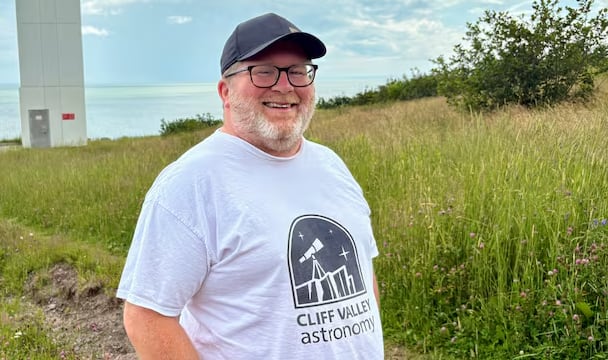 Astronomer, Stéphane Picard says rural parts of the province are dependent on the tourism that comes from their natural spaces, which include the natural night sky. (Emily Brass/CBC)
The province’s smaller rural communities can be dependent on the tourism that the province’s natural landscapes — and skies — can bring, he said.
“Traditionally, most people would discover by accident that we have dark skies,” he said.
“80 per cent of Americans right now can’t see the Milky Way from where they live; in Canada, it’s creeping above 60 per cent. It’s becoming harder, and people have to travel further to find a natural sky.”
On Wednesday, New Brunswickers had the chance to witness two astronomical events, a partial solar eclipse and a Perseid meteor shower. Picard watched these from one of the province’s dark-sky sites, Mount Carleton Provincial Park.
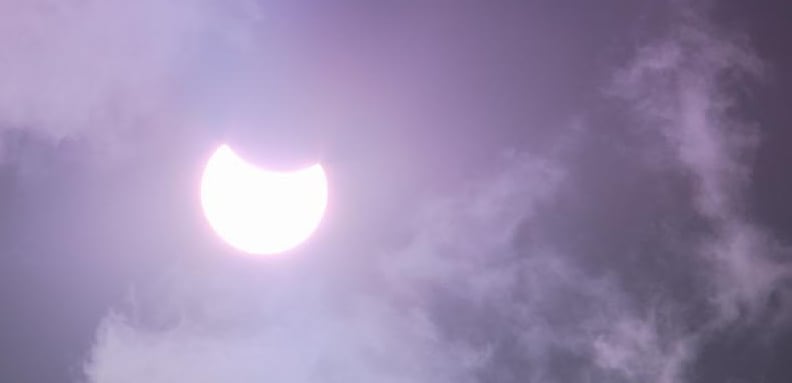 On Wednesday, New Brunswickers were able to witness a partial solar eclipse during the day and a Perseid meteor shower that night and into the following Thursday. (Peter Dawson/CBC)
Chris Curwin, who runs an astronomy group called Astronomy by the Bay in Saint John, also held a viewing event for the same occurrences at Irving Nature Park, another of the province’s dark-sky sites, which is called an “Urban Star Park.”
He said it will become increasingly difficult to enjoy these natural phenomena with more objects added to space.
“The next generation is not going to be able to appreciate the night sky like we can today,” he said at the watch event.
While eclipses can be seen by people in more urban areas, something like a meteor shower or even just a clear view of the stars isn’t as easy to spot in a well-lit city.
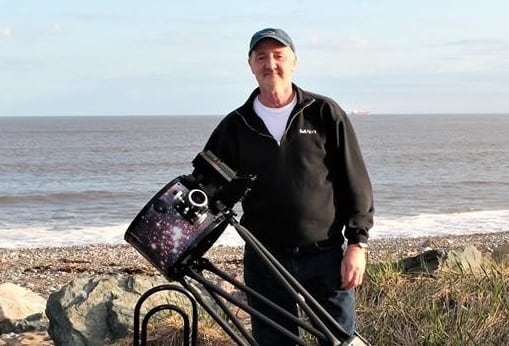 Chris Curwin, a local amateur astronomer in Saint John, says light pollution is getting worse and will make astronomy events more difficult to witness. (Submitted by Chris Curwin)
And light pollution, Curwin said, is getting worse.
“It’s very seldom that we find dark-sky preserves. New Brunswick has a large number of them, but we’re a very rural province. So we have that opportunity.”
Light won’t impact most places, company says
Reflect Orbital declined an interview with CBC News, but sent a statement that said the company aims to make clean, abundant renewal energy available on demand.
The company said “most places will never see this light” and it will be targeted towards customers who would require permits for the service and be turned off when idle. It will also, according to the statement, have exclusion zones “to cover astronomical observation sites.”
The statement said the company engaged with scientists, astronomers, environmental researchers and others whose feedback informed the project. The brightness levels would be “calibrated to levels humans and animals already tolerate,” the statement said.
Astronomy professors in British Columbia and Australia along with agencies like the U.S.-based Dark Sky Consulting and the American Astronomical Society have also expressed concerns.
The international agency, the United Nations Office for Outer Space Affairs, which deals with matters related to space including law, said in recent comments to CBC News, there isn’t anything prohibiting placing a reflective object in orbit.
But, the group said, objects are still subject to “due regard and consultation obligations owed to every other state,” and it would be up to countries to create laws around this type of service.