

Stay up to speed with stories written by drivers, for drivers.
Get automotive news, DIY tips, market trends, in-depth car profiles, and more right in your email inbox.
Until now, McLaren has been an exclusively forward-looking company that brings the latest Formula One hypertech to the road with cars known for sporting lots of computers and wind-shaping airfoils behind their atomic-insect faces. But McLaren has real heritage, and the new McL 6GT concept is its first drivable attempt to directly mine its past for gold. For one thing, it will have a feature not seen on a McLaren road car in three decades: a manual transmission.
Expected to be a million-dollar-plus limited edition special in the mold of the 2013 P1 or the 2020 Speedtail, the McL 6GT takes its voluptuous design cues from the very first road-going McLaren, the M6GT. A pet project of company founder Bruce McLaren that ended with McLaren’s death in a testing accident in 1970, the M6GT was built on a 1960s M6 Can-Am car as a test case for both a road car and a production-based Le Mans racer. It was impossibly low and impossibly wide, with gullwing doors and extra-fat racing tires in the rear. It’s thought that three examples were built by McLaren partner Trojan Cars, with a cramped racing cockpit sized to fit the diminutive McLaren, who commuted in it for a time with vague notions of becoming a road-car baron along the lines of Enzo Ferrari.
 Mclaren/James Lipman
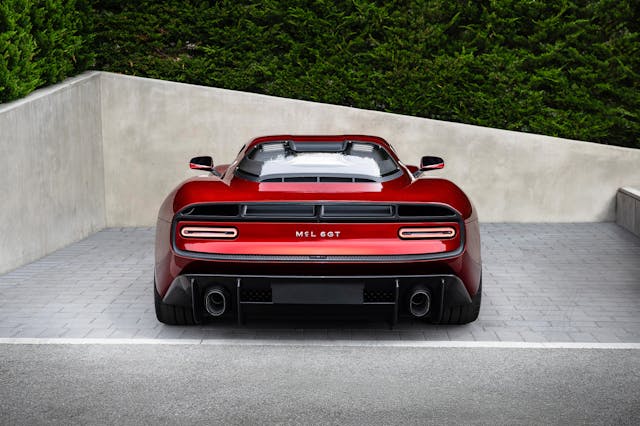
When it comes to market in 2028 as a production run of 500 units, the McL 6GT will have similar lines and heavily staggered tires with wide meats in back. “We really wanted to evoke the Can-Am cars and it starts with the stance so that at a glance, without me even opening the doors, it evokes that period,” said McLaren’s chief design officer Kemal Curic.
Other nods to the original are a body largely swept clean of airfoils, a vent opening ahead of the rear wheels, vertically stacked headlights encased in clear lens pods, and a sawed-off rear end finished with narrow rectangular taillights.
 Mclaren
“In terms of the surfacing, we really just wanted to go back to the beginning, chipping away some of the elements and asking, ‘Is this really necessary—do we need to add another line if it doesn’t have any purpose?’” said Curic. “Being really confident, having just two lines, the front fender and the rear fender, that’s, I think, the magic.”
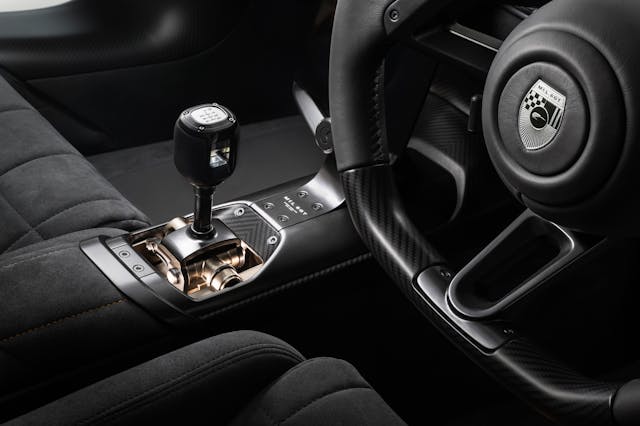
Underneath the skin is a unique carbon tub, we’re told, but details on the powertrain are still being closely held. Expect it to be some variation on the non-hybrid 778-hp 4.0-liter turbo V-8 in McLaren’s current (and amply-winged) 788 model. Behind the engine will be a six-speed manual, which is “the most visceral, the most engaging [feature] that goes back to the original spirit of McLaren,” said Curic.
 Mclaren/James Lipman
The two-seat cockpit tries to fuse the old and the new with, as Curic says, “a digital experience with analog inputs which enhance the drive experience.” But after years of watching new hypercars debut fully engaged in an arms race of wings, diveplanes, splitters, and underbody diffusers, is the million-dollar-plus market ready for some retro? After all, many still consider the Porsche 917 the prettiest race car ever made; several versions of it have no wings at all.
Curic isn’t ready to make a pronouncement about the market; he just calls the McL 6GT “an exploration” that harks back to a time when if a car looked fast, it probably was fast. “Purity never goes out of style.”
 Mclaren/James Lipman