
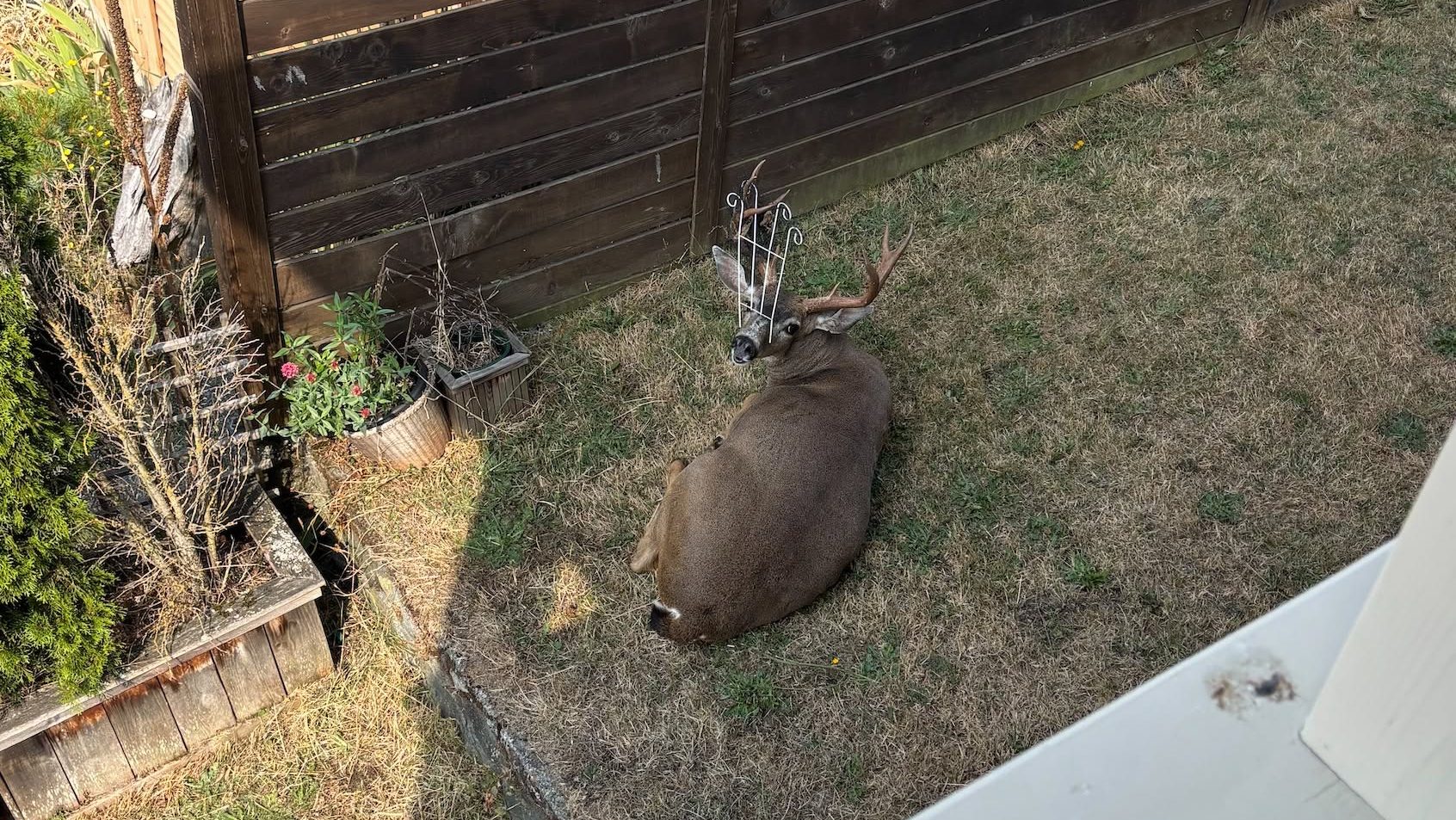
A deer with garden fencing and netting tangled on its antlers has prompted a call for help near the Victoria-Esquimalt border just weeks after Esquimalt approved new rules intended in part to prevent similar incidents.
Esquimalt resident Valerie Elliott spotted the buck Saturday morning near Colville Street with a small section of white metal garden fencing stuck on its face, along with mesh netting caught around one of its antlers.
Elliott told CHEK News the buck is a regular visitor to the neighbourhood and had appeared without the material as recently as Friday.
“I don’t know when he picked this up because I haven’t seen all of this gear on him before and I saw him yesterday, so this is something fairly new that he’s picked up,” she said.
She said the white fencing appears to be locked on the buck’s face because it is also caught around one of its antlers.
Elliott added the material didn’t appear to prevent the deer from moving, but she was concerned it could put the animal at risk.
She contacted the BC Conservation Officer Service Saturday morning and was told someone would follow up. In a social media post, Elliott also asked people in the area to help keep track of the buck’s location but warned against approaching it or attempting to remove the material themselves.
The incident comes shortly after Esquimalt council moved to regulate the types of materials that can be used for deer fencing.
Council unanimously adopted amendments to its zoning bylaw in July allowing deer fencing up to 2.5 metres high, with portions extending above normal fence-height limits required to be visually open and made from woven wire mesh.
However, netting and plastic are not permitted under the new regulations.
In its report to council, Esquimalt staff specifically cited the danger such materials can pose to wildlife, noting they have been known to become caught in deer antlers and can also trap animals including bats, reptiles and amphibians. The rules also prohibit protrusions on taller portions of deer fencing that could injure animals attempting to jump over them.
Black-tailed deer are native to Vancouver Island and have adapted well to urban environments, according to the township. Staff noted that deer frequently return to the same areas and that residents have used a variety of materials to protect gardens from browsing.
Elliott said the buck is well known in her neighbourhood and frequently visits her property.
“He comes and goes and eats from the garden and people have trouble with that, but we don’t,” she said.
CHEK News has reached out to the BC Conservation Officer Service for more information.
READ MORE: