
When the floodwaters receded from Niagara basements last week, residents thought the hard part was over. But for several, it was only the beginning. Dipping into retirement savings. Dealing with ignored calls. Mounting anxiety.
Much of the damage was immediate and visible. Waterlogged belongings. Ruined flooring. Boxes of memories carried to the curb. Destroyed furniture.
Some homeowners had insurance coverage, others learned it wasn’t enough. All are anxiously awaiting an assessment of the damage, which may take months to sort out.

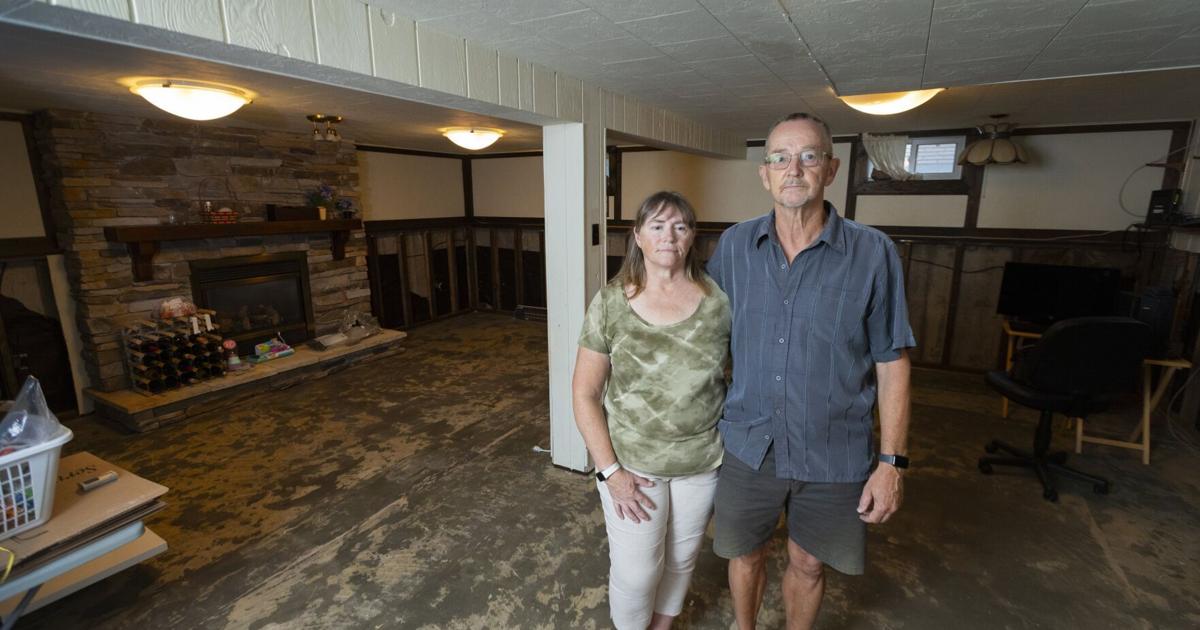
Charlotte and Al Hoare stand in their basement that was flooded during the recent rain storms in St. Catharines.
Julie Jocsak/St. Catharines Standard
Reaching into retirement
Al and Charlotte Hoare didn’t hear the water coming.
Their daughter, living back at home temporarily with her son, awoke to the sound of running water.
When she stepped out of bed, her feet landed in water — sewage was backing up through the basement drain.
That was how the Hoares realized the basement of the St. Catharines home they had lived in for 37 years — without any flooding — was taking on water.
“It was a nightmare. When it’s happening, you’re in a state of shock. You can’t believe what you’re seeing,” said Al Hoare. “You grab a shop vac and then you quickly realize there’s no stopping this. It’s coming in so fast, so hard that all you can do is watch and pray that it ends.”
Beyond housing their daughter, the basement was an often-used living space, with the family’s main television, a brand new sofa set and recliners, surround sound and computer speakers. They had just installed a new water heater and freezer. A few years ago, they also put in a brand new bathroom, at a cost of about $15,000.
Damaged laundry room.
Julie Jocsak/St. Catharines Standard
After the floodwater left about six inches in their basement, they went into cleanup mode.
They hired a crew to gut the space, with little left except the walls, which were cut two feet up to dry out the framing. The barnboard walls in the main family room were cut four feet up.
Al said any hope of restoration is still “quite a ways down the road.”
Without any direction from insurance, they took photos and attempted to upload descriptions of the damage themselves. With their adjuster on vacation, they reached out to the emergency contact but received no response.
The Hoares finally received an email a week later, asking them to confirm remediation work was underway.
“We’re just living in fear at the moment of the next rainstorm because we’re trying to get an inspection on the foundation to determine how serious a problem it is. But we can’t get anybody to even return a phone call,” he said.
Al said he has no doubt the $50,000 in coverage won’t be nearly enough to address the structural damage — with little expectations their belongings will be covered.
“We’ll be reaching into retirement funds to make up the difference,” he said. “Hopefully, the insurance company doesn’t try to lowball us, but I won’t know that until they actually pick up a phone.”
Downstairs bathroom had recently been renovated.
Julie Jocsak/St. Catharines Standard
Starting from scratch
Having never experienced a flood or filed an insurance claim, Nick LePalud didn’t know what coverage he had or what to do in the aftermath.
As 8 inches of brown and black water came in from floor and shower drains — damaging his floors, washer and dryer, freezer, couches and stereo equipment — everything was unknown.
“I really didn’t know all of the details of what I was covered for. Through the rumour mill, you start to hear all sorts of different things, that you’re covered for this, you’re not covered for that and honestly, I had not educated myself enough to know,” he said.
“I am covered, or at least I believe I am covered. I haven’t heard anything contrary.”
It took several days to reach his insurance company. The adjuster, based in Edmonton, had no idea what had happened in St. Catharines. LePalud was told to make a list of the damaged items, determine the replacement value and submit the total.
From hiring a company to strip out the drywall and insulation to taking out the damaged items, everything else was left for him to sort out.
“I’ve gotten an estimate for the damage which is, with taxes and everything, about $30,000,” he said. “I’ve never done this before, I don’t know if they are going to go, ‘it looks legit, here’s your cheque, less the deductible.’ Or are they going to argue with me on everything?”
LePalud said he was lucky to handle much of the work himself while waiting to hear back from his insurer. Not everyone was able to do the same.
“My neighbour across the road has been living in a squalor for two weeks (waiting for insurance company),” he said. “Finally, his brother and I had to go down there and start ripping things out because nobody had showed up.”
Reading the fine print
In both rainstorms, John Habel watched water flood his St. Catharines yard and patio before it travelled into the stairwell leading to his basement. Despite having a drain, it couldn’t handle the volume of water.
After the first storm, his insurer responded quickly. After the second, Habel spent more than a week unable to reach anyone.
There has been some movement this week. An adjuster came through and sent a crew to tear out floors and cut into the drywall to determine how high the water damage reached.
Habel expects his insurance to cover the damage. A few years ago, when a new agent took over, they reviewed the policy in detail. While he doesn’t have flood insurance, living near Lake Ontario, he has overland and sewage backup.
“None of the furniture is damaged so I’m lucky in that respect. The only thing that was damaged was the floor (and) the carpeting,” he said.
“The next problem is going to be trying to get someone to fix this stuff because all the contractors are going to be busy.”
Covered but not confident
More than 10 years ago, Joy Stewart-Riffle experienced her first flood. Within days, her insurer and a restoration company were on her doorstep, ready to help. This time, with so many homes affected, everything has been “incredibly delayed.”
“Days into the flood, I still haven’t heard back from the insurance company,” she said. “I knew that I had really good coverage because having been through the experience once, I was damn sure that if I ever had to deal with it again, I was going to have better coverage.”
During the August rainstorm, her sump pump couldn’t keep up. Clear water began rising through the shower drain and furnace vent pipes — despite having a backflow preventer and replacing the weeping tile in 2013 — spraying out “like it was a faucet.”
About six inches of water drained. But the damage to her refinished basement was done. All appliances and the hot water tank were damaged. She did eventually hear from an adjuster — the first based in New Brunswick, a second later out of Calgary — but is still waiting to learn the full extent of what needs to be removed.
“I don’t know if anybody from insurance is actually going to be able to come through the house before we have to begin tearing out what was downstairs and that worries me,” she said.
“Because if the pictures aren’t clear, or if we disagree on something about what the state of the damage was, where do I go? What do I do?”
Her other concern is the rebuild. Based on her experience, she wants to wait for confirmation there is no evidence of seepage before starting restoration.
But she said her insurer gave her a “hard time” last time, pushing to close the claim early.
“I know the payout I got did not cover the rebuild and that’s my primary worry,” she said. “I’m not going to be ready to rebuild in six weeks. That’s just insane to me. I may not be ready to rebuild for six or eight months.”
At the moment, her house is a “complete and total disaster,” with half her basement belongings crammed onto her main floor, a storage box in the driveway. She has coverage, but plenty of unknowns and no shortage of skepticism about how much patience her insurer will have — or what the claim will do to her premium.
“Frankly, it’s a lack of confidence or trust in how much protection I actually have from the insurance company,” she said.
“They don’t always feel like allies. They often feel more like adversaries. I know they’re trying to cut costs, that’s part of their job. But those costs can’t come out of my pocketbook.”