
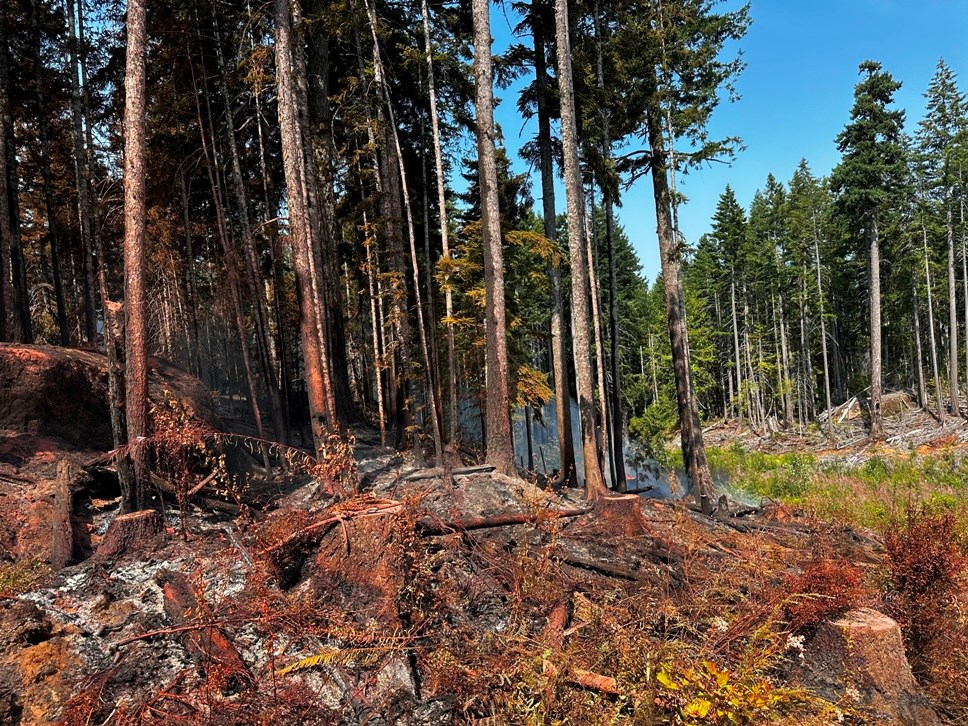
There were 17 fires burning on Vancouver Island as of Monday at noon.
Continued high temperatures, shifting winds and the possibility of more dry lightning strikes in the days ahead have put Vancouver Island at risk of additional wildfires.
There were 17 wildfires burning in the forests on the Island as of noon Monday, though most were small burns of about 90 square metres.
Data from the B.C. Wildfire Service’s Coastal division indicated 16 of the fires were caused by lightning strikes. Five were considered out of control, eight were being held and four were rated as under control.
Erika Berg, information officer for the B.C. Wildfire Service, said there have 740 lightning strikes touching down within the Coastal Fire Centre since Thursday, igniting 14 new starts.
She said the majority of the new fires started between Campbell River and Port McNeill in remote places “where fuel conditions presented a lower fire risk.”
“Overall, initial attack efforts have been successful at containing new starts,” Berg said Monday.
A fire three kilometres south of Fanny Bay was the only human-caused wildfire. On Monday, the wildfire service said there was no significant growth and crews were making progress on containing the blaze.
The agency said the wildfire wasn’t posing a threat to public safety or infrastructure, but smoke might be visible from Fanny Bay, Deep Bay and Bowser, and for drivers on Highway 19 and 19A.
Wildfire dispatch received 70 fire reports by phone and via the service’s app on Saturday, and the wildfire service responded immediately by sending aircraft with fire retardant from as far away as Kamloops to hit the fire.
A fire danger rating map of Vancouver Island shows various risk levels as low and moderate in some areas and high and extreme in others, including the eastern coast and the southern areas, including Greater Victoria and the Southern Gulf Islands.
The areas on Vancouver Island showing higher fire danger are primarily in the southern half, Berg said, adding it aligns with the partial prohibitions currently in effect for the Coastal Fire Centre.
A shift in airflow this week should help disperse smoke, which should make it easier to spot and respond to fires, she said. But it could also affect fire behaviour of the larger fires on the mainland.
She said the service is working closely with forecasters in anticipation of more dry lightning by the end of the week. “However, we are too far out to confidently predict how, when and where that weather system may materialize.”
Victoria Fire Chief Dan Atkinson said the fire risk in cities is also rising, and he’s urging people to be cautious.
“We don’t occupy the same sort of environment as more remote areas, but that doesn’t mean we have zero risk,” Atkinson said.
“We’re still experiencing drought conditions in Victoria, and those conditions are continuing to worsen as the hot and dry weather continues.”
In city parks like Summit, Dallas Road and Beacon Hill, Atkinson said fire risk is climbing every day.
He said one beach fire, a tossed cigarette or spark from a chainsaw or vehicle could ignite a major fire.
Atkinson said since the start of the year, the Victoria Fire Department has responded to 336 outdoor fires. About half of those fires have been over the past two months.
He said an “overwhelming majority” are human-caused.
“It doesn’t always mean it’s malicious in nature or intentional, but if there’s a human element associated with it, it does mean that it was preventable,” Atkinson said.
The City of Victoria does not allow any open burning or beach fires at any time of the year.
“We are certainly frustrated by the prevalence of outdoor burning and beach fires at all times, but it is of heightened concern to us when the weather gets as dry as it is right now,” Atkinson said.
The fire chief also recommends that home and business owners go to firesmartbc.ca to find ways to reduce fire risks around their properties.
As of Monday noon, there were 126 active fires in the province, with six new blazes in the past 24 hours. The wildfire service currently has 1,843 firefighters and 193 aircraft involved in the fight.
It said 104 of the wildfires have been caused by lightning, 17 by humans, and the remainder yet to be determind.