
ONC joins the hunt for cosmic particles in the ocean
Published 5:45 am Wednesday, August 19, 2026
University of Victoria’s Ocean Networks Canada (ONC) is part of a major project that will give scientists a glimpse into the universe from under the sea.
In this multi-partner Pacific Ocean Neutrino Experiment (P-ONE), ONC is co-engineering key infrastructure to create a deep-sea neutrino telescope that will transform vast stretches of the deep Pacific Ocean into a massive neutrino detector.
Research has shown that the pitch black of the deep ocean is a perfect environment to study neutrinos.
Since the cosmic particles, neutrinos, are tiny and nearly massless, massive and highly sensitive detectors are required to observe them.
The extreme conditions of working in the deep sea, however, present significant challenges that require specialized oceanographic instrumentation—a domain where ONC’s expertise is pivotal.
The installation of the telescope will be done over the course of several years by deploying 70 different mooring lines, each of them having 20 instruments on it to detect neutrinos.
Senior mechanical engineer Andrew Baron told Victoria News that these instruments will be communicating with one another and then sending live data back to shore.
The project is made possible because of an already installed ONC Neptune subsea observatory that has a telecom cable out hundreds of kilometres offshore off the west coast of Vancouver Island.
“And so, not only do we have to maintain the Neptune infrastructure and build on to it, but we’re also involved in the development of both the sort of the junction box.”
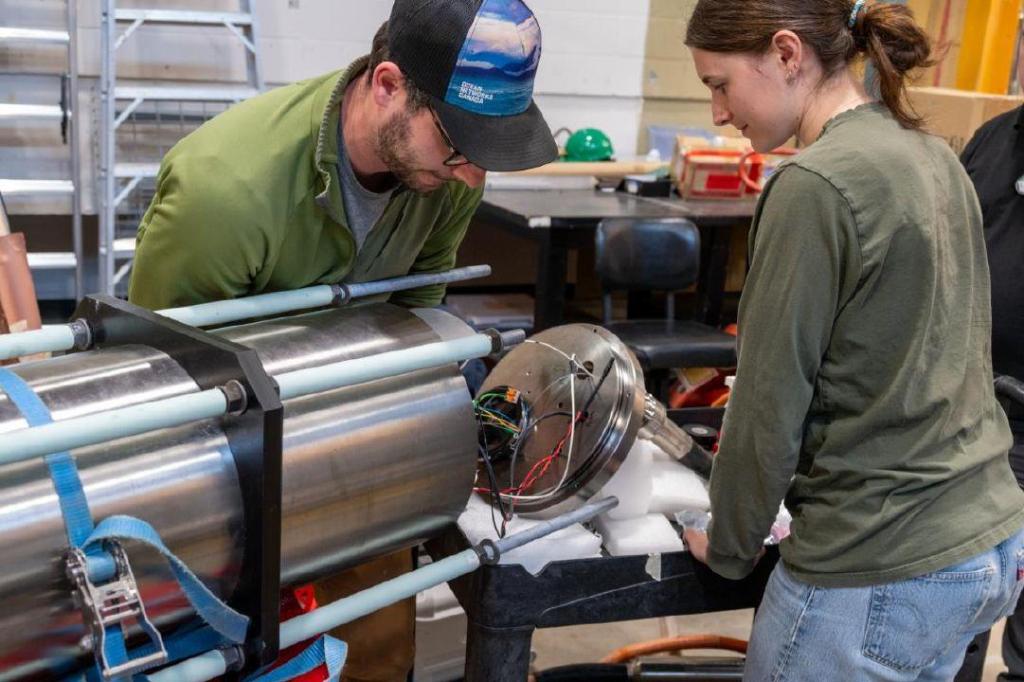
The junction box, as Baron says, is the brain that lives at the bottom of each mooring line, and the deployment frame, allowing them to go out on the vessels and safely deploy this instrument to the seafloor.
Baron says that, unlike light rays, neutrinos travel in perfectly straight lines, and they don’t get absorbed by anything, and can pass through planets, black holes, and other phenomena that affect light but don’t affect neutrinos.
“By building a detector for neutrinos and then determining where these neutrinos are coming from, it helps astrophysicists and astronomers understand far-off astrophysical phenomena such as black holes. And some of the discoveries were made using the neutrino observatory in the South Pole called IceCube.”
It will also help some of the early neutrino experiments that were done in Sudbury through SNOLAB, which is a Canadian organization that helped shed a lot of light on such astrophysical phenomena out in the universe.